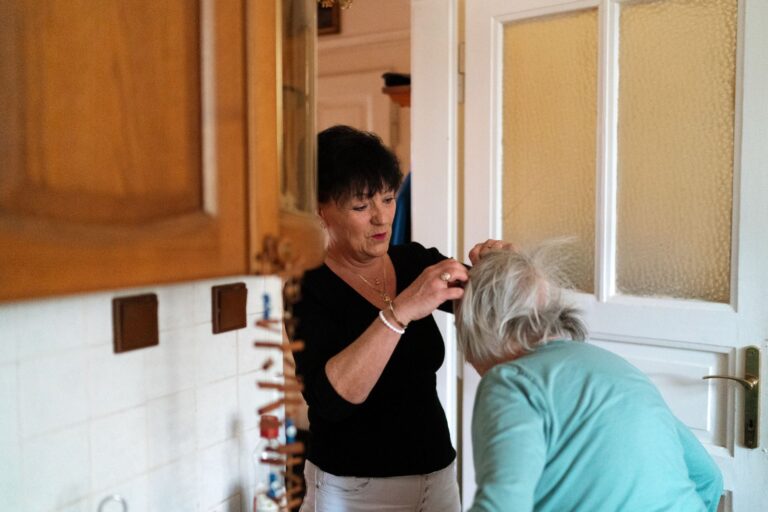
Guest contribution from Love and Mom, a pregnancy and parenting resource. Written for HelpDementia readers who are expecting while caring for a parent.
If you are pregnant and caring for a parent with dementia, there is no rule that says you must tell them, and no rule that says you must keep telling them. Decide based on your parent’s current stage, what reliably triggers distress, and what the repetition costs you. Then handle the two practical pieces that do not depend on that choice: get your obstetric provider’s guidance on lifting and transfers, and arrange help for after the baby arrives before you need it.
Medical information disclaimer: This article is for general educational purposes only and does not provide medical advice, diagnosis, or treatment. Always consult a physician or other qualified health professional about symptoms, medications, physical activity limits, or treatment decisions.
Table of Contents
- Should you tell a parent with dementia that you are pregnant?
- How dementia changes what they see when your body changes
- Lifting and transfers: what pregnancy changes about hands-on care
- Managing the emotional toll of two kinds of caregiving
- When family members have opinions about what you tell them
- Two timelines that do not line up
- When your baby arrives
- Frequently asked questions
- Key takeaways
Should you tell a parent with dementia that you are pregnant?
Your parent has dementia. You are pregnant. Does your parent remember the conversation you had three weeks ago about your pregnancy? Three days ago? Yesterday?
The overlap of prenatal caregiving and dementia caregiving is a real, often invisible burden. You are managing hormonal shifts, physical fatigue, and the vulnerability of pregnancy while also managing a parent whose brain is changing. And unlike the typical pregnancy milestone conversations, this one keeps resetting.
There is no clinical guideline for whether to disclose your pregnancy repeatedly, once, or not at all. The right answer depends on your parent’s current stage, what triggers distress, and what serves your own emotional health.
Some caregivers tell their parents over and over, finding that each retelling is like a first conversation. Your parent reacts with genuine surprise and pleasure, and for a moment, you have the reaction you wanted. But this cycle can drain you. You are not processing the news once; you are processing their forgetting, over and over.
Others tell their parents once or not at all, because repeated explanation causes agitation, confusion, or worry. Your parent might become anxious about you lifting them, or overwhelmed by information their brain cannot hold. In this case, their emotional stability matters more than their knowing.
Both approaches are valid. The question is not whether you are “supposed” to tell them. It is weighing the emotional cost of each choice: whether repeated disclosure drains you, or whether silence creates regret.
How dementia changes what they see when your body changes
Dementia can distort how a person perceives physical changes. Your growing belly, your fatigue, your nausea are visible shifts that your parent with dementia may interpret wrongly.
They might misread your weight gain as illness. They might ask repeatedly if you are okay, or worry that you are sick. In middle-stage dementia, some people become convinced their adult child is being neglected or mistreated if they appear different, thinner or heavier, than expected.
Your changing body can trigger suspicion, worry, or confabulation. Your parent might construct a narrative around why you look different that has nothing to do with pregnancy. “You look tired. Are you sick?” “You have gained weight. Are you okay?” In more advanced stages, some people with dementia move toward accusations: “Who is doing this to you?” or “Someone has hurt you, haven’t they?”
There is no way to logic your way out of this. Repeated explanations do not work. Reassurance does: “I’m fine. I’m healthy. This is normal for right now.” Keep it simple, repeat as needed, and do not extend the explanation. Calm reassurance and gentle cues, rather than correction or debate, are also what NIH MedlinePlus guidance on dementia behavior recommends when someone with dementia becomes agitated or confused.
It is also worth ruling out the ordinary explanations before assuming the behavior is the dementia talking. Discomfort your parent cannot name often surfaces as suspicion or irritability instead, which is why pain can show up as dementia behavior rather than as a complaint.
Lifting and transfers: what pregnancy changes about hands-on care
If you are a hands-on caregiver, lifting your parent, helping them to the bathroom, managing their hygiene or mobility, pregnancy changes what your body can safely do.
In the first trimester, many pregnant people feel too exhausted to handle the physical work of dementia caregiving. In the second and third trimesters, your center of gravity shifts, your balance changes, and lifting your parent becomes a different mechanical problem than it was before.
Your parent with dementia may not understand that you cannot pick them up anymore. They may resist the transfer belt. They may insist on the old way of doing things and become frustrated or agitated when you change the routine.
This is where you set a boundary for yourself, not because your parent will understand it, but because your pregnancy health matters. If lifting is part of your caregiving role, talk to your obstetric provider about what is safe for you. NIOSH guidance on physical job demands and reproductive health tells pregnant workers to discuss lifting limits with their doctor, and flags lifting from the floor, lifting while bending or reaching, and lifting overhead as the higher-risk patterns. Every one of those describes a bad transfer.
Then make a plan. Can a family member take over? Can you hire a caregiver? Can you use mechanical assists such as a transfer board, a gait belt used by someone else, or a lift? If transfers have become a two-person job, that is usually a signal to look at stage 6 dementia and the safety changes that come with it, because the care need is changing independently of your pregnancy.
Your parent’s agitation about the change is real, but it is not a reason to injure yourself or compromise your pregnancy.
Managing the emotional toll of two kinds of caregiving
You are processing the joy and anxiety of pregnancy while also watching a parent decline. You are managing prenatal appointments while also managing medical appointments for your parent. You are thinking about the future: your baby’s arrival, your parent’s progression, where everyone will be in five years.
This is grief layered on grief. You are grieving your parent’s cognitive loss and simultaneously preparing for a new life. Some pregnancies bring lightness and hope; this one might feel heavy with complexity.
What helps:
- Protect your prenatal mental health. Perinatal depression is a medical condition that, as the National Institute of Mental Health explains, can affect any pregnant or postpartum person regardless of age, income, or background, and anyone with symptoms should see a health care provider. Caregiver stress adds another layer. If you are finding it hard to sleep, hard to eat, or overwhelmed by worry, tell your obstetric provider. Love and Mom’s postpartum mental health resources cover recognizing depression and anxiety, and building a care plan before you need one.
- Build a small support circle. Find one or two people who understand both sides of what you are managing: a partner, a sibling, a therapist, or a friend who has been a caregiver. These people can hold the weight of it without needing you to explain or reassure them. If you are not sure how depleted you already are, the caregiver burnout check is a short, private way to see it in writing.
- Set realistic expectations for your parent’s involvement. Your parent probably will not be the grandparent you imagined. Accepting this early protects you from re-experiencing that disappointment after your baby arrives.
When family members have opinions about what you tell them
If your parent has dementia, other family members may have strong opinions about whether your parent “should” know you are pregnant. Some relatives worry that the news will upset your parent. Others believe you are obligated to tell them. Still others judge the timing, the frequency, or the way you handle it.
These opinions rarely account for what you actually know about your parent’s current state, what triggers them, or what your caregiving capacity looks like right now. Your siblings or cousins or in-laws are not managing your parent’s day-to-day confusion or your own prenatal health.
If a family member challenges your choice, you do not need to justify it at length. “I’ve thought about this carefully. I know what works for our parent right now.” Then stop. Their comfort with your decision is not your responsibility to manage. Families split over disclosure questions in dementia care regularly, which is the same dynamic that plays out when relatives disagree about knowing in genetic testing decisions.
Two timelines that do not line up
Pregnancy and dementia caregiving exist on different timelines. Your baby will arrive in nine months. Your parent’s decline follows its own arc, sometimes fast, sometimes slow, sometimes plateauing.
If you are in early-stage dementia caregiving and early pregnancy, you have time to plan. Talk to your parent’s doctor about what to expect. Talk to your obstetric provider about your caregiving role and what changes might be necessary. Start thinking about whether you will have help after your baby arrives, whether that is a family member stepping in more, a paid caregiver, or respite care for your parent. Ask about cost early, because respite charges vary and are worth asking about before you book a stay.
If you are in middle or late-stage dementia caregiving and pregnant, the timeline is tighter. You may need help sooner, and you may need to accept that your parent’s care and your newborn’s care cannot both fall on you alone. If the honest answer is that the current arrangement will not hold, it is worth reading through when assisted living is appropriate for someone with dementia while you still have months rather than weeks to decide.
When your baby arrives
Your parent with dementia will meet your baby, or might not, depending on their stage and your family dynamics. They might hold the baby and forget they held them five minutes later. They might ask who the baby is. They might be confused about the timeline: “I didn’t know you were pregnant,” or “When did you have a baby?”
This is not a reflection of love or capacity to bond. It is the nature of cognitive loss. Your parent can experience joy in the moment with your baby without remembering the moment existed. That moment is real for both of them, even if your parent does not store it.
Some grandparents with dementia become more engaged when a baby arrives; the sensory experience, the routine, and the sounds pull them into presence. Others become more withdrawn or confused. Both are possible.
What matters is that you have already done the work. You have made a plan for caregiving, protected your pregnancy health, managed your own emotional wellbeing, and set boundaries that honor both your parent and your baby.
Frequently asked questions
Should I keep telling my parent with dementia that I am pregnant?
There is no clinical rule either way. Repeat the news if your parent responds with pleasure and the retelling does not exhaust you. Stop repeating it if it produces agitation, worry, or fear each time, or if processing their forgetting is costing you more than the moment is worth.
Why does my parent think I am sick instead of pregnant?
Dementia can distort how physical change is interpreted. Weight gain, fatigue, and nausea are read as illness rather than pregnancy, and the brain may build an explanatory story around what it sees. Short reassurance works better than a longer explanation.
Is it safe to keep lifting my parent while pregnant?
That is a question for your obstetric provider, and the answer depends on your health, your fitness, and your stage of pregnancy. NIOSH advises pregnant workers to discuss lifting limits with a doctor and identifies floor-level lifting, lifting while bending or reaching, and overhead lifting as higher-risk. Transfers involve all three.
How do I handle relatives who disagree with my decision?
State once that you have considered it and that you know what works for your parent right now, then stop explaining. Relatives who are not managing daily care do not have the information the decision requires.
What should I arrange before the baby comes?
Name who takes over the physical caregiving tasks you will not be able to do, confirm whether that is family, paid help, or respite care, and price it before you need it. Arrangements made in the third trimester are harder to make than arrangements made in the first.
Key takeaways
- Disclosing your pregnancy to a parent with dementia is a choice, not an obligation. Do what serves your parent’s emotional stability and your own peace.
- Your changing body is not their responsibility to understand or accommodate. Short reassurance beats repeated explanation.
- Managing prenatal stress while caregiving deserves real support. Symptoms of perinatal depression or anxiety are a reason to call your provider, not to push harder.
- Ask your obstetric provider about lifting before you keep doing transfers, and change the method rather than the person doing it if you have to.
- Plan for help after your baby arrives. You cannot manage a newborn and a parent with dementia alone, and you should not try.
You might also like
- Caregiver Burnout Check
- When Is Assisted Living Appropriate for Someone With Dementia?
- Questions About Dementia Respite Charges Before Booking a Stay
About the contributor. This post was contributed by Love and Mom, a resource on pregnancy, postpartum health, and parenting. Learn more at loveandmom.com.