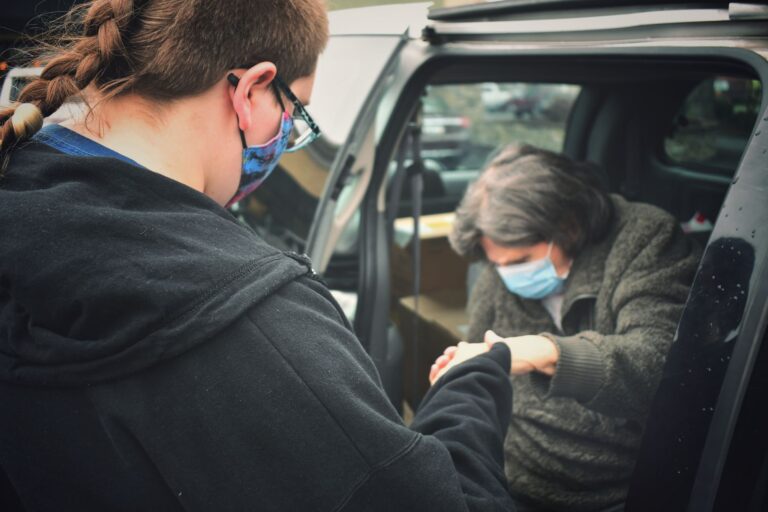
Gestures become more useful than written words when a person with dementia can no longer reliably understand or act on text but still responds to movement and visual cues. They are especially valuable when speech decreases and pointing, facial expressions, sounds, or simple actions become the person's main ways to communicate. This change is not universal. Communication abilities vary by individual, dementia type, stage, and sensory function, so the best method is the one the person understands at that moment.
Medical information disclaimer: This article is for general educational purposes only and does not provide medical advice, diagnosis, or treatment. Always consult a physician or other qualified health professional about symptoms, medications, tests, or treatment decisions.
Table of Contents
- Signs that gestures may work better
- What gestures can communicate well
- When written words may still be better
- Why gestures can also fail
- Build a communication method around the person
Signs that gestures may work better
Watch what happens after you offer a short written message. Gestures may be more effective if the person repeatedly overlooks the note, appears confused by it, or cannot connect it with the expected action. The clearest test is the person's response.
For example, if "Please sit here" causes uncertainty, point to the chair and demonstrate sitting. If the person follows the movement, the visual cue is currently more useful than the written instruction. As Alzheimer's progresses, people may speak less and rely increasingly on gestures. In severe stages, facial expressions, sounds, pointing, and other movements can become central to communication, according to the Alzheimer's Association guidance on communication.
What gestures can communicate well
Gestures work best for immediate, concrete messages. Pointing to a cup can offer a drink, extending an open hand can invite someone to walk with you, and demonstrating an action can make a one-step request clearer. Researchers who observed three people with moderately severe Alzheimer's found that gesture production continued despite declines in the amount and quality of speech.
Their findings suggest that meaningful gestures may sometimes compensate for spoken-language difficulties, although the study was very small and cannot establish how every person will communicate. Try combining several compatible cues: Avoid rapid gestures or several instructions at once. A single clear movement gives the person a simpler message to interpret.
- Make eye contact before communicating.
- Use one brief sentence or question.
- Point to or hold up the relevant object.
- Demonstrate the action when appropriate.
- Pause long enough for the person to respond.
When written words may still be better
Do not discard writing simply because gestures sometimes work. The Alzheimer's Association notes that short written messages may help during the middle stage of Alzheimer's when spoken words become confusing. Text may suit information that needs to remain available, such as a label on a door or a brief reminder. Test whether the person notices the words, understands them, and responds appropriately. Large, short, familiar wording is easier to evaluate than a long explanation.
Pictures can provide another option. A 2023 systematic review of six studies found that pictures improved conversation comprehension and might support decision-making for people with dementia. However, the review found little effect on the consistency of preferences and could not determine their effect on discourse across all communication situations. For a choice between tea and water, try showing the actual drinks or clear pictures rather than presenting a written list. Keep both options visible while the person considers them.
Why gestures can also fail
A person may continue gesturing without producing movements that another person can easily understand. Earlier Alzheimer's research found that participants gestured as often as people without the disease, but their gestures were more ambiguous and less conceptually complex. Clarity declined alongside language, conceptual, and movement-planning difficulties in that study. Do not assume that every gesture has an obvious meaning.
A repeated hand movement could indicate a request, discomfort, refusal, or something unrelated. Check your interpretation by showing an object, offering a simple choice, or watching whether the person relaxes or becomes more distressed. Your own gestures may also be misread. Use familiar movements, keep your hands visible, and support the gesture with a calm expression and a few simple words.
Build a communication method around the person
Treat communication as an ongoing comparison rather than a fixed rule. Try speech, a short note, a picture, an object, or a gesture, then keep the approach that produces the clearest response with the least frustration. Record useful patterns so that other caregivers can communicate consistently.
A practical note might say, "Pointing to the bathroom works better than asking," or, "She understands the written lunch card but chooses drinks more easily when shown the cups." Retain every channel the person can still use. If a short written note works, keep it; if words fail, add eye contact, facial expression, pointing, and visual cues. The aim is not to make gestures replace language, but to give the person several workable ways to understand and respond.