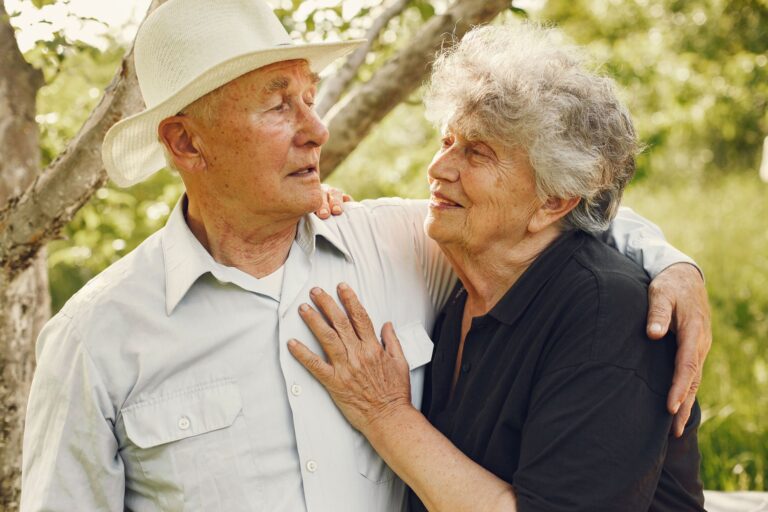
When a dementia patient stops recognizing you, the most important thing you can do is stop trying to make them remember. Correcting them, insisting on who you are, or asking “Don’t you know me?” typically causes distress and confusion without any benefit. Instead, shift your goal: your presence is still meaningful even without verbal recognition. Sit with them, speak gently, hold their hand if they’re comfortable with it. You are not visiting a stranger — you are visiting someone whose brain can no longer retrieve the file that holds your name, but who can still feel warmth, safety, and calm in your presence.
This shift in approach is not about giving up. It is about meeting the person where they are. Emotional memory — the felt sense of comfort or unease with another person — outlasts factual memory in most dementia progressions. A woman with late-stage Alzheimer’s may not know that the man sitting beside her is her son of 40 years, but she may relax when he enters the room, reach for his hand, and smile. That connection is real and worth sustaining. This article covers why recognition loss happens, what the neuroscience tells us about emotional memory, how to adjust your behavior during visits, and how to take care of yourself through what is genuinely one of the harder parts of caregiving.
Table of Contents
- Why Does a Dementia Patient Stop Recognizing Family Members?
- What Does Emotional Memory Mean for Your Visits?
- How Should You Behave When They Don’t Know Who You Are?
- Practical Strategies for Meaningful Visits When Recognition Is Gone
- When Non-Recognition Gets Worse Suddenly — A Warning Sign
- The Emotional Weight on Caregivers — Grief That Has No Clear End
- What Research Offers — and What It Cannot Yet Promise
- Conclusion
- Frequently Asked Questions
Why Does a Dementia Patient Stop Recognizing Family Members?
Recognition loss in dementia is not random and not personal. It is a predictable consequence of what Alzheimer’s disease does to the brain. The hippocampus — the region most critical for forming and retrieving memories — is one of the first structures damaged by Alzheimer’s pathology. As plaques and tangles accumulate, the brain’s ability to store new experiences and retrieve old ones erodes. Faces, which rely on a complex web of memory associations, become unanchored. This is a form of prosopagnosia, the inability to recognize familiar faces, caused in this case not by a single lesion but by widespread cortical degradation.
Recognition of family members typically fails in late-stage Alzheimer’s, roughly Stages 5 through 6 on common clinical scales, when cognitive and functional decline becomes severe. By this point, the disease has moved well beyond forgetfulness into a phase where a person may not know what year it is, where they live, or who their closest relatives are. This is not a sudden event for most families — it tends to arrive gradually, with the person sometimes knowing you and sometimes not, before settling into more consistent non-recognition. It helps to understand the scale of what we are dealing with globally. Approximately 55 million people worldwide were living with dementia as of 2019, a number projected to reach 78 million by 2030, according to the World Health Organization. That means tens of millions of families are navigating exactly this moment — the moment when a loved one looks at them without recognition — and learning to stay present anyway.

What Does Emotional Memory Mean for Your Visits?
The concept of emotional memory is not wishful thinking. It has a neurological basis. The amygdala, which processes emotional responses, is damaged by Alzheimer’s disease but tends to be affected later and less completely than the hippocampus. This means that while the factual record — your name, your relationship, shared history — may be gone, the emotional residue of who you are to this person often persists longer. Research and clinical observation both support the idea that people with dementia can still feel trust, comfort, and affection in someone’s presence even when they cannot identify who that person is. Dementia UK, one of the leading specialist dementia nursing organizations in the United Kingdom, explicitly advises families on this point: a person may not recall your name or relationship but can still feel safe, loved, and comforted in your company. The DAWN Method, a dementia care philosophy developed by caregiver trainer Judy Cornish, makes the same distinction between cognitive memory and emotional awareness.
A person with advanced Alzheimer’s may experience each visit as a meeting with a pleasant stranger — but a pleasant stranger is still a welcome presence, and your continued visits shape the emotional texture of their daily life. However, this does not mean every visit will feel meaningful to you. Some days the emotional warmth will be clear. Other days the person may be agitated, withdrawn, or frightened. These fluctuations are part of the disease, not a verdict on your relationship or the value of showing up. The limitation of leaning too heavily on emotional memory as comfort is that it can create unrealistic expectations. You may visit hoping for a moment of connection and leave having sat with someone who was simply confused and tired. Both outcomes are part of caregiving at this stage.
How Should You Behave When They Don’t Know Who You Are?
The single most consistent piece of guidance from dementia care experts is this: do not correct and do not argue. Saying “It’s me, Dad — your daughter, Sarah. Don’t you remember?” forces the person to confront a failure they cannot fix, which typically produces anxiety, shame, or agitation. The Alzheimer’s Association specifically advises against prompting recognition in this way. Instead, introduce yourself calmly without demanding recall: “Hi, I’m Sarah. I wanted to come spend some time with you today.” This removes the test and replaces it with a greeting. Nonverbal communication becomes more important as verbal recognition fades. Gentle touch — a hand on the arm, sitting close — communicates safety in ways words cannot always reach.
Eye contact, a calm tone of voice, a relaxed posture: these signals are processed through systems that remain partially intact even in advanced dementia. Think of it less as a conversation and more as a shared presence. Reading aloud, listening to familiar music together, looking through photographs, or simply sitting quietly can all create a form of contact that does not require the person to know your name. Photographs and mementos can be useful tools, but with an important caveat. Some people with dementia find familiar photographs comforting and orienting. Others find them confusing or distressing, particularly if they trigger awareness of what has been lost. A woman who no longer recognizes her adult children may see a photo of her own wedding and be moved by it — or may look at it blankly, or become upset seeing a younger version of herself she cannot place. Pay attention to the individual’s response and adjust accordingly. There is no universal script.

Practical Strategies for Meaningful Visits When Recognition Is Gone
Reorienting your expectations before each visit is a practical step that many experienced caregivers describe as essential. Instead of arriving hoping the person will know you, arrive with a smaller, more achievable goal: to spend 30 minutes with someone who might enjoy some company and music. Lowering the stakes of the visit protects both of you. You are less likely to push for recognition that isn’t coming, and the person is less likely to be subjected to distress. Consistent presence matters even without consistent recognition.
Visiting regularly, maintaining routines, bringing familiar sensory elements — a favorite scent, a well-worn blanket, music from their youth — helps create a predictable environment that can reduce anxiety even when the person has no memory of previous visits. The Ridge Senior Living, a network of memory care communities, advises families to focus on sensory and emotional cues rather than cognitive milestones. This is a meaningful reframe: you are not there to be remembered, you are there to be a source of calm. Compare two approaches: in the first, a caregiver arrives, reminds the person of who they are repeatedly, grows frustrated when the person seems frightened or distant, and leaves after 20 minutes feeling defeated. In the second, the caregiver arrives, introduces themselves warmly without pressing for recognition, puts on a record of the person’s favorite singer from the 1960s, sits beside them, and spends an hour in easy, low-demand company. The second approach requires the caregiver to grieve differently — to let go of being known — but it typically results in a calmer visit for everyone, and it honors the relationship without demanding the other person perform a memory they no longer have.
When Non-Recognition Gets Worse Suddenly — A Warning Sign
A gradual increase in non-recognition is expected as dementia progresses. What is not expected, and what should prompt immediate medical attention, is a sudden or sharp escalation in confusion or non-recognition over hours or days. Sudden worsening is one of the hallmark signs of delirium, which in older adults with dementia is frequently caused by an underlying medical problem: a urinary tract infection, pneumonia, a medication interaction, unmanaged pain, or dehydration. People with dementia are often unable to articulate pain or discomfort clearly. Instead of saying “my back hurts,” they may become agitated, withdrawn, or suddenly unable to recognize people they could recognize the day before. The Lewy Body Dementia Association, which provides guidance applicable across dementia types, specifically flags sudden behavioral changes as a reason to seek prompt medical evaluation.
This is a critical point for families: if a person who has been stable — even at a late stage — abruptly deteriorates, do not assume it is simply the disease advancing. Have them evaluated. Medication changes are a frequent culprit and one that families can sometimes identify by tracking what changed in the days before the shift. Anticholinergic drugs, sedatives, opioid pain relievers, and certain antidepressants can all exacerbate confusion significantly in people with dementia. If a new medication was introduced shortly before a notable decline in recognition, raise that with the prescribing physician immediately. Advocating for a medication review is one of the most concrete actions a family member can take in this situation.
The Emotional Weight on Caregivers — Grief That Has No Clear End
What caregivers experience when a loved one stops recognizing them is a form of ambiguous loss — the person is still present, still alive, still in the room, but the relationship as it existed is no longer accessible in the same way. This kind of grief is documented and real, and it does not follow the stages associated with death because there is no clear endpoint. Many caregivers describe it as mourning someone who is still there, which can be isolating precisely because the loss is invisible to others. Caregiver burnout in dementia care is a well-documented clinical concern.
HelpGuide and AARP both emphasize the importance of support groups, delegating tasks where possible, and accessing respite care — short-term relief care that allows the primary caregiver to step away temporarily. A daughter caring for a mother with late-stage Alzheimer’s who insists on handling all visits, all decisions, and all emotional weight alone is likely to reach a breaking point that affects both her own health and the quality of care she can provide. Respite is not a failure; it is a necessary part of sustaining long-term care. Importantly, a survey by the Alzheimer’s Association found that over 40% of people felt it was pointless to stay in contact with a loved one once recognition was lost — experts strongly dispute this, but the finding also tells us something about how much support caregivers need to keep showing up when it no longer feels reciprocal.
What Research Offers — and What It Cannot Yet Promise
Research into Alzheimer’s and related dementias is advancing faster than at any previous point. The FDA approved lecanemab in 2023 and donanemab in 2024, both anti-amyloid therapies shown to slow cognitive decline by approximately 30% in early-stage patients. As of the end of fiscal year 2024, the NIH was funding 495 clinical trials for Alzheimer’s and related dementias, including more than 225 testing pharmacological and non-pharmacological interventions, according to the NIA’s 2024 Report to Congress. The honest limitation here is important: these advances apply to early-stage disease.
They do not reverse late-stage recognition loss. They do not restore the hippocampal connections that have already been destroyed. For families caring for someone in Stage 5 or 6, the breakthroughs being reported are meaningful for future generations and for people caught earlier in the disease — but they do not change the practical reality of today’s visit. What may change, if research continues at this pace, is earlier detection and intervention, which could delay or prevent the stage at which recognition loss occurs. That is worth noting as a reason for cautious optimism, even if it does not help the person in the room right now.
Conclusion
When a dementia patient stops recognizing you, the answer is not to withdraw and not to insist. It is to stay present differently. The brain’s capacity for factual memory — names, faces, relationships — degrades with Alzheimer’s disease, but emotional responsiveness often persists far longer. Your presence, your calm, your touch, and your consistency continue to matter even when they cannot be named or explained by the person receiving them. Adjusting how you visit, what you expect, and how you define connection is not giving up on the relationship.
It is honoring it under new terms. Take care of yourself in the process. The grief of being unrecognized by someone who once knew you better than almost anyone is genuine and deserves acknowledgment. Seek support, use respite care, and resist the pressure to carry all of this alone. The research community is working to prevent future families from reaching this stage at all — but for those of us here now, in this room, with this person, the work is quieter and more immediate: to sit beside someone, to be a source of warmth they cannot name, and to keep showing up anyway.
Frequently Asked Questions
Should I correct a dementia patient who thinks I am someone else?
No. Correcting them — insisting on who you actually are — typically causes distress without benefit. If they call you by another name or think you are a different family member, go along with the warmth of the interaction rather than disrupting it with a correction they cannot retain.
Is it worth visiting a dementia patient who no longer recognizes me?
Yes. A survey found that over 40% of people felt visits became pointless once recognition was lost — experts consistently disagree. Emotional memory outlasts factual memory; your presence can still provide comfort, calm, and connection even without recognition.
How do I introduce myself to someone with dementia who doesn’t know me?
State your name warmly and without demanding they remember: “Hi, I’m Karen — I wanted to come spend some time with you today.” Remove the expectation of recognition from your greeting and focus on making the interaction pleasant.
What if my loved one seems frightened or aggressive when I visit?
Back off gently, give them space, and try again with a softer approach — different music, a different activity, or simply sitting quietly nearby. If agitation is new or severe, consider whether an underlying medical issue such as an infection, pain, or a medication change may be contributing, and consult their physician.
Can photographs help a person with dementia remember people?
Sometimes. Photographs and mementos can trigger familiarity and are worth trying, but responses vary widely. Some people find them comforting and orienting; others find them confusing or upsetting. Pay attention to how the individual responds and don’t force it if the reaction is distress.
When should I be concerned that non-recognition has gotten suddenly worse?
Sudden or sharp worsening over hours or days — rather than gradual decline — can signal an underlying medical problem such as a urinary tract infection, medication interaction, or pain. This warrants prompt medical evaluation, not an assumption that the disease has simply progressed.
You Might Also Like
- How to manage wandering in a dementia patient at night
- How to help a dementia patient who thinks deceased family is alive
- How to handle a dementia patient who wants to go home
For more, see NIH MedlinePlus — cognitive testing.