They eat eggs with leafy greens, berries with yogurt, and salmon cooked in olive oil. That is the short answer to what neurologists actually put on their plates each morning, and it is far less exotic than most wellness influencers would have you believe. Dr. Imad Najm, Director of the Epilepsy Center at Cleveland Clinic Neurological Institute, starts his day with egg whites cooked in olive oil alongside spinach or kale, followed by a double espresso. Dr. Caroline Tanner, Professor of Neurology at UC San Francisco, opts for plain unsweetened yogurt topped with organic fresh fruit.
These are not elaborate superfood rituals. They are simple, repeatable meals built around a handful of ingredients that research has consistently linked to better brain outcomes. What stands out when you survey the breakfast habits of practicing neurologists is how much their choices overlap. Berries, eggs, greens, nuts, olive oil, and fatty fish appear again and again. The agreement is not coincidental. These foods align closely with the MIND diet, a protocol developed by researchers at Rush University that was shown in a 2015 study of 923 participants to reduce Alzheimer’s risk by up to 53 percent with strict adherence. This article breaks down exactly what specific neurologists eat each morning, the research behind those choices, what they actively avoid, and how to build a practical brain-healthy breakfast without overthinking it.
Table of Contents
- What Do Neurologists Actually Choose for Their Own Breakfast?
- Why These Specific Foods Keep Appearing on Neurologists’ Plates
- The MIND Diet Breakfast Blueprint That Ties It All Together
- How to Build a Brain-Healthy Breakfast Without Overcomplicating It
- What Neurologists Deliberately Avoid at Breakfast
- The Gut-Brain Connection at the Breakfast Table
- Where Breakfast Brain Science Is Heading
- Conclusion
- Frequently Asked Questions
What Do Neurologists Actually Choose for Their Own Breakfast?
The most telling detail about neurologist breakfasts is how undramatic they are. Dr. Najm’s go-to is egg whites sauteed in olive oil with whatever leafy green he has on hand, usually spinach or kale. On other mornings he makes smoothies blending berries, kale, spinach, and pecans. He has mentioned that he personally avoids egg yolks, citing what he considers controversial research around them, though this is a personal preference rather than a consensus recommendation. Dr. Tanner’s yogurt-and-fruit combination is even simpler. She has specifically pointed to the gut-brain connection as her reasoning, noting that the probiotics in yogurt feed healthy gut bacteria that communicate directly with the brain. Dr.
Joseph Kandel, a board-certified neurologist practicing in Naples, Florida for over two decades, takes a slightly different approach. He recommends antioxidant-rich berries like blueberries and blackberries, avocados for their healthy fats, and whole eggs for choline, a nutrient essential for producing the neurotransmitter acetylcholine. Dr. Uma Naidoo, a Harvard-trained nutritional psychiatrist and author of This Is Your Brain on Food, has published her own top five breakfast brain foods: chia seed pudding for gut-brain fiber, eggs for vitamin D and serotonin support, tofu scramble for tryptophan and soy isoflavones, berries and rainbow vegetables for anthocyanins, and fatty fish or other omega-3 foods for their anti-inflammatory properties. The contrast between Dr. Najm avoiding yolks and Dr. Kandel and Dr. Naidoo recommending whole eggs is worth noting. Nutrition science is not monolithic, and even experts weigh the same evidence differently.

Why These Specific Foods Keep Appearing on Neurologists’ Plates
The recurring ingredients in neurologist breakfasts map directly onto the nutrients most strongly associated with cognitive protection. Blueberries carry the highest concentration of anthocyanin among commonly available fruits, a compound linked to improved memory function. Eggs supply choline, which the brain uses to manufacture acetylcholine, a neurotransmitter critical for memory and learning. Leafy greens like spinach and kale deliver vitamins A, C, K, and B9 along with calcium and iron. Olive oil provides monounsaturated fats and polyphenols with anti-inflammatory properties. Fatty fish such as salmon delivers omega-3 fatty acids in the DHA and EPA forms the brain can use most readily.
Whole grains like oats offer stable blood glucose, which matters because the brain consumes roughly 20 percent of the body’s glucose supply and performs poorly when levels spike and crash. However, none of these foods works as a standalone fix. A person who eats blueberries every morning but otherwise lives on processed food and added sugar should not expect meaningful cognitive benefits. The research supporting these ingredients was conducted in the context of overall dietary patterns, not individual foods eaten in isolation. The MIND diet study at Rush University, for instance, tracked participants’ entire eating habits over an average of 4.5 years. Among those 923 participants, 144 developed Alzheimer’s disease during the study period, but the risk reduction of 53 percent applied to those who followed the full dietary pattern strictly, not those who simply added one or two recommended foods to an otherwise poor diet. Even moderate adherence still reduced risk by 35 percent, which is encouraging, but the point remains that context matters more than any single ingredient.
The MIND Diet Breakfast Blueprint That Ties It All Together
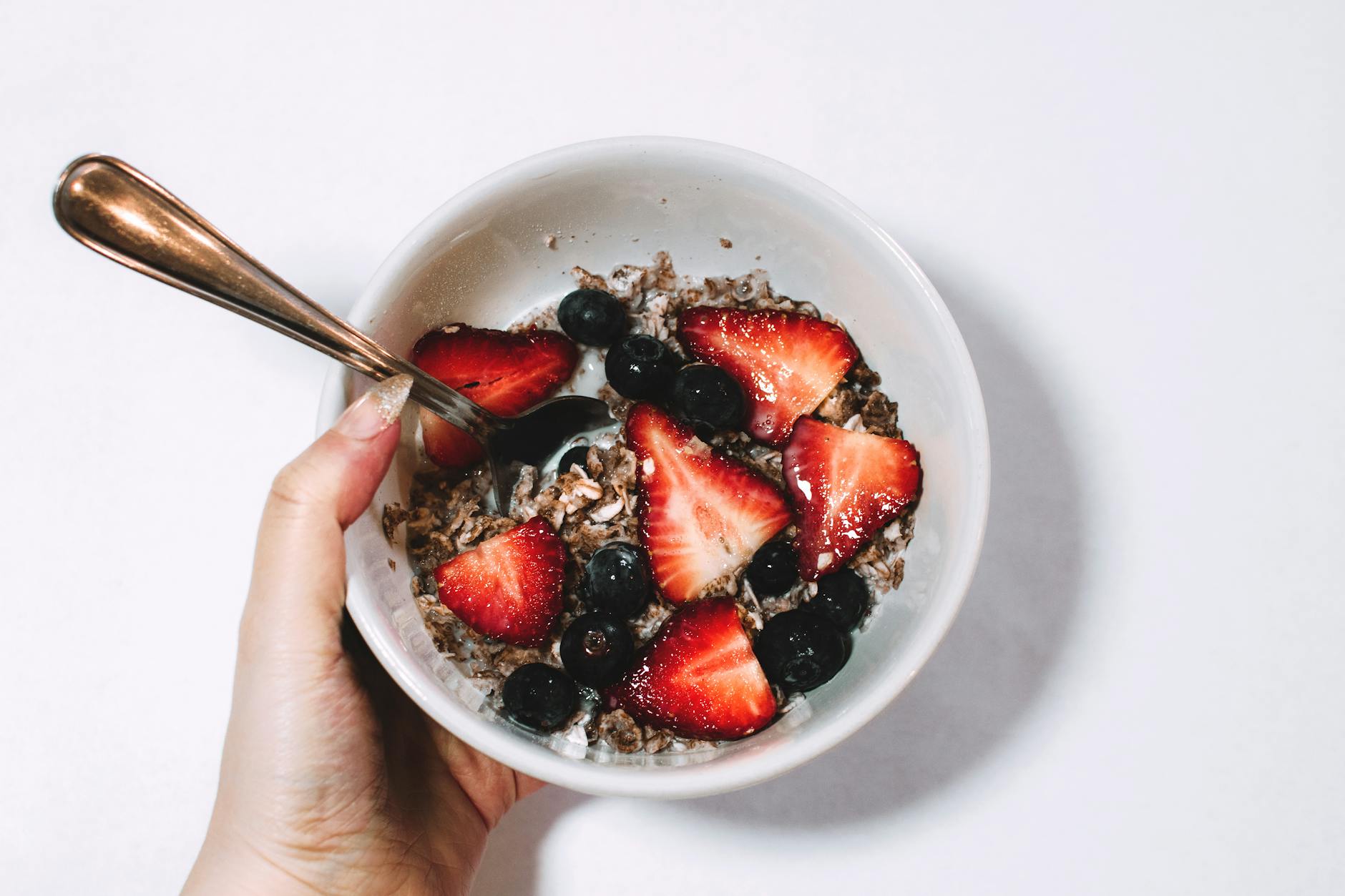
The MIND diet, short for Mediterranean-DASH Intervention for Neurodegenerative Delay, provides the clearest framework for translating neurologist breakfast habits into a practical template. Massachusetts General Hospital published a sample MIND diet breakfast that is worth using as a starting point: one cup of steel-cut oats topped with two tablespoons of slivered almonds, three-quarters of a cup of blueberries, and a sprinkle of cinnamon. This single meal checks several boxes at once. The oats supply whole grains for stable glucose. The almonds contribute healthy fats and vitamin E. The blueberries deliver anthocyanins. Even the cinnamon has been studied for potential blood sugar regulation, though the evidence there is less conclusive.
What makes this template useful is its flexibility. The oat base can be swapped for another whole grain. The almonds can be replaced with walnuts, which carry their own research backing. The blueberries can rotate with blackberries, strawberries, or whatever is seasonal and affordable. The Rush University study that established the MIND diet’s cognitive benefit found that the protective effect was equivalent to being 7.5 years younger in brain age. That is a striking number, and it came from a dietary pattern that does not require expensive specialty ingredients or complicated meal preparation. It requires consistency with a handful of food categories that neurologists already gravitate toward in their own kitchens.
How to Build a Brain-Healthy Breakfast Without Overcomplicating It
The practical challenge with brain-healthy eating is not knowing what to eat. It is actually doing it on a Tuesday morning when you are running late. The neurologists surveyed tend to rely on meals that take under ten minutes or can be prepped ahead. Dr. Najm’s egg whites with greens in olive oil is a five-minute skillet meal. Dr. Tanner’s yogurt with fruit requires no cooking at all. Smoothies like Dr.
Najm’s berry-kale-pecan blend can be prepped in bags the night before and blended in under two minutes. There are tradeoffs worth considering. Eggs are cheap, widely available, and nutrient-dense, making them the most accessible brain food on this list. Salmon, while excellent for omega-3s, is expensive and not realistic as a daily breakfast for most households. Walnuts offer a good compromise. A February 2025 study from the University of Reading, published in Food and Function, tested 32 healthy adults in a double-blind crossover trial and found that eating 50 grams of walnuts with breakfast led to faster reaction times on executive function tasks throughout the day. Memory recall was initially worse at the two-hour mark but reversed by six hours, with walnut eaters outperforming the control group. Brain activity recordings showed more efficient neural functioning during challenging tasks. Walnuts cost a fraction of salmon and require zero preparation, making them one of the most practical additions to any breakfast.
What Neurologists Deliberately Avoid at Breakfast
The avoidance list is just as revealing as the recommendation list. Neurologists surveyed consistently steer clear of sugary cereals, breakfast pastries, and foods with hidden added sugars, including sweetened yogurts that are often marketed as healthy options. This is a meaningful distinction because many people who think they are eating well at breakfast are actually consuming significant sugar loads disguised in flavored yogurts, granola bars, and juice. The issue with high-sugar breakfasts extends beyond simple calorie concerns. Rapid blood glucose spikes trigger inflammatory cascades, and chronic neuroinflammation is increasingly recognized as a contributing factor in cognitive decline and neurodegenerative disease.
Dr. Tanner specifically chooses plain, unsweetened yogurt rather than flavored varieties for this reason. The warning here is worth emphasizing: a breakfast that looks healthy on the packaging can still be problematic. A flavored yogurt parfait from a cafe may contain 30 or more grams of added sugar, which undermines whatever benefit the yogurt’s probiotics might provide. Reading labels matters, and the simplest rule of thumb from the neurologists surveyed is to assemble your breakfast from whole ingredients rather than buying it pre-made.

The Gut-Brain Connection at the Breakfast Table
Dr. Tanner’s emphasis on yogurt and the gut-brain axis reflects one of the more active areas of current neuroscience research. The gut microbiome communicates with the brain through the vagus nerve and through the production of neurotransmitters and short-chain fatty acids. Dr.
Naidoo’s recommendation of chia seed pudding follows the same logic from a different angle. Rather than supplying probiotics directly, chia seeds provide fiber that feeds existing beneficial gut bacteria. Both approaches aim at the same target: maintaining a diverse and healthy microbial population that supports brain function. For someone who dislikes yogurt, fermented foods like kefir or even sauerkraut alongside eggs could serve a similar purpose, though admittedly sauerkraut with breakfast is a harder sell in most American households.
Where Breakfast Brain Science Is Heading
The walnut study from the University of Reading, published in early 2025, points to an emerging trend in nutrition research: measuring acute cognitive effects of specific foods rather than relying solely on long-term observational data. The fact that researchers could detect measurable differences in reaction time and neural efficiency within a single day of walnut consumption suggests that breakfast choices may have more immediate cognitive consequences than previously appreciated.
Future research will likely explore whether combining multiple brain-healthy foods at a single meal produces compounding effects, and whether timing of nutrient intake interacts with circadian rhythms to influence cognitive performance. For now, the practical takeaway from the neurologists themselves is straightforward: keep it simple, keep it consistent, and build your morning around the same short list of ingredients they keep returning to.
Conclusion
The breakfast habits of practicing neurologists converge on a remarkably consistent set of foods: eggs, leafy greens, berries, nuts, olive oil, fatty fish, whole grains, and plain yogurt. These choices are grounded in research, particularly the MIND diet study showing up to 53 percent Alzheimer’s risk reduction and newer work demonstrating same-day cognitive benefits from foods like walnuts. Just as important is what neurologists leave off their plates: sugary cereals, pastries, and anything with hidden added sugar. The most practical lesson from surveying these experts is that brain-healthy breakfast does not require a radical overhaul or expensive specialty ingredients. Dr.
Najm’s egg whites with spinach in olive oil, Dr. Tanner’s plain yogurt with fruit, the Mass General MIND diet oatmeal template — these are all simple, fast, and affordable. Start with one of them tomorrow morning. Swap in different berries or greens as the weeks go on. The neurologists who study the brain for a living are not agonizing over elaborate morning protocols. They are eating real food, keeping it consistent, and getting on with their day.
Frequently Asked Questions
Is coffee good or bad for brain health?
Dr. Najm drinks a double espresso before work, and moderate coffee consumption has been associated with reduced risk of several neurodegenerative conditions in observational studies. However, excessive caffeine can disrupt sleep, which is itself critical for brain health. Most neurologists appear comfortable with moderate coffee intake but would not recommend starting a coffee habit solely for cognitive benefits.
Should I eat whole eggs or just egg whites for brain health?
This is genuinely debated even among neurologists. Dr. Najm avoids yolks, citing controversial research, while Dr. Kandel and Dr. Naidoo both recommend whole eggs for their choline, vitamin D, and serotonin-supporting properties. The majority of current nutrition research supports whole eggs in moderation for most people, but individuals with specific cardiovascular risk factors should consult their physician.
How quickly can dietary changes affect brain function?
The 2025 University of Reading walnut study found measurable improvements in reaction time and neural efficiency within a single day of eating 50 grams of walnuts at breakfast. Long-term benefits, such as the Alzheimer’s risk reduction seen in the MIND diet study, emerged over an average of 4.5 years. Both short-term and long-term effects appear to be real, but the protective benefits against neurodegeneration require sustained dietary patterns.
Are supplements a good substitute for these breakfast foods?
Neurologists in these surveys consistently emphasize whole foods over supplements. While omega-3 supplements and choline supplements exist, the bioavailability and synergistic effects of nutrients consumed in whole food form are generally considered superior. Dr. Naidoo specifically frames her recommendations around foods rather than isolated nutrients.
What is the worst breakfast for brain health?
Based on what neurologists actively avoid, the worst options are high-sugar, low-nutrient breakfasts: sweetened cereals, pastries, donuts, and sweetened yogurts or juice-based smoothies. These foods cause rapid blood glucose spikes followed by crashes, promote neuroinflammation, and provide little of the protective nutrition found in the foods neurologists choose for themselves.