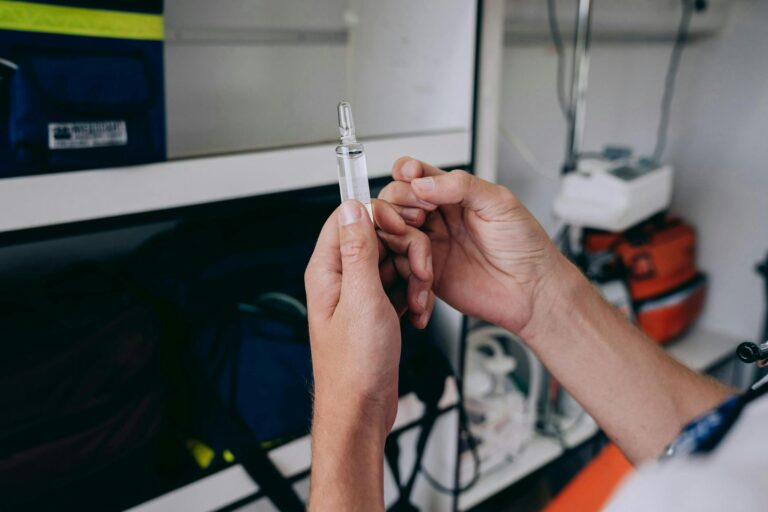
The drug is naloxone, sold under the brand name Narcan, and it can reverse an opioid overdose in as little as two to three minutes by restoring normal breathing. On March 29, 2023, the FDA approved Narcan 4 mg nasal spray as the first-ever over-the-counter naloxone product, meaning anyone can walk into a pharmacy, grocery store, or even a gas station and buy it without a prescription. For families caring for a loved one with dementia — many of whom take multiple medications, live with chronic pain, or reside in facilities where opioid exposure is a real possibility — this is a genuinely important development to understand. This shift matters more than most people realize.
Opioid prescriptions remain common among older adults managing pain from falls, surgeries, and degenerative conditions, and cognitive impairment raises the risk of accidental misuse. A caregiver who keeps a box of Narcan nasal spray in the medicine cabinet has a tool that could buy enough time for emergency responders to arrive. By September 2023, OTC Narcan was available for purchase at community pharmacies nationwide, and a second OTC naloxone spray called RiVive — made by the nonprofit Harm Reduction Therapeutics — received FDA approval in July 2023 as well. This article covers how naloxone actually works in the body, what it costs and where to find it, why overdose deaths are finally declining, and what caregivers of people with dementia specifically need to know about keeping this medication on hand.
Table of Contents
- How Does the Drug That Reverses Opioid Overdose in 2 Minutes Actually Work?
- What OTC Narcan Costs and Where Caregivers Can Find It
- The Overdose Crisis by the Numbers — and Why the Trend Is Finally Shifting
- Why Dementia Caregivers Should Keep Naloxone in the Home
- Limitations and Warnings Caregivers Need to Understand
- How to Use Narcan Nasal Spray — A Brief Practical Guide
- What Comes Next for OTC Naloxone and Overdose Prevention
- Conclusion
- Frequently Asked Questions
How Does the Drug That Reverses Opioid Overdose in 2 Minutes Actually Work?
Naloxone is an opioid antagonist. that means it competes with opioids like fentanyl, oxycodone, and heroin for the same receptor in the brain — the mu-opioid receptor. When someone is overdosing, opioids have flooded those receptors and effectively told the brain to stop breathing. Naloxone displaces the opioid molecules, knocking them off the receptor and reversing the respiratory depression that kills people. Within two to three minutes of nasal administration, breathing can return to normal. It is not a treatment for addiction. It is a rescue tool, and it does exactly one thing: buy time. One critical detail that makes naloxone especially safe for household use is that it is opioid-specific.
If you administer it to someone who has not taken opioids — say, a person with dementia who has collapsed from a stroke or a blood sugar crash — it will have no pharmacological effect. It will not help in that scenario, but it will not cause harm either. This makes it a low-risk addition to any home first-aid kit. Compare that to something like an EpiPen, which delivers epinephrine and can cause dangerous cardiovascular effects if given unnecessarily. Naloxone has no such downside when opioids are absent from the system. For caregivers, this distinction is worth internalizing. If you are ever uncertain whether an older adult’s unresponsiveness involves opioids, administering Narcan nasal spray is a reasonable step while waiting for paramedics. The worst outcome is that it does nothing. The best outcome is that it saves a life.
What OTC Narcan Costs and Where Caregivers Can Find It
The suggested retail price for a two-pack of Narcan nasal spray is approximately $44.99 — just under fifty dollars for two doses. That price point is not trivial for families already stretched thin by the costs of dementia care, but it is dramatically more accessible than the prescription-only era, when obtaining naloxone required a doctor visit, a pharmacy consultation, and often insurance approval. You can now find it at chain pharmacies like CVS and Walgreens, big-box retailers like Walmart and Target, convenience stores, grocery store pharmacies, and online. However, there is a meaningful price gap depending on where you shop. Independent pharmacies tend to charge roughly twenty dollars more on average than chain pharmacies for the same product.
If cost is a concern, it is worth checking prices at a few locations before buying. The nonprofit RiVive nasal spray, which delivers a 3 mg dose rather than Narcan’s 4 mg, may also be priced more accessibly as Harm Reduction Therapeutics has completed manufacturing upgrades and is fully stocked for 2026 demand. Here is the part many people miss: naloxone may be available for free. Local and state governments, public health departments, and harm reduction organizations distribute naloxone at no cost in many communities. SAMHSA lists naloxone as the standard treatment for opioid overdose prevention and supports these distribution programs. If you are a caregiver on a fixed income, searching for free naloxone through your county health department is a practical first step before paying retail.
The Overdose Crisis by the Numbers — and Why the Trend Is Finally Shifting
In 2024, the United States recorded 79,384 drug overdose deaths, an age-adjusted rate of 23.1 per 100,000 people. That number is staggering, but for the first time in years, it represents real progress. The synthetic opioid overdose death rate — driven overwhelmingly by illicitly manufactured fentanyl — dropped 35.6 percent year over year. Preliminary data for the twelve months ending September 2025 shows approximately 72,108 overdose deaths, an 18.9 percent decline. Forty-five states saw decreases. Only Alaska, Montana, Nevada, South Dakota, and Utah continued to see rising numbers. What changed? Experts point to several converging factors: expanded naloxone distribution, fentanyl supply saturation in some markets, a modest decrease in overall drug use, and expanded access to medications for opioid use disorder.
Nearly two million naloxone prescriptions were dispensed in 2024 alone, a number that does not even capture OTC purchases. The American Medical Association’s 2025 report on substance use specifically highlights expanded naloxone access as critical to the progress. But there is a warning embedded in these numbers. STAT News reported in March 2026 that the decline may be plateauing around 72,000 deaths per year rather than continuing downward. Seventy-two thousand annual deaths is not a victory — it is roughly equivalent to losing a mid-sized American city every year. For context, that is more than the number of Americans who die annually from diabetes. Complacency at this stage could stall or reverse the gains.

Why Dementia Caregivers Should Keep Naloxone in the Home
Opioid risk in dementia care is more common than most families expect. Older adults with dementia frequently have co-occurring conditions that involve pain — arthritis, spinal stenosis, post-surgical recovery, cancer. Opioid medications like oxycodone, hydrocodone, and fentanyl patches are routinely prescribed in these situations. A person with moderate-to-advanced dementia may not remember whether they already took a dose, may struggle to communicate pain levels accurately, or may have a caregiver who inadvertently administers a dose too close to the previous one. The result can be respiratory depression — the hallmark of opioid overdose. The tradeoff is straightforward.
A two-pack of Narcan costs less than fifty dollars and sits in a cabinet until needed, much like a fire extinguisher. The alternative — not having it — means relying entirely on the speed of a 911 response, which in rural areas can exceed twenty minutes. Same-day naloxone availability at pharmacies increased from 42.2 percent to 57.8 percent after OTC approval, so obtaining it has never been easier. If your loved one with dementia uses any opioid medication, even a low-dose fentanyl patch, having naloxone in the home is a reasonable precaution. That said, naloxone is not a substitute for medication management. If accidental double-dosing is a recurring risk, the more important intervention is a locked medication dispenser, a simplified pill schedule, or a conversation with the prescribing physician about whether opioid therapy is still appropriate.
Limitations and Warnings Caregivers Need to Understand
Naloxone is powerful, but it is not foolproof. The most important limitation for caregivers to understand is that its effects are temporary. Naloxone typically wears off in thirty to ninety minutes, while many opioids — particularly extended-release formulations and fentanyl patches — remain active in the body much longer. This means a person can be revived by naloxone and then slip back into overdose after it wears off. You must call 911 even if the person appears to recover fully after receiving naloxone. There is also the issue of precipitated withdrawal.
When naloxone rapidly displaces opioids from receptors, it can trigger sudden and severe withdrawal symptoms: agitation, nausea, vomiting, rapid heart rate, and confusion. In a person with dementia who is already disoriented, this can be frightening for both the patient and the caregiver. It is not dangerous in the same way the overdose is dangerous, but caregivers should be prepared for the possibility that the person may wake up distressed and combative rather than calm and grateful. Finally, not all unresponsiveness in older adults is opioid-related. A person with dementia who becomes difficult to rouse may be experiencing a stroke, severe infection, hypoglycemia, or simply the progression of their disease. Naloxone will not help in any of these situations. Use it when opioid involvement is plausible, but do not let its availability delay calling emergency services or performing other appropriate first aid.

How to Use Narcan Nasal Spray — A Brief Practical Guide
The mechanics are deliberately simple. Narcan nasal spray requires no assembly, no measuring, and no medical training. You peel back the packaging, insert the nozzle into one nostril, and press the plunger. One device delivers one dose. The person should be laid on their back, or in the recovery position on their side if vomiting is a concern.
If there is no improvement within two to three minutes, a second dose from the second device in the two-pack can be administered in the other nostril. Emergency services should be contacted immediately regardless. For caregivers of people with dementia, it is worth practicing the motion with the training device — some naloxone kits include one — or simply reviewing the instructions before a crisis occurs. Under stress, even simple tasks become difficult. Knowing where the Narcan is stored and how to open the packaging takes less than five minutes to learn and could be the difference that matters.
What Comes Next for OTC Naloxone and Overdose Prevention
The broader trajectory is cautiously hopeful. OTC availability has meaningfully expanded access, particularly in communities that were previously underserved by pharmacies willing to stock or dispense naloxone. The entry of RiVive as a second OTC option — backed by a nonprofit rather than a pharmaceutical company — introduces price competition and mission-driven distribution that could push costs down further. Public health officials are also exploring whether naloxone should be placed in AED-style public access cabinets in libraries, transit stations, and community centers.
But as STAT News cautioned in March 2026, a plateau at 72,000 deaths per year would represent a failure of ambition. The tools exist. Naloxone is available without a prescription for the first time in history. The question now is whether families, caregivers, institutions, and policymakers treat this as a solved problem or continue pushing for the structural changes — in pain management, addiction treatment, and drug policy — that could drive those numbers meaningfully lower.
Conclusion
Naloxone is a simple, safe, opioid-specific rescue medication that can reverse an overdose in minutes, and it is now available over the counter at pharmacies, retailers, and online for roughly forty-five dollars. For dementia caregivers whose loved ones take any form of opioid pain medication, keeping a two-pack of Narcan or RiVive nasal spray in the home is a practical and potentially lifesaving precaution. It requires no prescription, no medical training to administer, and poses no risk if used on someone who has not taken opioids.
The broader picture is one of cautious progress. Overdose deaths in the United States have declined meaningfully for the first time in years, and expanded naloxone access is a key reason. But 72,000 deaths a year is not an acceptable baseline, and the work of keeping vulnerable populations safe — including older adults with dementia who may be at risk for accidental opioid misuse — requires ongoing vigilance. Talk to your loved one’s physician about opioid safety, check whether your local health department offers free naloxone, and make sure everyone in the caregiving circle knows where the Narcan is and how to use it.
Frequently Asked Questions
Can naloxone hurt someone who hasn’t taken opioids?
No. Naloxone is opioid-specific and has no pharmacological effect if opioids are not present in the body. If you administer it to someone whose unresponsiveness is caused by something other than opioids, it simply will not do anything. It is considered safe to use even when the cause of unresponsiveness is uncertain.
How much does OTC Narcan cost?
The suggested retail price is approximately $44.99 for a two-pack containing two doses. Prices vary by retailer, and independent pharmacies tend to charge about $20 more than chain pharmacies. Naloxone may also be available for free through state and local health departments or harm reduction organizations.
Does naloxone expire, and how should it be stored?
Yes, naloxone does expire, and the expiration date is printed on the packaging. It should be stored at room temperature, away from direct sunlight. Caregivers should check the date periodically and replace expired stock. Even expired naloxone may retain some effectiveness in an emergency, but fresh stock is always preferable.
Why would a dementia caregiver need naloxone?
People with dementia often take opioid pain medications for co-occurring conditions like arthritis or post-surgical pain. Cognitive impairment increases the risk of accidental double-dosing or medication confusion. Having naloxone available provides a safety net if an accidental overdose occurs while waiting for emergency responders.
Is Narcan the only OTC naloxone product?
No. The FDA also approved RiVive, a 3 mg naloxone nasal spray made by the nonprofit Harm Reduction Therapeutics, for over-the-counter sale in July 2023. RiVive is fully stocked for 2026 demand and may offer an alternative at a different price point.
Should I still call 911 after giving someone naloxone?
Absolutely. Naloxone’s effects are temporary and typically wear off within 30 to 90 minutes, while many opioids remain active in the body much longer. A person can be revived by naloxone and then slip back into overdose after it wears off. Emergency medical care is always necessary.