Reviewed by the Help Dementia Editorial Team — our editors review every article for accuracy against guidance from the National Institute on Aging, the Alzheimer’s Association, and peer-reviewed sources.
A dementia-friendly community designation represents a formal commitment by cities, towns, and counties to become informed, safe, and respectful places for the millions of Americans living with dementia and their families. Over 300 communities across 43 states have already embarked on this designation process, driven by the urgent reality that 7.2 million Americans aged 65 and older now live with Alzheimer’s dementia. Towns like Naperville, Illinois, which received its official designation in 2020, have become models for what this transformation looks like—improving everything from how local businesses train staff to how police officers respond to someone who is confused or wandering.
This article explores what the dementia-friendly designation actually means, why communities are pursuing it, how the process works, and what real-world changes it brings to daily life. The movement reflects a fundamental shift in how American communities think about aging and brain disease. Rather than waiting for a cure or hoping individuals and families manage on their own, dementia-friendly communities take a proactive stance: they redesign services, train employees, adjust infrastructure, and coordinate across sectors—from health care and law enforcement to banking and retail—to ensure that someone with cognitive decline can navigate town life with dignity and safety. This is not a federal mandate or a funding program, but a grassroots, collaborative designation that requires genuine buy-in from multiple parts of the community.
Table of Contents
- What Exactly Is a Dementia Friendly Community Designation?
- The Driving Force: A Demographic Tsunami
- How Communities Formally Become Dementia Friendly
- What Changes Actually Happen in a Dementia Friendly Community
- Challenges and Limitations of the Dementia Friendly Movement
- Regional Variations and State-Level Leadership
- The Future of the Dementia Friendly Movement
- Conclusion
What Exactly Is a Dementia Friendly Community Designation?
A dementia-friendly community, as defined by Dementia Friendly America (DFA), is a village, town, city, or county that is informed, safe, and respectful of individuals with dementia and their caregivers. The designation is not simply an honorary title; it requires documented work across multiple sectors. Communities must engage people actually living with dementia, family caregivers, and representatives from business, health care, faith-based organizations, local government, and legal and financial services in deliberate, collaborative efforts to change how the community operates. The idea is that dementia affects the whole community—not just those diagnosed, but also the families struggling to keep a loved one safe, the bank tellers handling finances, the police responding to calls, and the shopkeepers seeing a regular customer who is increasingly disoriented.
To become designated, communities must complete a “Readiness and Recognition Criteria” application and demonstrate that they have formed coordinated teams addressing multiple areas: awareness and training, safety and access, early identification and support, and inclusion and participation. Once recognized, communities receive ongoing technical assistance, access to training materials, and community toolkits developed by DFA and its network of 35 national partner organizations. This is not a one-time achievement; it’s a commitment to continuous improvement. The designation process, administered by USAging in collaboration with Area Agencies on Aging (AAAs) across the country, ensures that there is actual infrastructure and accountability behind the label.

The Driving Force: A Demographic Tsunami
The reason communities are pursuing this designation now is straightforward: dementia is becoming impossible to ignore. The numbers are stark. As of 2025, one in every 14 Americans aged 65 and older has Alzheimer’s dementia. But prevalence rises sharply with age. Among people aged 65 to 74, about 5 percent have Alzheimer’s dementia. Jump to ages 75 to 84, and the rate climbs to 13.2 percent.
By age 85 and older, one out of every three people—33.4 percent—has Alzheimer’s dementia. This means that without major medical breakthroughs, as the Baby Boomer generation ages into their 80s and 90s, the sheer volume of people with cognitive decline will strain families, health systems, and communities to a degree many have not yet anticipated. The Alzheimer’s Association projects that by 2060, the number of Americans with Alzheimer’s dementia could reach 13.8 million—nearly double the current figure—unless disease-modifying treatments become widely available. The movement also includes people with younger-onset dementia; approximately 200,000 Americans between ages 30 and 64 have dementia, often going undiagnosed for years. For these individuals and their families, living in a community that understands dementia and offers coordinated support can be life-changing. However, dementia-friendly designation does not solve the access problem for rural communities or areas with fewer resources; communities need enough population base and organizational capacity to form the interdisciplinary teams required. A designation is only as strong as the commitment and resources behind it.
How Communities Formally Become Dementia Friendly
The path to designation begins with a planning phase. Communities must identify a lead organization (often an Area Agency on Aging, a health department, or a nonprofit focused on aging) willing to convene stakeholders and guide the application process. This lead organization works with city officials, hospital administrators, local business leaders, law enforcement, faith communities, and, critically, people with dementia and their caregivers to assess current gaps and design initiatives. The Readiness and Recognition Criteria application asks communities to document their efforts in specific areas: dementia awareness and training programs, initiatives to improve safety and access to services, efforts to support early identification and diagnosis, and ways to include people with dementia in community decision-making. Once an application is submitted and approved, the community is officially recognized and gains access to Dementia Friendly America’s toolkit and guidance system. Real-world examples illustrate different scales and approaches.
Naperville, Illinois worked through its Senior Task Force to address education, safety, business practices, and community events. In Virginia, communities including Lexington, Harrisonburg, Staunton, and Waynesboro, along with Rockingham and Augusta Counties, have pursued designation with state support. California has over a dozen cities working toward recognition, including Azusa, Los Angeles, Montrose, Redondo Beach, and others. Massachusetts has mobilized over 160 communities in dementia-friendly initiatives. Minnesota’s ACT on Alzheimer’s program supports more than 50 communities. The geographic and demographic diversity of these examples shows that designation is achievable for communities of different sizes and resources, though each must tailor its approach to local conditions.

What Changes Actually Happen in a Dementia Friendly Community
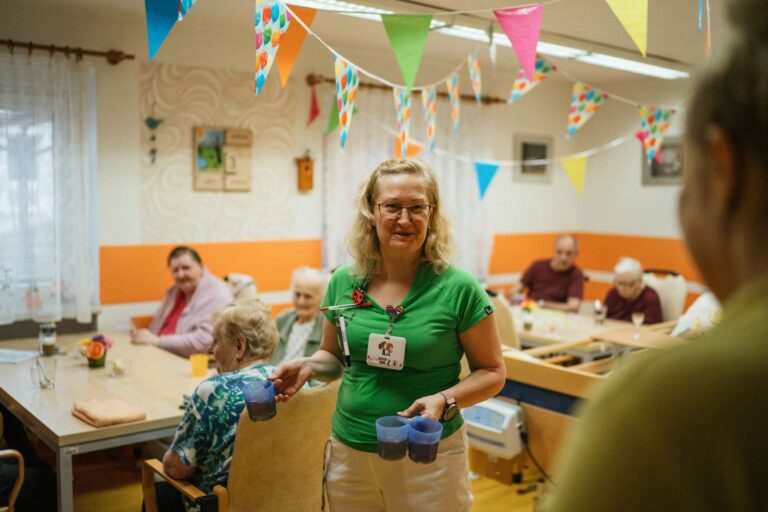
The designation process is not theoretical; it results in concrete changes. Businesses receive training on how to interact with customers who may be confused or anxious. Retail staff learn to be patient and kind rather than dismissive. Banks train tellers on how to recognize potential financial exploitation of older adults and how to communicate with someone who has memory loss. Police departments develop protocols for recognizing someone with dementia who may be lost or in crisis, prioritizing de-escalation and connection with family over arrest. Health systems improve screening for cognitive impairment and expand caregiver support programs.
Area Agencies on Aging report offering expanded services including information and referral (88 percent of AAAs), respite care (82 percent), nutrition programs (81 percent), caregiver training (75 percent), and in-home services (75 percent). The comparison between communities before and after designation reveals the scope of change. Before, a person with dementia might have been treated as a behavioral problem in a store, resulting in embarrassment or being asked to leave. After designation, staff are trained to recognize confusion, offer assistance, and connect the person with family or emergency services. A person driving while cognitively impaired might have been allowed to continue until causing an accident; in dementia-friendly communities, there are protocols for encouraging voluntary driving cessation or intervention. A family trying to navigate late-life financial planning might have faced generic advice; dementia-friendly communities have resource hubs where elder law attorneys and financial advisors understand the implications of cognitive decline. These changes seem incremental in isolation but accumulate into a fundamentally different experience of aging and dementia in the community.
Challenges and Limitations of the Dementia Friendly Movement
Despite the momentum, real challenges face communities trying to implement dementia-friendly initiatives. First, the designation process requires sustained effort and resources. Communities must maintain ongoing training, update protocols as staff turns over, and continuously coordinate across organizations that have different budgets, priorities, and governance structures. There is no federal funding specifically for dementia-friendly community efforts; organizations must fund initiatives through existing budgets, grants, and donations. A well-resourced urban area with a strong Area Agency on Aging and engaged business community can move quickly; a rural county with limited capacity may struggle to form the necessary teams.
Second, the dementia-friendly model assumes that people with dementia will have someone—a family member, caregiver, friend—advocating for them and helping them navigate the community. For the growing number of older adults with no family or few social connections, even a supportive community can feel isolating. Additionally, not every older adult with mild cognitive impairment wants to be identified or treated as having dementia, and communities must balance public health efforts with individual autonomy and privacy. The designation also does not address the underlying biology of dementia or provide a cure; it is a support system, not a solution. Communities can make life safer and more dignified, but they cannot stop the disease’s progression.

Regional Variations and State-Level Leadership
Different states and regions have embraced the dementia-friendly movement with varying degrees of intensity. Massachusetts has emerged as a national leader, with over 160 communities participating in the state’s dementia-friendly initiative. These communities span urban, suburban, and rural areas, demonstrating that the model is scalable across different community types. Minnesota’s ACT on Alzheimer’s program shows how state-level coordination can support local efforts; more than 50 communities participate, and the program has developed resources tailored to the state’s geography and demographics.
California, with its large and diverse aging population, has mobilized effort through regional partners like Alzheimer’s Los Angeles, which supports dementia-friendly initiatives in over a dozen communities including Azusa, Los Angeles, Montrose, Monrovia, Redondo Beach, Riverside, San Marino, Sierra Madre, and West Hollywood. Virginia has created a structured statewide framework with multiple designated communities and counties. These regional hubs often become training centers, sharing lessons with surrounding communities considering designation and speeding up the adoption process across the state. The existence of state-level infrastructure and coordination significantly accelerates the spread of dementia-friendly practices.
The Future of the Dementia Friendly Movement
As the number of Americans with dementia is projected to nearly double by 2060, the dementia-friendly movement will likely accelerate. More communities will pursue designation, not as an optional initiative but as a necessary adaptation to demographic reality. The 192,500 people who have become “Dementia Friends”—individuals who take a pledge to understand dementia and act with compassion—represent an emerging constituency that will push local officials and businesses to do better. Youth engagement is growing; younger people learning about dementia now will carry dementia-friendly principles into their future roles in business, government, and health care.
Technology will also play a role in the future. Communities are beginning to explore how digital tools—alert systems for people at risk of wandering, memory care apps, virtual visits with specialists—can complement the human and organizational changes that make a community dementia friendly. The movement is unlikely to remain purely a local initiative; national media attention, shared success stories, and the obvious need for coordination across state lines may eventually lead to more robust federal support and standardization. For now, the communities already designated and those in progress are pioneering a model that future communities will adopt, refine, and build upon.
Conclusion
The dementia-friendly community designation represents a fundamental rethinking of how American communities can respond to the aging brain. Over 300 communities across 43 states have already committed to becoming informed, safe, and respectful places for people with dementia and their caregivers. These designations are not honorary; they require documented changes in how businesses train staff, how police respond to crisis, how health systems screen and support patients, and how entire towns coordinate to ensure dignity for aging residents. The movement is driven by clear demographic necessity: 7.2 million Americans currently have Alzheimer’s dementia, and that number will nearly double by 2060 unless disease-modifying treatments emerge.
If you live in a community considering dementia-friendly designation, or if you are a person with dementia or a caregiver seeking resources, the first step is to contact your local Area Agency on Aging. These agencies can explain what designation means, what the process requires, and what support is available. For communities ready to commit to the work, the Dementia Friendly America network and state-level initiatives like Massachusetts’ program and Minnesota’s ACT on Alzheimer’s provide templates, training, and peer support. The dementia-friendly movement shows that communities can choose to adapt proactively rather than react in crisis—and that choice is increasingly urgent as the nation ages.
You Might Also Like
- The Dementia Savings Account Strategy That Financial Planners Are Now Recommending
- The Genetic Test for Dementia Risk That Costs $100 and Is Now Available Without a Doctor Order
- Why Your 40s Are the Most Critical Decade for Dementia Prevention and What to Do About It
For more, see CDC — Alzheimer’s and Dementia.