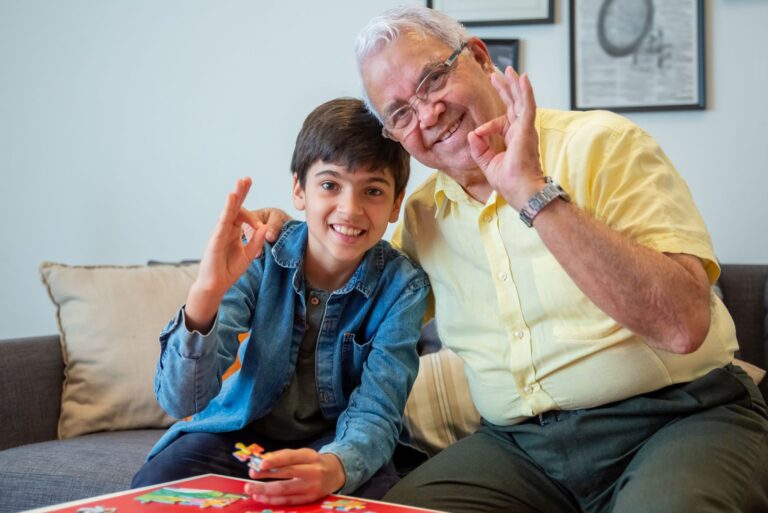
The clearest signs are physical and immediate: smiling or laughing at the table, hands that keep reaching for pieces, and unprompted talk about the picture. Time spent handling and placing pieces matters more than whether the puzzle ever gets finished. No study has directly measured enjoyment of jigsaw puzzles in dementia. What researchers have built instead are validated observational scales for reading engagement and mood when someone can no longer reliably describe their own feelings — and those scales translate neatly to a puzzle on a kitchen table.
Medical information disclaimer: This article is for general educational purposes only and does not provide medical advice, diagnosis, or treatment. Always consult a physician or other qualified health professional about symptoms, medications, tests, or treatment decisions.
Table of Contents
- What the observational scales actually count
- Why time at the table beats a finished picture
- Reading the face when words are gone
- Signs it is not working
- Matching the puzzle to the person
- Frequently Asked Questions
What the observational scales actually count
The Menorah Park Engagement Scale (MPES) is an 11-item tool developed alongside Montessori-based dementia programming, designed for a watcher to score what a person does during an activity. Its coding categories define Pleasure narrowly and usefully: clearly observable smiling or laughing. Nothing about contentment inferred from stillness.
It scores pleasure — alongside anger, anxiety or fear, and sadness — over five-minute observation intervals, marking each as 0 (not at all), 1 (up to half the interval), or 2 (more than half). That gives a caregiver a concrete test rather than a vague impression: does smiling occupy most of a five-minute stretch at the puzzle? The scale also splits behaviour into Constructive Engagement, Passive Engagement, Non-Engagement and Other Engagement, recording the minutes spent in each. Handling and placing pieces is constructive. Watching a partner do it is passive — still engagement, still worth something, but a different thing.
Why time at the table beats a finished picture
Cohen-Mansfield and colleagues defined engagement in dementia as "the act of being occupied or involved with an external stimulus," a definition carried into their 2024 wellbeing study. Under that definition, the measurable outcome is duration of involvement — not completion, not accuracy, not speed. This matters because completion is the wrong yardstick as dementia progresses.
A person who spends twenty absorbed minutes sorting edge pieces and never assembles them has done the thing the research counts. A person who finishes a puzzle quickly while looking tense has not. The same research group built the Group Observational Measurement of Engagement (GOME) specifically to capture how group recreational activities affect engagement and general wellbeing. A puzzle worked on at a shared table is a group recreational activity, so there is a purpose-built instrument for exactly that setting.
Reading the face when words are gone
A 2021 systematic review in Frontiers in Psychology identified five observational instruments that code emotion from facial, bodily and behavioural expression: FACS, MAX, the Observed Emotion Rating Scale, the Observable Displays of Affect Scale, and the Apparent Emotion Rating instrument. Their existence establishes the principle — when self-report is unreliable, facial expression is the accepted proxy for inner state.
That is a licence to trust what you see, with a limit attached. These are structured instruments used by trained observers over defined intervals, not permission to read deep meaning into a single glance. Practical signs to watch for during a five-minute stretch:.
- Smiling or laughing that persists, not one flicker
- Hands reaching for pieces without being prompted
- Leaning in toward the board rather than back from it
- Talking about the picture — the cat, the seaside, the year
- Returning to the puzzle after a pause or interruption
Signs it is not working
Enjoyment is not automatic, and the honest evidence says so. The Jigsawdio pilot ran a multi-sensory puzzle system pairing images with audio, twice weekly for six weeks in 30–40 minute sessions, with 19 participants — 9 people living with dementia, 6 caregivers and 1 staff member. Pre-to-post scores for cognition and depression both improved significantly (p < .05), reported in Gerontechnology in 2025. The qualitative interviews from the same study tell the other half.
Participants struggled with the puzzles, reported frustration, and described painful attachment to past experiences the images stirred up. A picture chosen for its nostalgia can land as grief rather than pleasure. Nine people with dementia is far too small a sample to generalise from, in either direction. Treat the trial as a reason to try a puzzle attentively, not as evidence that puzzles reliably help.
Matching the puzzle to the person
Frustration is usually a fit problem before it is a puzzle problem. The Alzheimer's Society shop sells puzzles from 9 to 100 pieces, designed and tested so users of all abilities can complete them unassisted, with large pieces for people with dexterity difficulties and a sturdy frame that allows completion in the box or on the lap. That range is a usable difficulty ladder.
Start below where you think the person is, and step up only when the constructive-engagement minutes hold steady and the pleasure signs are there. Stepping down after a bad session is a fit adjustment, not a defeat. The Alzheimer's Society also notes in its guidance on games and puzzles designed for people with dementia that supporting activity engagement underpins independence, enjoyment, communication and quality of life, and that puzzles can reduce stress, spark memories and prompt conversation. So when someone stops assembling and starts talking about the picture, that is the activity succeeding — not a distraction from it.
Frequently Asked Questions
How long should I watch before deciding?
The MPES uses five-minute intervals, scoring whether pleasure occupies none, up to half, or more than half of that window. One five-minute observation is enough to record something; repeated ones across sessions tell you far more than a single verdict.
Is passive watching a failure?
No. The MPES counts Passive Engagement — watching without handling pieces — as a distinct category from Non-Engagement, and records its duration in minutes. Someone sitting at the table watching is still involved with the activity.
Should I pick a puzzle image from the person's past?
Cautiously. Nostalgic images can spark memories and conversation, but Jigsawdio participants also described painful attachment to past experiences. Watch the first session with an image closely before making it a regular one.