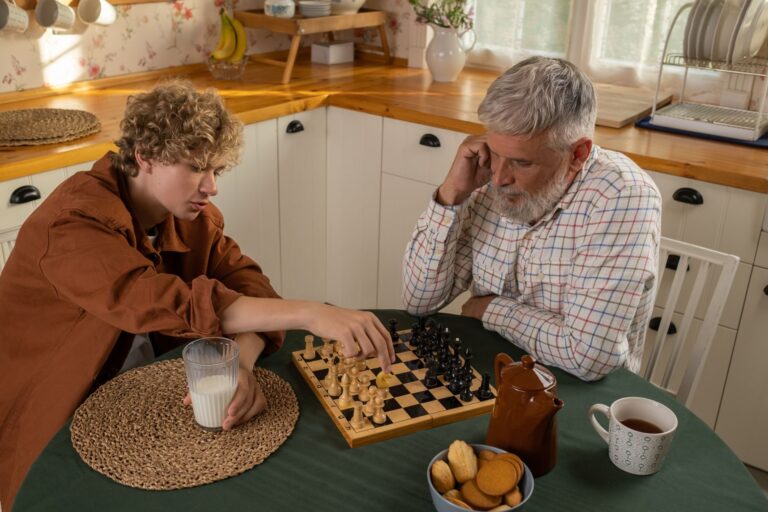
Engagement during a matching game shows up as leaning forward, smiling, naming cards aloud, or reaching for a turn before it's offered. Distress shows up differently: a sudden flush of frustration, pushing the cards away, going quiet, or snapping at a neighbor over a missed match. Matching games are a common activity in memory care groups because they're simple to adapt and easy to score by sight rather than by self-report. Reading the room matters as much as running the activity — a facilitator who can't tell the difference between a participant who's quietly thinking and one who's quietly shutting down will miss the moment to step in.
Medical information disclaimer: This article is for general educational purposes only and does not provide medical advice, diagnosis, or treatment. Always consult a physician or other qualified health professional about symptoms, medications, tests, or treatment decisions.
Table of Contents
- Why Matching Games Are Used in Memory Care Groups
- What Engagement Actually Looks Like
- What Distress Looks Like, and What's Driving It
- Adjusting the Game When Distress Shows Up
- Frequently Asked Questions
Why Matching Games Are Used in Memory Care Groups
Matching games belong to a broader category called Cognitive Stimulation Therapy, or CST — structured small-group sessions built around activities like matching, word games, music, and current-events discussion, designed to stimulate memory and thinking in people with dementia. The UK's National Institute for Health and Care Excellence has recommended CST for mild-to-moderate dementia since 2006, regardless of whether the person also takes dementia medication, according to NICE guidance summarized by UCL. Standard CST runs 14 sessions of 45 minutes each, rotating through games, music, and discussion topics, per UCL's evidence base for the program.
A matching game fits that format well: it has a clear goal, a visible endpoint, and no reading or writing required, which keeps it accessible across a wide range of cognitive ability within one group. The evidence behind CST isn't anecdotal. A 201-participant randomized controlled trial published in the British Journal of Psychiatry found that people in CST groups improved significantly more than a control group on standard cognitive tests (ADAS-Cog, p=0.014) and overall quality of life (p=0.028), with no difference in behavior, depression, or anxiety scores between groups — meaning the sessions didn't appear to upset participants on average, according to the Spector et al. 2003 trial.
What Engagement Actually Looks Like
Facilitators and family observers don't need a verbal check-in to know whether someone is engaged — the signs are physical and visible. The Philadelphia Geriatric Center Affect Rating Scale, also called the Observed Emotion Rating Scale, was built specifically to score this without relying on self-report. It tracks six observed-affect categories from facial expression and body movement: pleasure, interest, and contentment signal engagement, while sadness, anxiety or worry, and anger signal distress, according to the Lawton, Van Haitsma & Klapper 1996 scale.
In practice during a matching game, engagement tends to look like: leaning toward the table, tracking cards with the eyes as they're turned over, smiling or laughing at a match, humming or talking along with the group, and initiating a move rather than waiting to be prompted. Interest can also show up as watching another player's turn closely, even without touching a card. None of these signs require the person to remember the rules perfectly or complete the game "correctly." A participant who turns over the same card twice but keeps smiling and reaching for more cards is still registering as engaged on the pleasure and interest items of the scale above — the activity is doing its job even if the score sheet would show no matches.
What Distress Looks Like, and What's Driving It
Distress during an activity usually has a cause, and most causes aren't about the game itself. The Alzheimer's Association names overstimulation — noise, glare, a television left on, too much happening at once — and unmet physical needs such as pain, hunger, thirst, a full bladder, fatigue, or infection as common triggers for agitation, and recommends a prompt medical checkup if agitation appears suddenly rather than building gradually, per the Alzheimer's Association's guidance on anxiety and agitation. A more acute form of distress specific to tasks is what dementia care training calls a "catastrophic reaction": an excessively anxious, fearful, or despairing response to frustration at being unable to complete a task or understand what's happening. Signs range from shouting, crying, or striking out to agitated pacing, refusing to participate, or going silent and withdrawing, according to In The Know Caregiver Training's definition.
The same training guidance identifies specific triggers common during group activities: too many steps packed into one task, a facilitator who seems rushed or stressed, an unfamiliar room, a break from the person's usual routine, fatigue, pain, and hunger. It recommends logging when episodes happen so caregivers can spot a pattern — a participant who always struggles late in the afternoon, for instance, per the same source. Dementia Australia frames over-reacting to a small setback, like a missed match or mild correction, as a disease-driven catastrophic reaction rather than stubbornness or a character flaw. Facilitators are advised to hold that framing so a distressed response to a failed match reads as a symptom to address, not defiance to correct, according to Dementia Australia's help sheet on changed behaviours.
Adjusting the Game When Distress Shows Up
The fix for most distress signals during a matching game is to change the game's demands, not to stop playing entirely. Activity-adaptation guidance for dementia groups recommends removing scoring and competition from matching games outright and allowing play in groups as small as two people, both of which lower task complexity and performance pressure for participants with cognitive impairment, per Activities for Care's guidance on memory games.
Concrete adjustments a facilitator can make mid-session: Because triggers like fatigue and time of day repeat, tracking which sessions produced distress — and at what point in the session — helps a facilitator adjust the next one proactively rather than reactively. A participant who tenses up fifteen minutes in may simply need shorter sessions, not a different activity altogether.
- Drop from a full deck to six or eight pairs, cutting the number of steps in the task.
- Pair a struggling participant with a partner instead of leaving them to play alone.
- Remove any scorekeeping or timer, since competition adds pressure the task itself doesn't need.
- Lower glare and background noise — turn off a nearby TV, close blinds, move away from a noisy hallway.
- Check for an unmet physical need first: offer water, ask about pain, or suggest a bathroom break before assuming the behavior is about the game.
Frequently Asked Questions
Should a facilitator correct someone who matches cards incorrectly?
Dementia Australia's guidance frames harsh self-criticism over small errors as disease-driven, not a character issue, so facilitators are advised to avoid correcting mistakes directly and instead redirect attention to the next card.
Does a matching game need to be timed or scored to be effective?
No — activity-adaptation guidance for dementia groups specifically recommends removing scoring and competition from matching games to reduce performance pressure.
How many people should play a matching game together in a memory care group?
Guidance on adapting memory games allows for groups as small as two players, which keeps the pace manageable for participants with more advanced cognitive impairment.