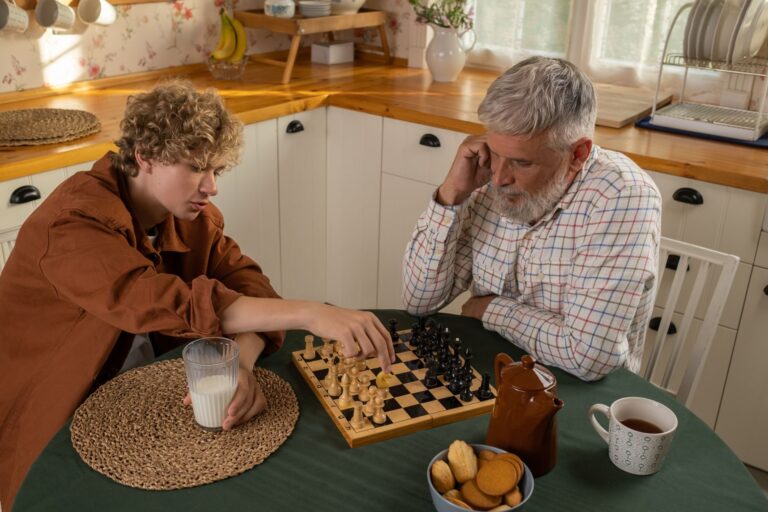
When matching games stop holding someone's attention, the fix is usually to change the format of engagement, not abandon it altogether. Music-based activities, simple sorting or folding tasks, movement, and reminiscence work all give a person living with dementia a different way to stay engaged at home. Interest fades for predictable reasons as dementia progresses, and caregivers can read those signals to choose what comes next. The options below swap short-term memory and problem-solving demands for activities that lean on rhythm, habit, and familiar movement instead.
Medical information disclaimer: This article is for general educational purposes only and does not provide medical advice, diagnosis, or treatment. Always consult a physician or other qualified health professional about symptoms, medications, tests, or treatment decisions.
Table of Contents
- Why Interest in Matching Games Wanes
- Modify the Activity Instead of Replacing It
- Music as a Direct Substitute
- Movement, Arts, and Simple Hands-On Tasks
- Reminiscence and Conversation-Based Alternatives
- Frequently Asked Questions
Why Interest in Matching Games Wanes
A person with dementia often pulls back from activities they used to enjoy early in the disease, and a matching game that once felt satisfying can start to feel confusing or overwhelming. The Alzheimer's Association notes that this withdrawal is common, and the response is to offer a smaller, quieter setting rather than pushing through the same activity at the same difficulty. Waning attention span and rising frustration are the specific cues to watch for.
The same guidance tells caregivers to end or switch an activity the moment either shows up, rather than trying to coax the person back into focus. As the disease advances, the goal shifts again: toward simpler, more repetitive tasks where the person can take a smaller, less active role. A card-matching game that demanded recall and sequencing a year ago may need to become something with one step and no right-or-wrong outcome.
Modify the Activity Instead of Replacing It
Before swapping in something entirely new, consider whether the loved activity itself can be scaled down. The Alzheimer's Association points out that favorite activities don't need to be dropped — modifying them to match current ability can also reduce wandering or agitation, which a flat-out replacement activity doesn't address on its own.
For a matching game, that might mean cutting the card count from a full deck to six pairs, switching from symbols to photos of family members or pets, or turning it into a one-step task: "find the two that look the same," demonstrated rather than explained. If attention or frustration shows up anyway, that's the signal to move to a different format rather than a harder version of the same one.
Music as a Direct Substitute
Personalized music is one of the better-supported replacements for a cognitively demanding game, because it asks nothing of working memory. A Wichita State University pilot study gave six older adults with dementia at an Ohio care center individualized playlists and observed better mood, less disruptive behavior, and more eye contact and smiling — though the sample was small and had no control group, so it's a signal rather than proof.
A current UK trial recruiting through 2025 is building similarly personalized playlists for care-home residents, with early findings pointing the same direction: improved mood and reduced agitation. At home, this means building a short, personal playlist — songs tied to a wedding, a job, a region the person grew up in — rather than generic "calming music" compilations. It can run during a transition point, like before a meal or after a difficult moment, instead of as a scheduled activity block.
Movement, Arts, and Simple Hands-On Tasks
The NHS lists several categories that work as direct substitutes for tabletop games: dance, tai chi, yoga, swimming, walking groups, arts-based activities, reminiscence work, and singing. None of them depend on short-term recall, which is what makes them durable as matching games stop fitting. A separate line of research supports keeping movement and structured activity going even once apathy has set in.
Combined occupational and physical activity sessions, ongoing weekly for ten months among nursing-home residents, kept apathy from worsening compared with a control group — though the benefit faded within a year after the sessions stopped, meaning the activity has to continue to keep working. For hands-on tasks with no performance pressure, single-step sorting or folding work — folding towels, sorting a deck of cards by color — engages procedural memory instead of short-term recall, according to Montessori-based dementia-care materials. The task is demonstrated rather than described, and the person is offered a choice between two simple options rather than open-ended instructions.
Reminiscence and Conversation-Based Alternatives
Reminiscence work — looking through old photos, talking about a familiar place, handling an object tied to a past routine — sits on the same NHS list of substitutes for tabletop games, alongside dementia-specific apps and video calls that keep social contact going without a game board. It asks for recognition and storytelling rather than matching or sequencing, which is often still accessible even when gameplay has become frustrating.
The evidence on how much reminiscence therapy helps is mixed: a review of 22 randomized trials found inconsistent effects on mood, cognition, and communication, in part because studies define "reminiscence therapy" differently from one another. That doesn't rule it out as a home activity — it means results will vary by person, and the practical test is the same one used for any activity: does this person's attention stay, and does frustration stay low.
Frequently Asked Questions
How do I know it's time to stop using matching games entirely, versus just making them easier?
Watch for waning attention span or rising frustration during the activity itself — the Alzheimer's Association treats those two signs as the cue to switch tasks, not a reason to keep adjusting the same format.
Is personalized music better than generic relaxation playlists?
The research behind the mood and behavior improvements used playlists built around each person's own history — a wedding song, a favorite artist from their working years — not generic calming-music compilations.
Do folding or sorting tasks need to be explained to the person?
No — Montessori-based dementia care materials recommend demonstrating the task rather than explaining it verbally, then offering it as one of two simple choices.