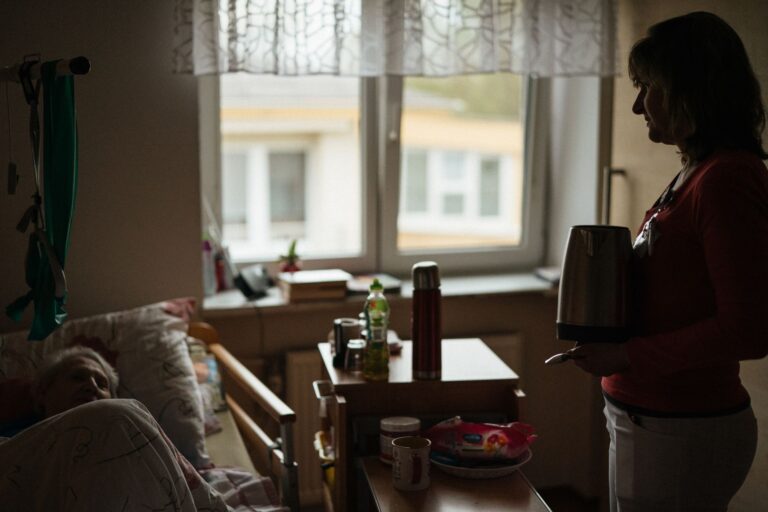
Care facilities handle dementia behavior changes by starting with assessment—identifying what’s triggering the shift rather than treating the behavior as random. A resident who becomes aggressive after lunch might be responding to pain, overstimulation, or a change in routine, not to the dementia itself. Facilities that succeed at this first step—mapping the when, where, and what of a behavior—catch the actual cause and intervene there, rather than reflexively reaching for medication or restraint. The second critical step is environmental: adjusting lighting, noise levels, staffing ratios, or activity schedules often stops behavior changes before they escalate.
Documentation over time is how facilities spot patterns. If a resident becomes restless every Tuesday at 2 p.m., staff needs to notice and record it. Was it the day the grandson visited last week? Did a new staff member start? Is that when the unit gets loud during shift change? Real behavior management is detective work, not crisis response. Facilities with lower incident rates invest in observation first and interventions second.
Table of Contents
- What Triggers Behavior Changes in Dementia Residents?
- Assessment and Documentation—The Foundation of Response
- Environmental Modifications That De-escalate Behavior
- De-escalation Techniques and Communication Strategies
- Medication and Medical Factors in Behavior Management
- Staff Training and Consistency
- Family Partnership and Communication About Behavior Changes
- Frequently Asked Questions
What Triggers Behavior Changes in Dementia Residents?
Behavior changes in dementia are almost always communication. When a resident cannot use words to express discomfort, fear, or unmet needs, the body takes over. Pain is the most common hidden cause—a urinary tract infection, constipation, or arthritis flare will produce agitation or aggression in a person with dementia faster than in anyone else, because the person cannot vocalize the problem. A facility that checks for infection, medication side effects, and physical discomfort first, before assuming the behavior is “dementia acting up,” will resolve the majority of incidents without any behavioral intervention. Fear and environmental overstimulation are the second layer. A resident with dementia loses the ability to filter sensory input—a loud television, multiple conversations, strong smells, or bright fluorescent lights feel overwhelming rather than just background noise.
Moving to a quieter room, dimming lights, or reducing the number of people in the space often calms agitation instantly. A resident who becomes combative during hygiene care might not be fighting the caregiver but reacting to the shock of cold water or the confusion of being undressed without understanding why. Routine disruption and grief also trigger behavior changes that facilities frequently overlook. A resident whose daughter usually visits on Wednesday might become distressed and withdrawn on Thursday if the visit is canceled. Changed meal times, a new roommate, or a staff person leaving the facility can produce weeks of behavioral fallout. Facilities that maintain consistent routines and prepare residents for changes—even small ones—see fewer crisis moments.
Assessment and Documentation—The Foundation of Response
Effective assessment requires facilities to create a detailed behavior log that goes beyond “resident hit staff member.” The log needs to record the time, antecedent (what happened right before), the behavior itself, and the consequence (how staff responded and what happened next). A entry like “2:15 p.m., Mr. J. was asked to shower, became verbally aggressive, was offered juice and a break, calmed within 10 minutes” is actionable. “Behavior incident: aggressive” is not. Facilities often skip the medical workup and go straight to behavioral labels.
A diagnosis of “sundowning” or “challenging behavior” becomes an excuse to avoid investigating underlying causes. The limitation here is that assessment takes time—it requires staff to observe closely, ask family questions about what the resident was like before dementia, and coordinate with medical providers. A busy facility might document the bare minimum and move on. The best facilities treat assessment as ongoing: every behavior change is logged, patterns are reviewed weekly, and the plan is adjusted based on what the data shows, not on assumptions. Family history is critical data that staff rarely gather thoroughly. A family member might mention that the resident always hated crowded spaces, was a night owl, or had undiagnosed anxiety—information that shapes how staff approaches the resident forever. Facilities that conduct detailed admission interviews with family and transfer that insight to care plans see immediate reductions in conflict.
Environmental Modifications That De-escalate Behavior
The physical environment is a behavior-management tool that works before staff intervention is needed. Residents with dementia do better in spaces with soft, warm lighting (fluorescent overhead lights produce more agitation); familiar furnishings and photos; and lower noise levels. A unit redesigned to reduce echoing, separate common areas from high-traffic zones, and provide quiet retreat spaces will have fewer behavioral incidents simply because the space is less stressful to navigate. Staffing ratios directly impact behavior. A unit staffed at one caregiver per ten residents will see more behavioral crises than one staffed at one per six, because residents with dementia respond acutely to the feeling that they are not safe or not being heard. When a facility is short-staffed, residents become more agitated, staff become more reactive, and incidents accelerate.
This is a hard constraint: understaffed units will have more behavior problems regardless of how good the training is. Some facilities accept this as a cost trade-off; the best ones do not. Activity and engagement matter more than most facilities assume. A resident with nothing to do all day will create activity through agitation. Facilities that offer consistent, person-matched activities—whether that is reminiscence work, structured crafts, music, or one-on-one engagement—see significant reductions in challenging behavior. This is not entertainment; it is neurological. Activity engages the resident in the present moment and reduces the internal distress that drives behavior.
De-escalation Techniques and Communication Strategies
When a behavior change is happening in real time, staff response matters enormously. Yelling back, arguing, or using force escalates almost every situation. De-escalation begins with tone—calm, slow speech; a lowered voice; and gentle body language. A staff member who stands at eye level, keeps hands visible, and speaks in short, simple sentences de-escalates faster than one who stands over the resident, uses complex language, or makes sudden movements. Validation is a technique that works even when the resident’s stated reason for distress doesn’t make logical sense. If a resident says “I need to pick up my children from school,” arguing that the children are adults now is useless. Acknowledging the emotion—”You’re worried about your children.
That matters to you”—without confirming the false belief often calms the resident. Redirection follows: “Let’s sit here while we wait for them” or “I know they’re important to you. What was your favorite time with them?” This is not lying; it is communicating in the resident’s reality. Offering choices gives residents a sense of control, which reduces resistance. Instead of “You need to get washed,” try “Would you like to wash up now or after breakfast?” or “Do you want hot or cold water?” The choice itself—even between two staff-approved options—often eliminates the conflict. A limitation is that this takes more time than directive care, and facilities under time pressure often skip it. The payoff is less resistance and fewer restraint situations over time.
Medication and Medical Factors in Behavior Management
Medications are frequently the hidden cause of behavior changes or are used as a first-line response when they should not be. Antipsychotics and sedating medications can mask agitation but also cause side effects—falls, stroke risk, and oversedation—that create new problems. A facility that medicates every behavior without first ruling out medical causes or trying non-pharmacological approaches is practicing reactive care, not preventive care. A resident on a new blood pressure medication might become confused or agitated due to a drop in blood pressure, not due to dementia progression. A resident with a urinary tract infection will behave dramatically differently once treated—the infection, not the dementia, was driving the behavior.
Facilities need partnerships with physicians who understand dementia and will investigate before prescribing. A warning: some healthcare providers over-prescribe psychiatric medications to dementia residents because behavioral control is easier than investigation. Families and care facility staff must push back and ask, “What medical cause have we ruled out?” before accepting a new medication. When medication is appropriate—for example, for a resident with untreated anxiety or depression that predated the dementia—it should be part of a larger plan that includes environmental changes and behavioral strategies, not a replacement for them. Medication alone rarely fixes behavior; it works best alongside other interventions.
Staff Training and Consistency
Staff who understand dementia pathology and have practiced de-escalation techniques create fewer incidents. A facility that invests in ongoing training—not just once-a-year orientation—sees staff confidence rise and behavioral crises drop. Staff trained in validation techniques, redirection, and the medical causes of behavior react differently to agitation than untrained staff, who often interpret behavior as willful or rude. Consistency across shifts is critical.
If the night shift responds differently to the same behavior than the day shift, the resident is confused about what is expected and will test more. A unified response—the same de-escalation approach, the same routine, the same environmental setup—reduces the resident’s uncertainty and lowers their baseline anxiety. This requires documented protocols and regular team communication. Facilities that brief staff at shift change about which residents had difficult nights and what worked see fewer daytime escalations.
Family Partnership and Communication About Behavior Changes
Families often misinterpret behavior changes or feel blamed when a facility reports them. A facility that frames behavior changes as information—”Your mother became very restless during afternoon care today; we’re investigating what might be causing it”—rather than as a problem—”Your mother is being difficult”—keeps families as allies instead of adversaries. Regular, proactive communication prevents families from learning about issues only during crisis calls.
Facilities benefit from asking families to help solve the behavior puzzle. A family member might recognize a pattern: “She hates that time of day because she used to teach morning classes” or “He becomes agitated when he hears that particular alarm sound.” This context, held by family and lost in medical records, is gold for staff. A facility that incorporates family insight into behavior management plans and documents the solutions sees better outcomes and stronger family satisfaction.
- —
Frequently Asked Questions
What is the most common cause of behavior changes in dementia residents?
Pain and medical conditions like urinary tract infections are the most common causes, followed by environmental overstimulation and routine disruption. Many facilities check for behavioral or psychiatric causes first when they should always rule out medical issues first.
How should staff respond when a resident becomes aggressive?
De-escalation begins with calm tone, slow speech, and validation of the emotion. Offering choices and redirecting to a preferred activity often stops the conflict. Arguing, raising your voice, or using force almost always makes it worse.
Is medication the answer to dementia behavior problems?
Medication can be one part of a plan, but it should never be the first response. Medical causes, environmental changes, and behavioral strategies should be tried first. Over-medication masks the underlying problem and creates new side effects.
Should families be told about every behavior incident?
Yes, but framed as information gathering, not blame. Regular communication about patterns helps families provide insight and feel included in the care plan, not blindsided by crisis calls.
Can behavior changes be prevented?
Many can be prevented through consistent routines, adequate staffing, attention to the physical environment, and daily engagement activities. Medical conditions should be caught early before they escalate into behavioral crises.
What role does documentation play in behavior management?
Detailed documentation of when, where, and what happened before the behavior reveals patterns that guide intervention. Without documentation, staff respond to each incident separately instead of recognizing underlying causes.