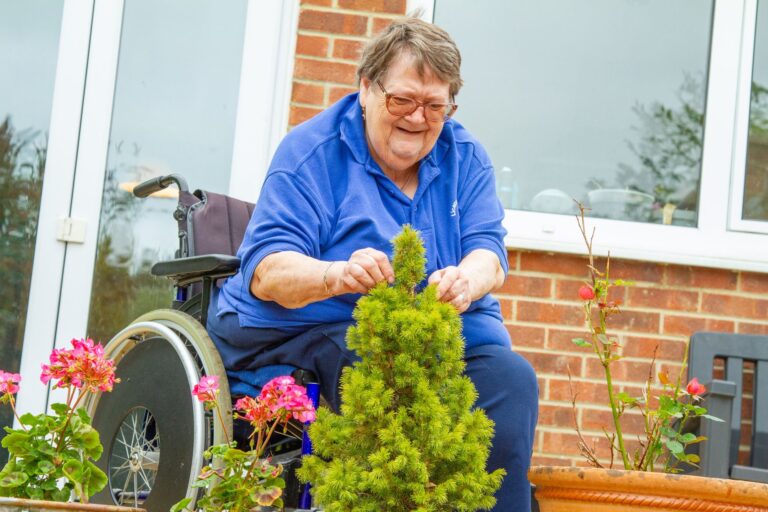
A simple baking session fits well once or twice a week on a dementia activity calendar, with daily food-related tasks filling the gaps between. That weekly rhythm comes from the two intervention studies that tested cooking and baking directly, not from a fixed rule anyone has set for dementia care. The right number still depends on the person and the day. Caregivers can treat baking as one recurring anchor activity and use shorter food-prep tasks — washing fruit, stirring batter, setting a table — on the days in between.
Medical information disclaimer: This article is for general educational purposes only and does not provide medical advice, diagnosis, or treatment. Always consult a physician or other qualified health professional about symptoms, medications, tests, or treatment decisions.
Table of Contents
- What the research actually tested
- What weekly baking changed for participants
- Building baking into a weekly calendar
- Safety steps every baking slot needs
- Matching frequency to the person's stage and tolerance
What the research actually tested
The clearest evidence comes from a 2017 randomized controlled trial by Murai and Yamaguchi, which assigned 36 dementia-care facility residents (mean age 85.4) to either weekly 90-minute group cooking classes or recreation-only sessions for 12 weeks, with both groups also getting standard rehab twice a week, according to the trial published in Progress in Rehabilitation Medicine. That's once a week, not daily, and it ran for three full months before the results were measured. A separate 2020 Korean study by Lee and Lee took a different frequency entirely: a dedicated baking-and-pastry program ran for ten dementia daycare attendees over roughly two months (January 2 to February 28, 2017), compared against nine non-participating controls, as reported in the Journal of the Korea Academia-Industrial Cooperation Society.
That study reported a statistically significant cognitive-function improvement in the baking group, but it didn't isolate how many sessions per week produced that result — only that a sustained program over two months did. A third study, by Gigliotti, Jarrott, and Yorgason, tested a much higher frequency: cooking, craft, and planting sessions three times a week for nine weeks at a community adult day program, with each task broken into simple steps so participants could complete at least one step even with help, according to their findings in Dementia: The International Journal of Social Research and Practice. So the frequency that's actually been tested ranges from once weekly to three times weekly, depending on the program.
What weekly baking changed for participants
In the Murai and Yamaguchi trial, the weekly-cooking group's behavioral-disturbance score improved from 21.6±12.2 to 11.4±11.5 over the 12 weeks (P<0.001), while the control group showed no improvement at all, according to the same trial. The control group's executive-function score, measured with the Yamaguchi Kanji Symbol Substitution Test, actually got significantly worse over the same period — meaning the weekly cooking sessions didn't just help, their absence coincided with decline. That same trial found no significant difference between groups on its other cognitive measures.
In practical terms, once-weekly cooking sessions were linked more reliably to steadier behavior and preserved executive function than to broad gains in memory or overall cognition, per the trial. The three-times-weekly program measured a different outcome: participants spent less time idle and showed more positive affect during cooking, craft, or planting sessions than during the center's traditional activities, with no meaningful difference in benefit between the three task types, according to the Dementia journal study. That suggests frequency matters less than the activity being hands-on and achievable — the benefit showed up whether the task was baking, a craft, or planting.
Building baking into a weekly calendar
A practical calendar can borrow the shape of the tested programs rather than inventing a new frequency. A few starting points: Neither the Alzheimer's Association guide nor the Irish planner sets a fixed weekly count for food preparation or baking. Both treat it as one rotating option among several — gardening, music, folding laundry — rather than a task with its own required frequency.
- Anchor one or two sessions a week around a simple baking task — mixing, rolling, or decorating something that doesn't require precise timing or oven handling by the person with dementia.
- Fill other days with shorter food-related tasks (washing produce, folding napkins, setting the table) rather than repeating baking daily.
- Time the session to when the person functions best during the day, since the Alzheimer's Association's "Activities at Home" guide notes that sustained focus is difficult for people in middle and late stages.
- Keep sessions short rather than long. The Alzheimer Society of Ireland's weekly activity planner cites the WHO benchmark that even 10-minute sessions can be worthwhile when attention is limited.
Safety steps every baking slot needs
Every baking session on the calendar still requires a caregiver present the entire time — this isn't a task to hand off as independent activity. The Alzheimer's Association's kitchen-safety guidance recommends: These steps apply regardless of whether baking happens once a week or three times a week. The frequency decision is about engagement and routine; the safety setup is the same every time.
- Locking away knives and sharp tools before the session starts.
- Removing stove knobs when the stove isn't actively supervised.
- Turning pan handles toward the center of the stovetop, out of reach.
- Using auto-shut-off appliances wherever possible.
Matching frequency to the person's stage and tolerance
No single frequency is recommended across every stage of dementia, and the three studies cited above used three different schedules. The better approach is starting with one session a week, watching how the person responds — whether they engage, grow frustrated, or seem calmer afterward — and adjusting from there.
The Gigliotti, Jarrott, and Yorgason program showed that breaking a task into simple steps let participants with a range of abilities succeed at completing at least one step, even when they needed physical or verbal help, according to their study. That principle matters more than hitting a specific number of sessions: a baking task simplified to one or two manageable steps can work into a calendar more often than a complex one, simply because each session asks less of the person.