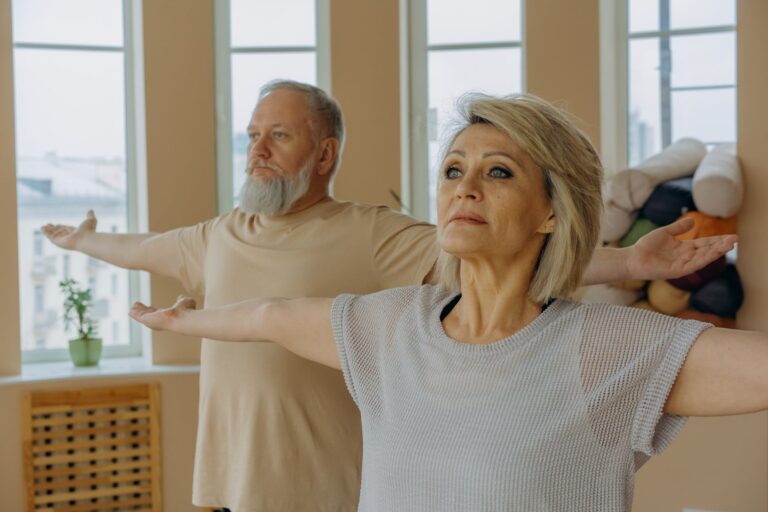
Group chair yoga has evidence of emotional benefits for some care-home residents with dementia, while one-on-one sessions may help residents who struggle to join a class. No trial has directly compared these formats in a dedicated memory-care unit, so individual delivery should be viewed as an access adaptation—not a proven superior treatment. Chair yoga adapts yoga movements, breathing, and relaxation so participants can remain seated. In memory care, the right format depends on the resident's abilities, response to groups, health risks, and likelihood of attending consistently.
Medical information disclaimer: This article is for general educational purposes only and does not provide medical advice, diagnosis, or treatment. Always consult a physician or other qualified health professional about symptoms, medications, tests, or treatment decisions.
Table of Contents
- What does the group evidence show?
- When does a group class fit?
- When might one-on-one chair yoga help?
- How should a memory-care team choose?
- Set realistic expectations and safeguards
What does the group evidence show?
A 2024 University of Hertfordshire study included care-home residents with mild-to-severe dementia. Seventeen residents received 30- to 45-minute group sessions twice weekly for eight weeks; 16 residents in two other homes received assessments only. Participants in chair yoga improved in anxiety, depression, and negative affect compared with controls.
Balance confidence and health-related quality of life did not change, according to the University of Hertfordshire care-home study. These results make group chair yoga a reasonable option for emotional well-being and enjoyable activity. They do not show that it improves mobility, prevents falls, or broadly raises quality of life.
When does a group class fit?
A group may suit residents who can tolerate shared activity, follow repeated demonstrations, and remain engaged for much of a short session. The format may also provide enjoyment, stimulation, purpose, and a sense of social inclusion. Attendance is a practical test of fit.
In the 2024 study, 17 qualifying participants averaged 80.5% attendance. Eight of 26 attendees fell below the required 55% because of illness, appointments, emergencies, avoidance, lethargy, or forgetting earlier sessions. Staff should therefore look beyond whether a resident can complete the movements. A workable group program must also account for memory, motivation, competing care needs, and changes in health.
When might one-on-one chair yoga help?
Individual sessions may be more accessible for someone who becomes distressed, distracted, withdrawn, or overwhelmed in a group. They also allow the instructor to slow the pace, repeat one direction at a time, and offer breaks around that resident's needs. In a qualitative University of Hertfordshire study, three activity staff members suggested one-on-one sessions might better suit residents with more severe dementia.
However, this was staff feedback—not evidence of better clinical outcomes. The same study's residents associated the program with inclusion, enjoyment, purpose, stimulation, and relaxation, as described in the care-home chair-yoga report. Use individual delivery when it removes a barrier to participation. Do not assume it will produce stronger emotional, physical, or cognitive effects than a group class.
How should a memory-care team choose?
Start with the least restrictive format the resident can comfortably use, then adjust it according to observed responses. A resident may also need a flexible combination: regular group classes on receptive days and brief individual sessions when joining the group is not manageable.
- Try a small, predictable group when the resident accepts shared activities and can follow demonstrations.
- Try one-on-one delivery when noise, waiting, complex instructions, or other participants interfere with engagement.
- Shorten the session or add breaks when attention, energy, or comfort declines.
- Keep the timetable, setting, instructor, and sequence as consistent as practical.
- Record attendance, refusals, distress, enjoyment, and participation rather than judging success by movement accuracy alone.
Set realistic expectations and safeguards
Chair yoga should not be presented as a stand-alone answer to loneliness or mobility problems. In a small remote group study, researchers reported no injuries or other adverse events, but found no significant improvements in pain interference, mobility, sleep, or social loneliness. Emotional loneliness increased during the pandemic, according to the Florida Atlantic University-led study.
Both formats require individual planning. The Alzheimer's Society dementia-friendly activity guide advises providers to assess risks individually, adapt the activity's type and intensity, use shorter classes or breaks, maintain a consistent schedule, and demonstrate or repeat instructions. Before the first session, document the resident's risk assessment, suitable session length, needed breaks, instruction style, and the signs that mean the activity should pause.