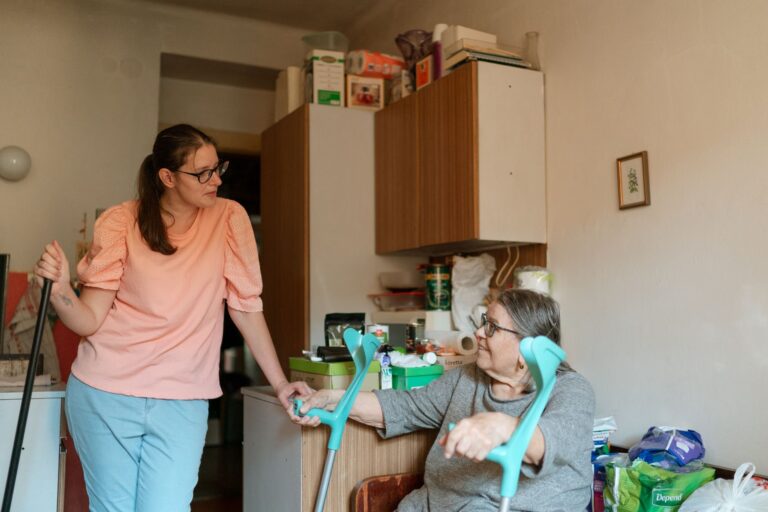
Yes—guided walking, meaning individualized walking with an accompanying caregiver, can be practical for ambulatory people with moderate or advanced dementia. It may support well-being, but it has not been shown to improve cognition or control wandering. Whether it is appropriate depends more on walking ability and safety than on the dementia label alone. The plan should change when balance, mobility, or understanding declines.
Medical information disclaimer: This article is for general educational purposes only and does not provide medical advice, diagnosis, or treatment. Always consult a physician or other qualified health professional about symptoms, medications, tests, or treatment decisions.
Table of Contents
- What benefits can families reasonably expect?
- Does walking help with wandering or sleep?
- Can people with advanced dementia participate?
- How should caregivers decide?
- When walking is no longer appropriate
What benefits can families reasonably expect?
A randomized trial assigned 97 nursing-home residents with moderate dementia to 30-minute walks, five days a week, for six weeks. Walking was feasible, but it produced no significant cognitive benefit compared with the control condition, according to the 2009 International Psychogeriatrics study.
The strongest reason to try guided walking may be comfort rather than cognitive improvement. In a separate trial involving 81 nursing-home residents, individualized walking for up to 20 minutes daily improved anxiety and quality of life, according to The Gerontologist. Strength-and-balance training improved physical performance more than walking alone.
Does walking help with wandering or sleep?
planned walking is not an established way to prevent dementia-related wandering. A U.S.
Department of Veterans Affairs review found two randomized trials in which exercise or walking did not affect wandering. The broader evidence was inconsistent because studies differed in exercise intensity, dementia severity, and measured outcomes. Longer sleep and fewer nighttime awakenings were the most consistent findings in the VA evidence review, but those results do not guarantee better sleep for an individual.
Can people with advanced dementia participate?
Some people with advanced dementia can still take part if they remain ambulatory and accept guidance. A cluster-randomized nursing-home study of people with severe cognitive impairment reported greater activity and function, with falls affecting 28% of participants versus 50% of controls.
That finding supports structured physical and functional activity, not walking for everyone. A person who cannot follow a route may still manage a brief, familiar walk with close support, while another person may need a different activity.
How should caregivers decide?
Begin with an individualized safety assessment, then match the walk to the person's current ability. Practical safeguards recommended by the Alzheimer's Society include supervision, familiar routes, suitable footwear, and fall-risk reduction.
Before each walk, check: Do not treat a fixed distance or schedule as the goal. An individualized walk may last only as long as the person remains able to participate safely.
- Can the person stand and walk with their usual level of help?
- Are the route and duration familiar and manageable?
- Is suitable footwear available?
- Can a caregiver remain close enough to assist?
- Would strength-and-balance activity better address the person's physical needs?
When walking is no longer appropriate
People who can no longer walk—common in late-stage Alzheimer's disease—need a different plan. The National Institute on Aging documents clinician-guided safe transfers and range-of-motion movement as appropriate alternatives to walking.
Ask a clinician to show caregivers how to perform those movements safely. If the person can no longer bear weight or walk with their usual assistance, pause the walking program and request guidance on transfers and range-of-motion movement.