Brain stimulation sits at the center of this dementia and brain health question.
The Brain Stimulation Collaboratory represents a significant shift in how clinicians approach Alzheimer’s disease care. Developed through a partnership between Cognito Therapeutics and Ochsner Health, this new initiative combines non-invasive neurotechnology with clinical oversight to deliver treatment directly in patients’ homes, moving care beyond traditional office visits and pharmaceutical interventions alone.
Rather than waiting for disease progression, the collaboratory uses synchronized light and sound stimulation to actively promote healthy neural activity—a fundamental change in philosophy that treats Alzheimer’s as something that can be actively managed through brain health optimization, not just symptom suppression. The collaboratory integrates Cognito’s Spectris™ platform with a comprehensive tracking system called the Brain Health Index, designed to monitor cognitive performance and disease progression in real-world settings. This article explores how this partnership works, what the underlying science shows, where the technology is available, and how it fits alongside existing approved treatments for cognitive decline.
Table of Contents
- What Is the Brain Stimulation Collaboratory and How Did It Start?
- How Spectris™ Delivers Brain Stimulation at Home
- The Research Foundation Behind 40Hz Stimulation
- Geographic Reach and Real-World Implementation
- How 40Hz Stimulation Compares to Other FDA-Approved Brain Stimulation Methods
- The Brain Health Index—Measuring What Matters
- Expansion and the Future of Collaborative Brain Care Models
- Conclusion
What Is the Brain Stimulation Collaboratory and How Did It Start?
The brain Health Collaboratory represents a structured partnership model that expands beyond a single institution. Cognito Therapeutics first launched this concept in November 2025 with West Virginia University’s Rockefeller Neuroscience Institute, demonstrating that specialized centers could deliver advanced brain stimulation care to both urban and rural patients. The Ochsner Health expansion brings this model to Louisiana, Mississippi, and surrounding areas—regions that have historically limited access to cutting-edge neurotechnology research and care.
What makes this collaboratory different from traditional clinical centers is its dual focus on research and real-world care delivery. Rather than treating patients in a research lab and then saying “we don’t know what happens when they go home,” the collaboratory framework explicitly designs for home-based treatment. Patients receive the Spectris platform at home, use it regularly, and their outcomes feed back into the research data stream. This creates a continuous feedback loop where real-world efficacy data informs care protocols, which then improve treatment outcomes for subsequent patients.
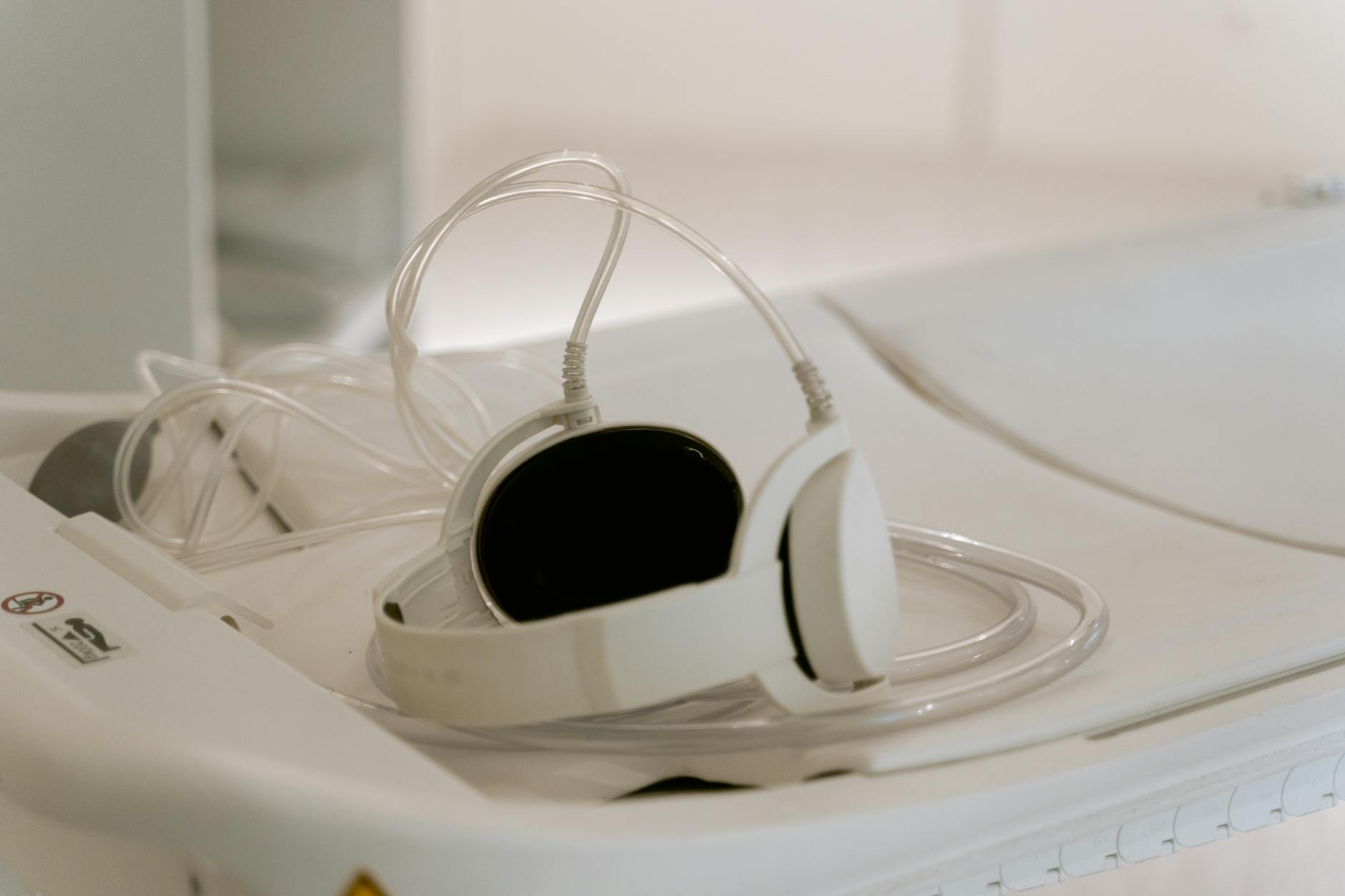
How Spectris™ Delivers Brain Stimulation at Home
The Spectris platform uses what researchers call 40Hz gamma stimulation—synchronized light and sound delivered at a frequency of 40 cycles per second. This specific frequency has become central to Alzheimer’s research because emerging evidence suggests it promotes healthy neural oscillations, the synchronized electrical activity that normally declines in cognitive aging. The device delivers this stimulation non-invasively, meaning no surgery, no implants, and no medication interactions. However, it’s important to understand that home-based neurotechnology requires commitment.
The treatment isn’t a passive process like taking a pill; patients must use the device regularly and consistently. The studies showing cognitive improvements and slowing of brain atrophy involved participants who maintained their treatment schedules. For patients or caregivers dealing with memory loss, maintaining that consistency can be challenging, which is why the collaboratory model pairs the technology with clinical oversight and monitoring rather than simply selling a device and expecting patients to manage it alone. Early phase II and phase III trial data shows the approach can slow cognitive decline compared to untreated controls, but this depends on actual usage patterns.
The Research Foundation Behind 40Hz Stimulation
The science supporting 40Hz gamma stimulation isn’t new, but it’s accelerating. MIT researchers have documented expanding evidence that this specific frequency promotes brain health, showing improvements in cognitive function and slowing of the brain atrophy that characterizes Alzheimer’s progression. Phase II and Phase III clinical trials have now moved beyond proof-of-concept into larger patient populations, with results indicating that consistent stimulation can produce measurable changes in cognitive testing and brain imaging.
What’s significant about these trials is that they show 40Hz works through a mechanism distinct from current Alzheimer’s medications. While approved drugs like aducanumab and lecanemab target amyloid-beta—the protein plaques associated with Alzheimer’s—40Hz stimulation appears to work by enhancing neural synchronization and potentially supporting the brain’s own cleanup mechanisms. This means the technology could potentially complement existing pharmacological treatments rather than replace them. A patient on an anti-amyloid medication could theoretically benefit from adding Spectris to their regimen, though more research is needed to establish optimal combination protocols.

Geographic Reach and Real-World Implementation
The Ochsner Health partnership explicitly targets both urban and rural communities across Louisiana, Mississippi, and surrounding areas. This geographic specificity matters because rural patients have historically been excluded from or delayed access to clinical innovations. Research infrastructure, specialist availability, and treatment centers cluster in urban areas, leaving rural patients with fewer options for advanced care. By building the collaboratory across this region, Cognito and Ochsner are attempting to close that gap.
Implementation in a real health system also introduces practical constraints that laboratory settings don’t face. The collaboratory must navigate varying insurance coverage, integrate with patients’ existing care teams, coordinate between neurology clinics and primary care, and manage the reality that some patients will have comorbid conditions—diabetes, hypertension, heart disease—that affect how they respond to treatment. The Ochsner partnership has the advantage of being a large integrated system, which theoretically allows better care coordination. However, even integrated systems face logistics challenges: scheduling devices for patients, ensuring training on consistent use, managing technical support, and tracking outcomes across multiple clinic locations is substantially more complex than running a single research site.
How 40Hz Stimulation Compares to Other FDA-Approved Brain Stimulation Methods
The FDA has already approved several non-pharmacological approaches for cognitive disorders. Transcranial Magnetic Stimulation (TMS) uses magnetic pulses to stimulate brain regions and has shown promise in clinical trials for mild cognitive impairment. Transcranial Direct Current Stimulation (tDCS) applies weak electrical currents directly to the scalp and shows potential to delay disease progression in some patients. Both are established methods with established safety profiles, but both require regular clinic visits to a center equipped with the appropriate hardware.
The 40Hz light-and-sound approach offers a potential advantage: home-based delivery without implants or intensive electrical stimulation. This could improve adherence and accessibility. However, the tradeoff is that evidence for 40Hz is newer and still emerging, whereas TMS and tDCS have longer clinical histories. For patients who have access to TMS or tDCS programs and can maintain regular clinic visits, those might remain preferable options, at least until 40Hz data accumulates further. The collaboratory model essentially says that 40Hz should be available as an option alongside these other methods, not as a replacement for them.

The Brain Health Index—Measuring What Matters
A key innovation within the collaboratory framework is the Brain Health Index, a tracking system designed to go beyond standard cognitive testing. Rather than just measuring memory or thinking speed in a clinic office once or twice a year, the index aims to capture how cognitive function changes in real time and in the patient’s actual environment. This could include digital cognitive assessments, biomarker tracking, disease progression markers, and treatment response indicators.
Why does this matter? Traditional cognitive testing has limitations. A patient might score the same on a Mini-Cog test in clinic but experience meaningful differences in daily function—managing medications, handling finances, remembering appointments. A comprehensive index that captures real-world cognitive performance, tracked longitudinally, gives both patients and clinicians a more honest picture of whether the treatment is actually working. For the collaboratory’s research mission, this data feeds back into understanding which patients benefit most from 40Hz stimulation and whether combinations with other treatments improve outcomes.
Expansion and the Future of Collaborative Brain Care Models
The collaboratory model itself—not just the technology—represents a shift toward distributed innovation in neurodegenerative disease care. Rather than concentrating cutting-edge treatment in a handful of research institutions, Cognito and partners are building networks where specialist-level care reaches patients closer to home and integrates with existing health systems.
If this model succeeds at Ochsner, expect similar partnerships to expand to other integrated health systems, potentially reaching the broader geographic disparities in dementia care. Looking forward, the collaboratory framework also positions participating centers to be natural research sites for new brain health interventions. As additional neurotechnologies emerge—graphene-based brain implants like those from InBrain Neuroelectronics, newer combinations of light and sound frequencies, AI-guided personalized stimulation protocols—the collaboratory infrastructure allows rapid evaluation of whether these innovations actually improve patient outcomes in real-world conditions, not just in laboratory studies.
Conclusion
The Brain Stimulation Collaboratory represents a meaningful advance in Alzheimer’s care by moving proven neurotechnology from research settings into clinical practice and from clinics into patients’ homes. By combining the Spectris platform with systematic outcome tracking through the Brain Health Index, the partnership between Cognito Therapeutics and Ochsner Health creates a model where treatment, data, and care coordination support each other.
For patients in Louisiana, Mississippi, and surrounding areas, this means access to a non-pharmacological approach with emerging evidence for slowing cognitive decline. For anyone with a dementia diagnosis or cognitive concerns, discussing the Brain Health Collaboratory with their neurology team makes sense as part of a comprehensive treatment plan—potentially alongside existing medications, lifestyle modifications, and other brain stimulation approaches. As data from this collaboratory accumulates, it will provide clearer answers about which patients benefit most, how to optimize results, and whether this model should expand to other regions and health systems.
You Might Also Like
- Harvard Researchers Optimistic About New Era in Alzheimer’s Care
- Caregiver Education Conference Launches in Partnership With Alzheimer’s Groups
- Texas Researchers Develop New Approaches to Prevent Alzheimer’s
For more, see Alzheimer’s Association — medical tests.