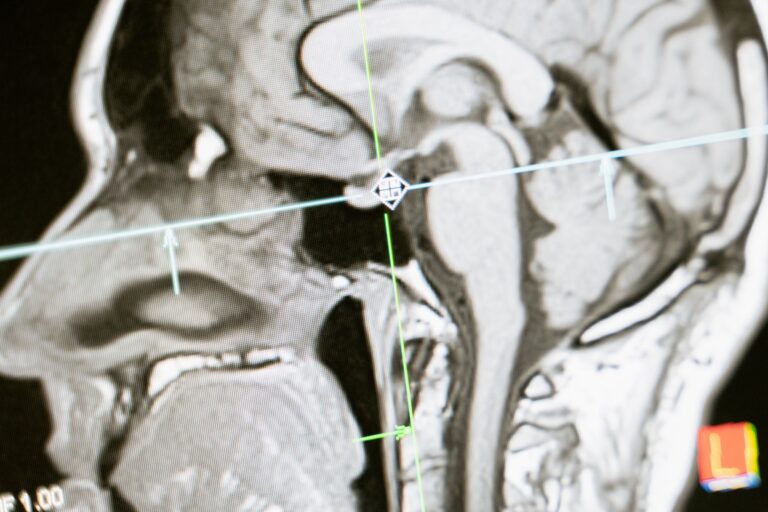
At the AD/PD 2026 Conference in Copenhagen (March 17-21), Anavex Life Sciences presented clinical data demonstrating that oral blarcamesine preserves brain volume in early Alzheimer’s disease while slowing cognitive decline. The key finding: patients treated with blarcamesine showed 77.4 weeks (approximately 18 months) of preserved cognitive function compared to controls after 144 weeks, with MRI imaging revealing a strong structural correlation supporting this clinical benefit. This represents one of the first drug programs to show a measurable, consistent link between actual brain volume preservation and real-world cognitive improvement in Alzheimer’s patients.
Professor Dr. Timo Grimmer presented these results from the AD-004 Phase IIb/III trial, which included a precision medicine sub-analysis that revealed an even more promising signal: patients carrying wild-type variants of the SIGMAR1 and COL24A1 genes showed substantially greater clinical and structural benefit. For the dementia care field, this finding matters because it suggests Alzheimer’s treatments may work differently depending on individual genetic makeup—a shift toward personalized medicine rather than one-size-fits-all approaches. This article explores what brain volume preservation actually means for patients, why the genetic findings matter, how blarcamesine’s mechanism differs from other Alzheimer’s drugs in development, and what these data suggest about the future of early Alzheimer’s treatment.
Table of Contents
- Why Does Brain Volume Matter in Alzheimer’s Disease?
- Understanding the 77.4-Week Cognitive Benefit—What It Actually Represents
- The ABCLEAR32 Precision Medicine Finding and Genetic Screening
- How Blarcamesine’s Mechanism Differs From Other Alzheimer’s Drugs
- Interpreting the Biomarker-Clinical Correlation Improvement
- What These Data Mean for Current Alzheimer’s Patients and Caregivers
- The Broader Outlook for Alzheimer’s Treatment and Precision Medicine
- Conclusion
Why Does Brain Volume Matter in Alzheimer’s Disease?
brain volume loss is a hallmark of Alzheimer’s disease progression. As neurons die, the hippocampus and cortex shrink measurably on MRI scans—a process that correlates with cognitive decline. Most Alzheimer’s drugs have slowed this shrinkage only modestly or not at all, making blarcamesine’s demonstrated brain volume preservation noteworthy. The correlation improvement Anavex reported is quantifiable: in the ABCLEAR32 precision medicine population, the relationship between brain volume preservation and cognitive improvement strengthened from an R² of 0.23 to 0.41 for the ADAS-Cog13 cognitive scale, an improvement of 78%.
What this means in practice: if a doctor observes a patient’s brain volume holding steady on annual MRI scans while their cognitive scores stabilize or improve, that’s typically a positive sign the treatment is working at a structural level, not just temporarily masking symptoms. Most Alzheimer’s treatments either slow cognitive decline modestly or don’t preserve brain structure; blarcamesine appears to do both simultaneously. The limitation here is important: correlation is not the same as causation. The data shows that brain volume preservation and clinical improvement move together in blarcamesine-treated patients, but it doesn’t definitively prove one causes the other. Some researchers might argue the genetic background (SIGMAR1 and COL24A1 variants) is the true driver, with brain volume and cognition both responding to the drug’s underlying mechanism.

Understanding the 77.4-Week Cognitive Benefit—What It Actually Represents
The headline figure—77.4 weeks of preserved cognitive decline over 144 weeks—requires careful interpretation. This doesn’t mean treated patients gain 18 months of perfect memory or reversed cognitive loss. Instead, it means their cognitive decline trajectory was significantly slower than the control group’s over the three-year trial period. If an untreated Alzheimer’s patient typically loses 8 points on the ADAS-Cog13 scale over three years, a blarcamesine-treated patient in this trial might have lost only 2-3 points, translating to the observed weeks of “saved” cognitive decline when measured against natural disease progression rates. The AD-004 trial tracked patients with early Alzheimer’s disease, not advanced stages.
This is a crucial distinction because early disease is more amenable to treatment—there’s more brain tissue preserved and more cognitive function to protect. A patient diagnosed at the mild cognitive impairment stage, who receives blarcamesine early, might experience a meaningfully different disease trajectory than someone who starts treatment later. Real-world outcomes depend heavily on when the drug is given relative to disease stage. However, trial data from controlled studies doesn’t always translate one-to-one to clinical practice. The 144-week benefit assumes patients remained compliant with oral medication for the full three years, which is challenging in Alzheimer’s disease where cognitive decline can affect medication adherence. Additionally, the trial enrolled patients at a specific disease stage meeting precise diagnostic criteria, so benefits in routine clinical settings may differ from research settings.
The ABCLEAR32 Precision Medicine Finding and Genetic Screening
Anavex’s most striking secondary finding emerged from the ABCLEAR32 sub-analysis: patients carrying wild-type (normal) variants of the SIGMAR1 and COL24A1 genes showed “substantially greater” clinical and structural benefit than the broader trial population. This genetic signal suggests that not all Alzheimer’s patients will respond equally to blarcamesine, and pre-treatment genetic testing might identify who is most likely to benefit. This represents a fundamental shift in Alzheimer’s drug development. Rather than launching a treatment and hoping it works for everyone, blarcamesine data suggests a path toward precision medicine: “If a patient carries wild-type SIGMAR1 and COL24A1 variants, blarcamesine may preserve brain volume and slow cognitive decline.
Without these genetic markers, the benefit may be smaller.” This approach allows neurologists and memory clinics to tailor treatment recommendations based on individual biology, much like how genetic testing now guides cancer treatment selection. The practical limitation is that genetic screening infrastructure for Alzheimer’s is not yet standard in most memory clinics. While the test itself is straightforward—a blood test or saliva sample—most neurology practices don’t routinely order SIGMAR1/COL24A1 testing. If blarcamesine advances toward FDA approval, this could catalyze faster adoption of precision diagnostics in the Alzheimer’s field, but that adoption lag is real and affects how quickly patients could access treatment optimized for their genetics.

How Blarcamesine’s Mechanism Differs From Other Alzheimer’s Drugs
Blarcamesine is a selective sigma-1 (σ1) receptor agonist—a different target from the amyloid and tau approaches dominating Alzheimer’s drug development. Anavex’s hypothesis is that activating the sigma-1 receptor helps cells survive neuronal stress, reduces neuroinflammation, and potentially preserves synaptic function. This mechanism doesn’t directly target amyloid or tau plaques but instead attempts to make neurons more resistant to the damage those proteins cause. This differs sharply from recent FDA approvals like aducanumab and lecanemab, which target amyloid-beta directly by trying to clear the protein from the brain. Those monoclonal antibodies require intravenous infusions every 2-4 weeks and carry the risk of amyloid-related imaging abnormalities (ARIA)—microhemorrhages or microinfarcts detected on MRI.
Blarcamesine, being an oral tablet, avoids infusion burden and appears to have a cleaner safety profile based on trial data so far, though head-to-head comparisons don’t exist yet. The tradeoff is fundamental: amyloid-targeting drugs directly attack what many researchers believe is the root cause of Alzheimer’s. Sigma-1 agonists like blarcamesine work downstream, protecting neurons from damage. If amyloid is the culprit, targeting it earlier (before substantial brain damage) might be more effective. If neuronal resilience is the bottleneck even with amyloid present, blarcamesine’s mechanism may shine. Real patients may eventually benefit from both approaches combined.
Interpreting the Biomarker-Clinical Correlation Improvement
The 78% improvement in R² correlation (from 0.23 to 0.41 for ADAS-Cog13) deserves close scrutiny. This metric measures how tightly brain volume preservation tracks with cognitive improvement in patients taking blarcamesine. A higher R² means brain imaging findings (MRI brain volume) and cognitive test scores (ADAS-Cog13) move together more predictably—both get better or both hold steady, rather than diverging. Why this matters: historically, some Alzheimer’s drugs have shown cognitive benefits on tests without corresponding brain volume preservation on MRI, raising questions about whether improvements are real or merely behavioral/testing artifacts. Conversely, some compounds preserve brain volume on imaging without translating to meaningful cognitive benefit for patients.
Blarcamesine’s strengthened biomarker-clinical correlation suggests the drug’s benefit is “real” at both the structural (brain imaging) and functional (cognitive testing) levels, not an artifact of one measurement system. A critical limitation: correlation does not prove the relationship holds in all patients or that it will persist long-term. The 144-week trial provides evidence up to approximately 2.8 years; whether brain volume preservation and cognitive stability persist for 5, 10, or 20 years is unknown. Additionally, the ABCLEAR32 sub-group represents only a subset of trial participants—those carrying specific genetic markers. Whether the strong correlation holds in the broader, genetically mixed Alzheimer’s population remains unclear from these presented data.

What These Data Mean for Current Alzheimer’s Patients and Caregivers
For someone diagnosed with early Alzheimer’s disease today, Anavex’s AD/PD 2026 presentation is relevant context for future treatment conversations but not an immediate game-changer. Blarcamesine remains investigational and has not yet received FDA approval. The trial shows promise, but regulatory pathways remain, and availability is likely 1-2 years away at minimum, pending FDA review and manufacturing.
For caregivers and family members, the data reinforce an evidence-based principle: early diagnosis and early treatment initiation appear critical. Blarcamesine’s benefits were demonstrated in early Alzheimer’s disease, not advanced stages. A family member noticing cognitive decline should pursue formal neuropsychological testing sooner rather than later, ensuring that if effective treatments become available, the patient is identified early enough to benefit.
The Broader Outlook for Alzheimer’s Treatment and Precision Medicine
Anavex’s presentation at AD/PD 2026 reflects a broader shift in Alzheimer’s treatment strategy. For decades, the field pursued amyloid as the primary target, with limited clinical success. Recent approvals of amyloid-targeted monoclonal antibodies represent progress, but they are infusion-based, expensive, and carry safety risks. Blarcamesine and other neuronal resilience approaches offer an alternative avenue: oral tablets targeting different mechanisms, potentially for patients who don’t respond to amyloid-targeting therapies or cannot tolerate them.
The precision medicine angle—identifying patients most likely to benefit based on genetic screening—is equally significant. Future Alzheimer’s treatment will likely involve a combination: genetic testing at diagnosis, stratified treatment recommendations, regular MRI and cognitive monitoring, and potential combination therapies targeting multiple pathways. This complexity is challenging but represents medicine moving toward individualized, biology-guided care rather than population-wide approaches. If blarcamesine gains approval and real-world use, it could accelerate adoption of sigma-1 agonist research and precision genetic screening throughout the neurology field.
Conclusion
Anavex’s presentation of brain volume preservation data from the AD-004 trial at AD/PD 2026 demonstrates that oral blarcamesine can slow cognitive decline in early Alzheimer’s disease while preserving measurable brain volume on MRI scans. The correlation between structural brain imaging and clinical cognitive improvement strengthened by 78% in the precision medicine sub-group carrying wild-type SIGMAR1 and COL24A1 variants, suggesting a path toward genetically-informed treatment selection.
While regulatory approval and real-world availability remain ahead, these data contribute meaningfully to the growing evidence that Alzheimer’s treatment is shifting toward precision medicine, combination approaches, and non-amyloid mechanisms. For patients and families navigating early cognitive concerns, the takeaway is straightforward: pursue early diagnosis and connect with memory specialists who stay current with emerging treatments, so that future options are accessible at the stage when they are most likely to help.