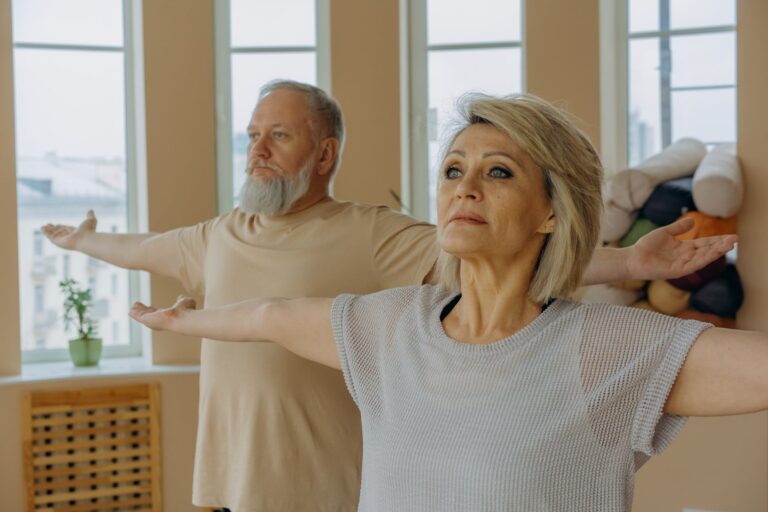
To do chair yoga with a person who has dementia, use a stable chair, begin with breathing, demonstrate one seated movement at a time, and finish with relaxation. Match the routine to the person's abilities, comfort, and attention instead of trying to complete every step. Here, chair yoga means breathing, gentle movement, and relaxation performed while seated or using a chair for support. Caregivers can practice alone for self-care or make it a shared activity with the person they support.
Medical information disclaimer: This article is for general educational purposes only and does not provide medical advice, diagnosis, or treatment. Always consult a physician or other qualified health professional about symptoms, medications, tests, or treatment decisions.
Table of Contents
- Decide whether chair yoga fits today
- Prepare the chair and space
- Follow a simple chair-yoga sequence
- Adapt the session for dementia
- Know when to stop and what the evidence means
Decide whether chair yoga fits today
Consider the person's alertness, mobility, mood, and interest before starting. The Alzheimer's Association recommends choosing activities that reflect current abilities and personal preferences rather than focusing on performance or past skill level in its guidance on dementia-friendly activities.
Offer an invitation, not a demand: "Would you like to sit with me and stretch?" If the person appears tired, distressed, or uninterested, try another time or choose a familiar activity instead. A shared session can be practical at home. The Alzheimer's Association includes seated exercise among the activities caregivers and people with dementia can do together.
Prepare the chair and space
Choose a flat, firm chair with a firm seat and backrest. Do not use a wheeled chair. Clear nearby objects that could catch a foot or restrict the caregiver's access. Ask the participant to sit tall near the front of the chair with both feet firmly on the floor.
This position comes from the CDC's fall-prevention exercise guidance. If sitting near the front feels unsteady, prioritize secure support rather than forcing that position. Keep needed items within reach and stay close enough to assist. arrange yourself where the person can easily see each demonstration.
Follow a simple chair-yoga sequence
Use calm, brief directions. Complete one step before introducing the next.
A dementia research program used about 10 minutes of breathing, 25 minutes of chair-based postures, and 10 minutes of guided relaxation. It combined flexibility, strength, balance, breathing, and relaxation, according to the 2019 study report. A home session can be shorter; preserve the same order and stop when attention or comfort declines.
- Settle: Invite the person to place both feet on the floor and rest their hands comfortably.
- Breathe: Guide a few easy breaths without asking for unusually deep or prolonged breathing.
- Demonstrate: Show one movement slowly, then invite the person to copy it.
- Lean gently: While inhaling, lean back only as far as comfortable. Exhale while returning upright.
- Pause: Check facial expression, breathing, balance, and willingness before continuing.
Adapt the session for dementia
Use single-step cues such as "feet on the floor" or "sit tall." Long explanations can make a simple movement harder to follow. Demonstrate first and allow extra time for a response. Treat participation broadly. Watching, breathing quietly, or completing only part of a movement can still be the session.
Avoid correcting small differences when the person remains comfortable and safe. Watch for frustration, distraction, or fading attention. Simplify the movement, offer hands-on assistance only when appropriate, or end on a calm note. Do not push the person to finish a planned routine.
Know when to stop and what the evidence means
Stop immediately if either participant feels pain, becomes unwell or dizzy, develops chest pressure, or feels unsteady. Anyone with health problems, injuries, concerning symptoms, or a recent major health event should seek a clinician's advice before starting. Yoga may also help caregivers manage some emotional effects of caregiving, but the evidence is not definitive.
A 2025 systematic review of eight studies involving 161 mostly female caregivers reported improvements in stress, anxiety, depression, quality of life, and self-compassion, but not caregiver burden; the studies had a moderate risk of bias. Chair yoga should therefore be treated as an adaptable activity, not a treatment or test of ability. If balance, symptoms, or recent health changes create doubt, pause the routine until a clinician advises whether and how to continue.