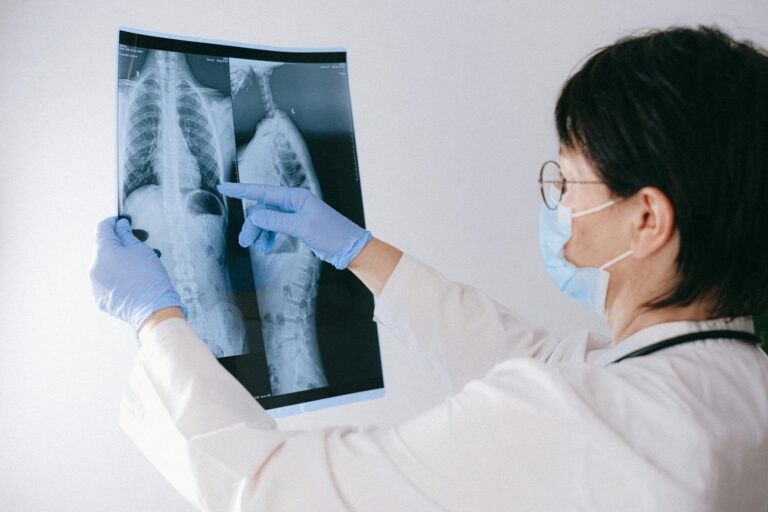
Lumbar spine degeneration—the gradual breakdown of discs and vertebrae in the lower back—happens to nearly everyone to some degree as they age. Doctors see six primary causes driving this process: natural disc water loss that accelerates after age 40, genetic predisposition that significantly influences degeneration speed, accumulated microtrauma from daily activities and biomechanical stress, smoking and reduced blood flow to spinal tissues, obesity combined with sedentary lifestyle increasing mechanical pressure, and hormonal changes in postmenopausal women. While aging itself is inevitable, understanding these specific causes helps explain why some people experience severe degeneration while others remain relatively unaffected well into their later years.
This article explores each cause in depth, examining how they work individually and in combination to affect the lumbar spine, along with what research shows about slowing their progression. The lumbar spine bears significant weight and handles repetitive stress throughout daily life, making it particularly vulnerable to age-related changes. A 55-year-old might notice persistent lower back pain that didn’t exist a decade earlier, attributing it simply to “getting older”—but the real story involves multiple specific biological and mechanical factors working together. Knowing these causes matters because some are modifiable while others are not; recognizing which category each falls into helps guide realistic expectations about prevention and management.
Table of Contents
- How Disc Water Loss Drives Degeneration With Age
- Genetic Predisposition as the Primary Risk Factor
- Accumulated Microtrauma and Biomechanical Stress
- Smoking’s Impact on Spinal Tissue Blood Flow and Healing
- Obesity, Sedentary Lifestyle, and Mechanical Overload
- Hormonal Changes and Postmenopausal Disc Degeneration
- Major Trauma and Injury History as Accelerants
- Conclusion
How Disc Water Loss Drives Degeneration With Age
Spinal discs function like shock absorbers between vertebrae, and their composition changes dramatically over a lifetime. At birth, intervertebral discs are approximately 80 percent water. This high water content gives them flexibility, resilience, and the ability to distribute forces evenly across the vertebral bodies. As people age, discs gradually lose both water and protein content, becoming more brittle and less capable of absorbing shock. By age 40, imaging studies show that almost everyone has some measurable disc degeneration, even without symptoms. By age 60, the vast majority of people have disc changes visible on MRI, whether they experience pain or not. This water loss occurs through a combination of mechanisms.
The gel-like nucleus pulposus at the disc’s center becomes less hydrated, while the tough outer fibrous ring (annulus fibrosus) develops microscopic tears that allow remaining fluid to escape. The process accelerates as collagen and proteoglycans—proteins that hold water in the disc—break down over time. One critical point: this degeneration can progress asymptomatically for years, with people having significant structural changes yet feeling fine. However, once enough water loss occurs, the disc loses height, which changes how forces distribute through nearby joints and can trigger pain. The timeline varies considerably between individuals, which is where genetics and lifestyle factors become crucial. Someone with a sedentary job and poor posture may show more advanced disc water loss at 50 than an active person at 60. Conversely, a genetically predisposed person might show disc changes at 35 despite excellent habits. The water loss itself is not reversible in the traditional sense—you cannot fully rehydrate an aged disc—though physical therapy and activity can help slow further degeneration and improve how surrounding muscles support the spine.

Genetic Predisposition as the Primary Risk Factor
Genetic factors emerge from research as the strongest predictor of who will develop significant lumbar disc degeneration. Multiple genes affect both disc structure and inflammation response, determining how quickly discs age and how vulnerable they are to breakdown. Interestingly, genetic predisposition influences degeneration risk more substantially than environmental factors like occupation or exercise, which surprises many people who assume lifestyle choices dominate the outcome. If your parents or siblings experienced early disc degeneration, your own risk is considerably elevated, regardless of how carefully you maintain your health. This genetic influence works through several pathways. Some people inherit variations in collagen genes that make their discs structurally weaker from the start. Others carry genes associated with heightened inflammatory responses, meaning their immune system reacts more aggressively to disc damage, accelerating the breakdown process.
Still others have genetic variations affecting water retention in disc tissue, making them prone to earlier dehydration. A 45-year-old with a strong family history of back problems may show advanced degeneration on imaging, while a 65-year-old without genetic predisposition might have minimal changes. Testing for genetic risk factors remains largely research-based rather than clinically routine, so most people discover their genetic vulnerability only after symptoms appear. The important limitation here is this: recognizing genetic predisposition does not mean degeneration is inevitable or uncontrollable. Rather, it means such individuals benefit especially from preventive measures and early intervention. Someone with a genetic risk for disc degeneration gains more benefit from consistent exercise, weight management, and postural awareness than someone without genetic risk, even though both should pursue these habits. Genetics loads the gun, but lifestyle and trauma determine whether it fires.
Accumulated Microtrauma and Biomechanical Stress
Daily life subjects the lumbar spine to constant stress, and over decades, this accumulated microtrauma—thousands of small injuries from normal activities—adds up to significant degeneration. A person who repeatedly bends incorrectly to lift objects, sits with poor posture for hours each day, or engages in high-impact sports without proper conditioning subjects their discs to uneven mechanical forces. When the body ages, muscle mass decreases and flexibility diminishes, which redistributes these forces unevenly across the lumbar spine. Instead of load distributing symmetrically, pressure concentrates on vulnerable areas, accelerating degeneration in those zones. Consider a concrete example: a 50-year-old accountant who spent 30 years sitting at a desk often develops degeneration on the front of the discs (anterior to the nucleus), while a construction worker who regularly twists and lifts may show degeneration distributed differently. The construction worker’s history of repeated microtrauma to multiple spinal structures produces a more generalized degeneration pattern.
Young athletes who sustain injuries without full recovery—like a college football player with a mild disc injury—often develop accelerated degeneration in that exact disc even if they stop playing professionally and become sedentary. The damage seeds degeneration that manifests years later. Age-related changes in body composition amplify this effect. As people enter their 50s and 60s, they typically lose muscle mass while gaining fat, shifting their center of gravity and changing how forces load the spine. Someone who could safely lift heavy objects at 30 may create harmful stress patterns at 60 with the same lifting mechanics, because their supporting musculature is weaker and their disc water content is lower. This is why personal trainers often recommend modifying exercise technique as people age—not because exercise is bad, but because the spine’s tolerance changes.

Smoking’s Impact on Spinal Tissue Blood Flow and Healing
Smoking accelerates lumbar disc degeneration through a straightforward mechanism: it restricts blood flow to spinal tissues, depriving discs of oxygen and nutrients while impairing the body’s ability to repair damage. Nicotine acts as a vasoconstrictor, narrowing blood vessels throughout the body, with particularly significant effects on small vessels supplying intervertebral discs. The discs themselves have limited blood supply to begin with—only the outer edge receives direct blood flow, while the inner nucleus relies on diffusion from surrounding tissues. Smoking worsens this marginal blood supply, creating a situation where discs cannot efficiently receive nutrients or clear metabolic waste products. Research shows smokers develop more advanced disc degeneration at younger ages than non-smokers with otherwise similar risk factors. The repair limitation matters as much as the ongoing damage. When a disc sustains microtrauma—which happens constantly through normal activity—the body initiates repair mechanisms. In someone with good blood flow, nutrients reach the injury site, inflammatory cells clean up damage, and new tissue formation begins.
In a smoker, this process moves sluggishly. Small injuries persist longer and accumulate rather than resolving, accelerating overall degeneration. A 50-year-old smoker with one other degeneration risk factor often shows disc changes comparable to a 65-year-old non-smoker. Additionally, smoking impairs collagen synthesis and increases inflammation systemically, both of which accelerate disc breakdown beyond the local blood flow issue. The clinical significance is that smoking cessation offers one of the few interventions that can potentially slow degeneration progression. Someone who quit smoking at age 50 after 30 years of smoking still benefits, as blood flow gradually improves and the disc’s repair capacity increases. However, cessation does not reverse existing damage—it stops the acceleration. This is an important distinction: a smoker with advanced degeneration at age 50 will not see that degeneration regress after quitting, but their remaining discs are more likely to avoid the same degree of damage.
Obesity, Sedentary Lifestyle, and Mechanical Overload
Excess body weight and physical inactivity create a harmful combination for lumbar spine health. Every pound of body weight increases the mechanical stress borne by the lower spine, and someone who is significantly overweight places substantially more load on their discs throughout the day. Additionally, sedentary lifestyle weakens the core muscles—abdominal and back stabilizers—that are supposed to protect and support the spine. Without strong supporting musculature, the spine relies more heavily on disc and ligament structures to maintain stability, accelerating their degradation. A person with BMI over 30 combined with minimal exercise shows markedly faster disc degeneration than a lean, active person of the same age. The sedentary component deserves particular attention because inactivity does not simply fail to prevent degeneration—it actively accelerates it. Discs receive nutrients through diffusion and movement; when someone sits motionless for hours, disc nutrition becomes compromised. Muscle atrophy, commonly seen in sedentary people, further compromises spinal stability.
Over years, this creates a downward spiral: stiffness and minor pain reduce activity further, leading to more muscle loss, more degeneration, and more pain. A 55-year-old who weighs 220 pounds at 5’8″ and works a desk job while exercising only occasionally faces much higher degeneration risk than a 55-year-old at healthy weight who walks daily and maintains strength. However, if X then Y: if that heavier, sedentary person starts a reasonable exercise program and loses even 10-15 percent of body weight, their disc stress decreases substantially and degeneration progression often slows noticeably. The tradeoff here involves intensity and sustainability. High-impact exercise like running places significant stress on the lumbar spine and can accelerate degeneration in someone with existing disc damage, even though exercise generally protects spine health. Low-impact activities like swimming, walking, and cycling reduce both body weight and mechanical load while preserving or improving core strength. Someone beginning an exercise program after years of sedentary lifestyle should prioritize sustainable, low-impact activity over dramatic intensity, even if dramatic intensity would produce faster weight loss. The goal is establishing habits that continue for decades, not a short-term intervention.
Hormonal Changes and Postmenopausal Disc Degeneration
Estrogen influences intervertebral disc integrity and structure, a fact evident in research showing postmenopausal women experience accelerated disc degeneration compared to premenopausal women of similar age. As estrogen levels decline during and after menopause, discs appear to lose water retention capacity and structural resilience more rapidly. The exact mechanisms remain incompletely understood, but estrogen appears to affect both disc nutrition and the stability of collagen and other structural proteins. Women often notice worsening back pain or new-onset degeneration around the time of menopause, even without significant lifestyle changes. By age 60, postmenopausal women frequently show more advanced disc degeneration than men of the same age, a difference largely attributed to estrogen’s role in maintaining disc health. Diabetes and other metabolic conditions compound hormonal effects on disc degeneration. Diabetes impairs blood glucose control, which affects collagen synthesis and promotes inflammation—both accelerate disc breakdown.
Someone with poorly controlled diabetes plus menopause experiences degeneration risk from multiple directions simultaneously. Thyroid dysfunction, which becomes more common with age, also influences disc health through its effects on metabolism and inflammation. These concurrent health conditions do not simply add to each other linearly; they interact, creating multiplicative risk in some cases. A 60-year-old postmenopausal woman with diabetes faces considerably higher degeneration risk than either condition alone would predict. For women, recognizing this hormonal component matters for realistic expectations about prevention. A postmenopausal woman maintaining excellent lifestyle habits may still develop disc degeneration because hormonal factors beyond her control now dominate the equation. This does not mean lifestyle becomes irrelevant—exercise and weight management still matter considerably—but it explains why some women see accelerated changes despite doing “everything right.” Hormone replacement therapy’s effects on disc degeneration have not been extensively studied in modern research, so whether HRT influences spine health remains unclear, and women should discuss spine health as one factor alongside others when making menopause treatment decisions with their physicians.
Major Trauma and Injury History as Accelerants
Direct injuries to the lumbar spine—from motor vehicle accidents, falls, sports injuries, or workplace trauma—can accelerate degeneration far beyond normal age-related rates. An injury that damages disc structure, even if initially managed successfully, leaves permanent vulnerability in that area. Studies of individuals with prior lumbar spine trauma show substantially higher degeneration rates in the injured segments compared to age-matched controls without injury history. A 40-year-old who sustained a significant low back injury at age 25 in a car accident often shows degeneration comparable to someone 15-20 years older at the injured disc level, even if they remained physically active and healthy otherwise. The mechanism involves both direct structural damage and scar tissue formation that alters normal biomechanics. When a disc’s annulus fibrosus tears, it heals with scar tissue that lacks the elasticity and resilience of normal disc material.
This scar tissue cannot tolerate stress as well, making re-injury more likely and degeneration more probable. Even injuries that seemed minor at the time—a herniated disc that improved with conservative care, a whiplash injury that resolved—can establish a weak point where degeneration accelerates silently for decades. Someone with a history of disc herniation at age 30 may develop recurrent problems or advanced degeneration at that level by age 50, while their uninjured levels remain relatively preserved. Military personnel, former athletes, and people in physically demanding occupations commonly report this pattern. A former soldier with low back injury from his service years now experiences earlier-onset degeneration than colleagues without injury history, even though both are now sedentary office workers. This underscores why preventing injuries in the first place matters for long-term spine health, and why proper rehabilitation after injury—focusing on restoring strength and stability rather than simply reducing pain—provides lasting protection. Someone with prior lumbar injury benefits especially from core strengthening, postural awareness, and avoiding high-impact activities.
Conclusion
Lumbar spine degeneration results from six interconnected causes that physicians observe with remarkable consistency as patients age: natural disc water loss beginning around age 40, genetic predisposition that determines individual vulnerability, accumulated microtrauma from daily stress and activity patterns, smoking’s restriction of blood flow, obesity combined with sedentary lifestyle increasing mechanical overload, and hormonal changes in postmenopausal women. These causes do not operate in isolation; a 60-year-old with genetic predisposition plus obesity plus a smoking history faces degeneration risk many times higher than someone with only one or two factors present. The encouraging reality is that most of these causes include modifiable elements—lifestyle choices, smoking cessation, exercise, and weight management can slow degeneration progression even if they cannot reverse existing damage or overcome genetic predisposition entirely.
If you are experiencing lower back pain or have family history of spine problems, discussing your specific risk factors with a healthcare provider offers value beyond generic recommendations. Knowing whether your degeneration stems primarily from mechanical stress, smoking history, metabolic disease, or hormonal changes helps determine which interventions provide the most benefit. Early intervention before significant damage occurs, such as starting physical therapy at the first signs of degeneration or making lifestyle changes in your 40s rather than waiting until your 60s, substantially improves long-term outcomes. Your lumbar spine will age inevitably, but understanding these six causes illuminates paths toward maintaining function and minimizing pain throughout your later years.