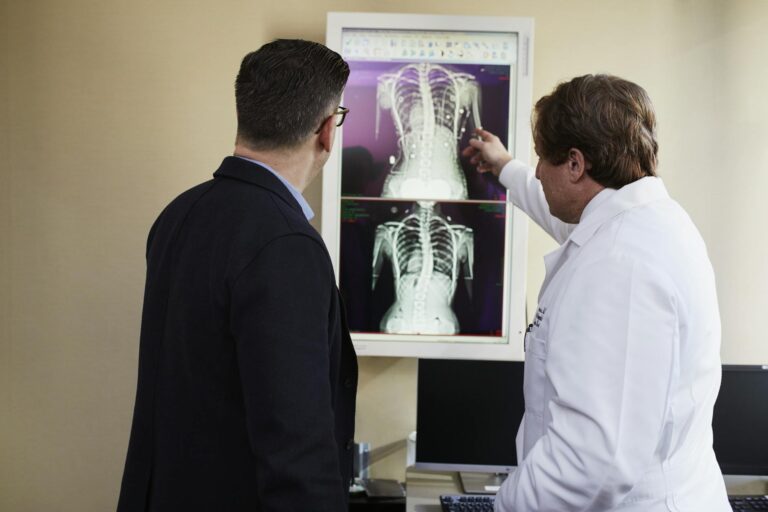
Doctors identify eight primary causes of lumbar disc herniation, with age-related degeneration and trauma accounting for the majority of cases. When the gel-like nucleus of a spinal disc pushes through its outer fibrous ring, it can compress nearby nerves, causing pain, numbness, and weakness in the lower back and legs. For example, a 45-year-old warehouse supervisor might develop a herniated disc at the L4-L5 level after years of repetitive lifting, while a sedentary office worker in their late 30s could experience the same condition from accumulated disc wear and poor posture.
Understanding these eight causes helps explain why herniation rates peak between ages 30 and 50, affecting roughly 2-3% of the population at any given time, with significantly higher prevalence in men (4.8% in men over 35 versus 2.5% in women over 35). This article examines each of the eight primary causes that doctors encounter most frequently, along with the specific mechanisms behind each one. We’ll explore how your age, occupation, lifestyle choices, genetics, and medical history contribute to disc herniation risk—and what that means for your spinal health moving forward.
Table of Contents
- How Age-Related Degeneration Drives Most Lumbar Disc Herniations
- Acute Trauma and Mechanical Injury as Triggering Events
- Occupational and Activity Factors—The Cumulative Burden of Repetitive Stress
- Smoking, Obesity, and Posture—Modifiable Lifestyle Risk Factors
- Genetic Predisposition—The Role of Inherited Vulnerability
- Medical Comorbidities and Systemic Health Conditions
- Understanding Your Individual Risk Profile
- Conclusion
How Age-Related Degeneration Drives Most Lumbar Disc Herniations
Age-related degeneration is the single most common cause of lumbar disc herniation. As you age, the nucleus pulposus—the gel-like center of your intervertebral disc—gradually loses water content and becomes less hydrated. This happens because the surrounding tissue loses its capacity to retain moisture, a process that begins in your 20s and 30s but accelerates noticeably after 40. Simultaneously, the chemical composition of your disc shifts: the ratio of type 1 collagen increases while proteoglycans break down, weakening the structural integrity of the disc itself.
The disc’s outer ring, called the annulus fibrosus, also undergoes changes with age. Small tears and fissures develop in the annulus, making it more vulnerable to rupture when even normal stress is applied. Unlike a younger person whose disc can absorb and distribute force effectively, someone in their 50s may experience a herniation from activities that would have caused no problems earlier in life—bending to pick up something light, for instance, or taking an awkward step. This age-related vulnerability explains why the mean age for symptomatic disc herniation is 37 years, with incidence continuing to rise through the 40s and 50s.
Acute Trauma and Mechanical Injury as Triggering Events
Trauma and mechanical injury represent the second most common cause of disc herniation that doctors observe. This category encompasses sudden, forceful events—a car accident, a fall from height, a heavy lifting accident—where a large biomechanical force is applied directly to the spine. Unlike the gradual weakening seen with age, trauma can cause acute rupture through the annulus fibrosus, forcing disc material to extrude suddenly and compress adjacent nerve roots.
However, it’s important to recognize that trauma often acts in combination with existing disc degeneration. A person with a pre-existing degenerative disc may herniate from trauma that wouldn’t affect a younger spine, while someone with an already-weakened disc might experience herniation from an injury that seems minor by comparison. For example, two people in their 40s might slip on ice; one with a healthy spine recovers fully, while another with age-related degeneration suffers a herniation. This is why doctors always consider both the severity of the trauma and the baseline health of the disc when evaluating herniation risk.
Occupational and Activity Factors—The Cumulative Burden of Repetitive Stress
Occupational risk factors and repetitive activity emerge as the third major cause of disc herniation. Certain jobs expose workers to consistent, high-impact loading of the spine through lifting, bending, and carrying. Construction workers, warehouse staff, nurses, and laborers face elevated risk due to constant repetitive movements. Even weight-bearing sports—weight lifting, hammer throw, and similar activities—create cumulative stress on the intervertebral discs over years of training.
The mechanism is straightforward: every time you bend forward and lift with your back muscles rather than your legs, every repetitive twist while carrying a load, every hour spent in a forward-bending posture, the annulus fibrosus experiences micro-trauma. Over months and years, these micro-injuries accumulate, creating weakness in the disc’s outer layers. Someone who spends 30 years in manual labor develops herniation risk from the accumulated effect of thousands of small movements, not a single catastrophic event. Prolonged sitting—sitting for more than 6 hours daily—carries similar cumulative risk, particularly when combined with poor posture, because sustained flexion of the spine places ongoing pressure on the posterior annulus fibrosus where herniations most commonly occur.

Smoking, Obesity, and Posture—Modifiable Lifestyle Risk Factors
Smoking increases the odds of disc herniation by 1.7 times (95% confidence interval 1.0-2.5), making it a significant independent risk factor. Smoking damages the blood vessels that supply nutrients to your discs, reducing oxygen and nutrient delivery to disc tissue. Over time, this impaired perfusion contributes to disc dehydration and degeneration, making herniation more likely. A 50-year-old smoker with 30 pack-years of smoking history faces substantially higher disc herniation risk than a non-smoker of the same age. Obesity (BMI greater than 30) represents another major modifiable risk factor.
Excess weight increases the compressive load on every spinal segment, and particularly stresses the lumbar spine which bears body weight. Additionally, obesity is often accompanied by metabolic dysfunction that may contribute to accelerated disc degeneration. The combination of smoking, obesity, and poor posture—characterized by slouching, forward head position, and weak core muscles—creates compounded risk. Consider two office workers of the same age: one maintains good posture, exercises regularly, and maintains a healthy weight; the other slouches at the desk for 8 hours daily, smokes, and carries significant extra weight. The second individual’s spine faces constant, compounded mechanical and metabolic stress.
Genetic Predisposition—The Role of Inherited Vulnerability
Genetic factors account for up to 75% of individual susceptibility to intervertebral disc degeneration, making inherited vulnerability one of the most powerful—and least modifiable—causes of herniation risk. Some people are genetically predisposed to faster disc degeneration due to variations in genes affecting collagen structure, water-binding capacity, or inflammatory response in disc tissue. If both of your parents experienced disc herniation, your risk is substantially elevated regardless of your lifestyle choices. However, genetic predisposition does not guarantee herniation will occur.
It determines your baseline susceptibility, but occupational stressors, smoking, poor posture, and trauma can either accelerate or delay the expression of that genetic risk. Someone with high genetic risk can minimize herniation through excellent posture, avoiding smoking, maintaining a healthy weight, and limiting heavy lifting. Conversely, someone with lower genetic risk might still develop herniation if they smoke, remain sedentary, and work in a high-stress occupation. The gene-environment interaction is bidirectional: your genes load the gun, but your lifestyle choices determine whether the trigger is pulled.
Medical Comorbidities and Systemic Health Conditions
Medical conditions including diabetes, hyperlipidemia, and cardiovascular risk factors contribute to disc herniation risk, particularly in women. Diabetes impairs blood vessel function throughout the body, reducing nutrient delivery to disc tissue much like smoking does. Hyperlipidemia (elevated blood lipids) and cardiovascular dysfunction compromise the vascular supply to spinal structures.
These conditions accelerate disc degeneration through metabolic and vascular mechanisms independent of mechanical loading. A 55-year-old woman with diabetes, high blood pressure, and elevated cholesterol faces accelerated disc degeneration compared to a metabolically healthy woman of the same age. The combination of multiple cardiovascular risk factors significantly amplifies herniation risk, suggesting that good management of diabetes and cardiovascular health isn’t only about heart and blood vessels—it protects your discs as well.
Understanding Your Individual Risk Profile
Your herniation risk isn’t determined by any single cause but rather by the combination of multiple factors. With approximately 5-20 new cases of symptomatic herniation occurring per 1,000 adults annually, and a lifetime risk of 1-3% for symptomatic herniation (though asymptomatic disc bulges are far more common), most people will never experience significant disc problems. This is reassuring data: even though disc bulges and herniations are common on imaging studies, the majority of people either remain completely asymptomatic or experience self-limiting pain that resolves within weeks.
Approximately 95% of lumbar disc herniations occur at the L4-L5 or L5-S1 levels, the lowest two disc spaces where mechanical load is highest. The fact that 60-90% of disc herniations spontaneously resolve within 6-12 months means that even when symptoms do develop, the natural history is favorable. This doesn’t mean ignoring symptoms, but rather recognizing that herniation isn’t automatically a surgical condition and that many cases improve substantially with conservative management including physical therapy, activity modification, and time.
Conclusion
The eight primary causes of lumbar disc herniation—age-related degeneration, trauma, occupational factors, smoking, obesity, poor posture, genetic predisposition, and medical comorbidities—overlap considerably in most cases. A single individual might be aging, work in a physically demanding job, smoke, and carry extra weight, meaning their herniation risk comes from multiple converging sources. Understanding these causes provides clarity: some factors you cannot change (your age, genetics, family history), but others are directly under your control (smoking cessation, weight management, posture, physical conditioning, activity pacing).
If you’re experiencing lower back pain, numbness, or weakness, a healthcare provider can determine whether a disc herniation is actually present and whether your symptoms warrant specific treatment. Remember that the natural history of disc herniation is generally favorable, with most cases improving significantly over time. Focus on the modifiable causes within your control: maintain good posture, avoid smoking, keep your weight healthy, stay active, and seek guidance on proper body mechanics for your occupation or activities. These changes won’t erase your genetic predisposition, but they can substantially reduce your risk of symptomatic herniation and protect your spinal health throughout your life.