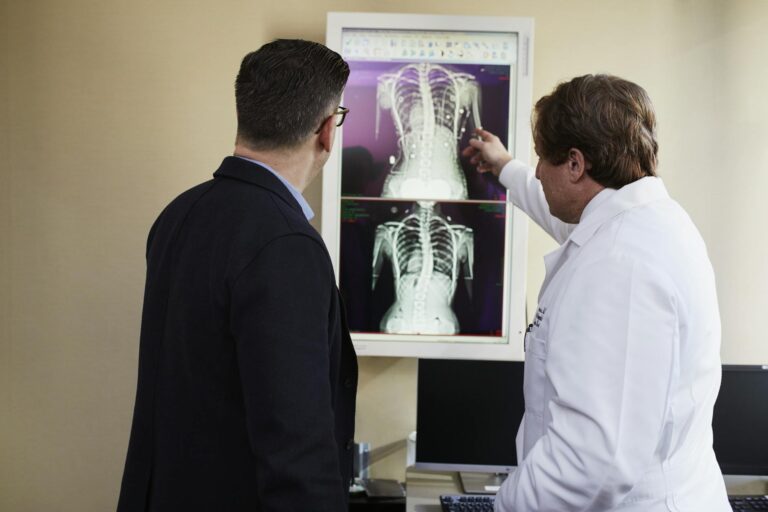
Doctors most often diagnose lumbar spine instability as a consequence of degenerative changes rather than as a single condition. The eleven causes they encounter most frequently include intervertebral disc degeneration (the most common), facet joint osteoarthritis, ligamentous insufficiency, muscle deconditioning, spondylolisthesis, trauma, lumbar spinal stenosis, pathological conditions, postural dysfunction, excess body weight, and anatomical predisposition. For example, a 65-year-old woman experiencing lower back pain with stiffness may have multiple overlapping causes—disc space narrowing combined with arthritic facet joints and weakened supporting muscles—rather than a single structural failure.
This article examines each of these causes, how doctors identify them, and why understanding the root mechanism matters for treatment decisions. Understanding which cause is driving someone’s instability helps determine whether the focus should be on physical rehabilitation, medications, imaging surveillance, or—in select cases—surgery. The causes often work together rather than in isolation, which is why comprehensive evaluation is essential before pursuing any treatment plan.
Table of Contents
- Intervertebral Disc Degeneration—The Most Prevalent Cause of Lumbar Instability
- Facet Joint Osteoarthritis and Progressive Structural Collapse
- Ligamentous Insufficiency and Loss of Passive Stability
- Muscle Insufficiency and Deconditioning as Drivers of Instability
- Spondylolisthesis—Vertebral Slippage and Loss of Alignment
- Trauma, Fractures, and Acute Injury as Precipitants of Instability
- Lumbar Spinal Stenosis and the Narrowing of Spinal Spaces
- Pathological Conditions—Infections and Tumors Affecting the Spine
- Postural Dysfunction and Excessive Lumbar Lordosis as Predisposing Factors
- Excess Body Weight and Metabolic Factors Contributing to Instability
- Risk Factors and Individual Susceptibility to Developing Instability
- Conclusion
Intervertebral Disc Degeneration—The Most Prevalent Cause of Lumbar Instability
Intervertebral disc degeneration stands as the most common cause of lumbar spine instability in adults. The statistics are striking: approximately 80% of people aged 40 and older show signs of spinal osteoarthritis affecting the lumbar spine, based on data from 2013–2015. Within that population, disc space narrowing occurs in 50–64% of cases, while osteophyte formation (bone spur development) is present in 75–94%. When discs degenerate, they lose height and water content, reducing their ability to cushion movement between vertebrae. The disc becomes less of a shock absorber and more like a damaged spring—it can no longer maintain proper spacing or stability.
As the disc degenerates, the facet joints above and below must compensate, often developing their own arthritis in the process. This cascade of change is why disc degeneration is rarely the only finding in someone with instability; it typically triggers or accelerates other degenerative changes simultaneously. The progression varies considerably. Some people with severely degenerated discs remain pain-free, while others with milder changes develop significant symptoms. This variability depends on individual factors like muscle strength, spinal alignment, and activity level—demonstrating why imaging findings alone don’t determine who will have problems and who won’t.

Facet Joint Osteoarthritis and Progressive Structural Collapse
Facet joint osteoarthritis represents one of three major local mechanisms through which vertebrae lose stability and may slip relative to one another. These small joints on the back of each vertebra act as guides for motion and load-bearing supports. When cartilage wears away and bone spurs develop, the joints lose precision, and the vertebra above becomes more likely to move excessively or shift position. The relationship between disc degeneration and facet arthritis creates a mechanical problem: as discs lose height, they transmit more force to the facet joints. The joints respond by developing degenerative changes, which further reduces their stabilizing capacity.
doctors often see both problems simultaneously in the same spinal segment. However, some individuals develop prominent facet arthritis even when disc degeneration is relatively mild, suggesting that genetics, alignment, or loading patterns may predispose certain joints to earlier wear. One important limitation: facet joint arthritis visible on imaging doesn’t automatically mean it’s causing symptoms. Many people have imaging evidence of facet arthritis without pain. This is why physical examination—testing how pain changes with movement and position—remains crucial for determining whether a particular facet joint is the source of instability and discomfort.
Ligamentous Insufficiency and Loss of Passive Stability
The ligaments that stabilize the spine—particularly the anterior and posterior longitudinal ligaments and the interspinous ligaments—can malfunction through either structural damage or excessive laxity (looseness). When ligaments become insufficient, the spine loses what doctors call “passive stability,” meaning the skeleton and connective tissues can no longer keep vertebrae properly aligned without muscle effort. Ligamentous insufficiency can develop gradually through repetitive microtrauma, prolonged poor posture, or degenerative changes.
It can also occur acutely after a significant injury that tears or overstretches ligaments. Some people are born with generalized ligament laxity—a condition affecting connective tissue throughout the body—which predisposes them to spinal instability at multiple levels. A critical distinction exists between ligament insufficiency and other forms of instability: ligament problems may not show clearly on standard MRI images, yet they produce real instability that can be detected through functional tests or clinical assessment. A patient might have normal-appearing ligaments on imaging but demonstrate excessive movement on flexion-extension X-rays, indicating ligamentous insufficiency.

Muscle Insufficiency and Deconditioning as Drivers of Instability
The deep and superficial muscles of the lumbar spine provide what doctors call “active stability”—meaning they must work to keep the spine aligned and controlled during movement. Poor posture, sedentary lifestyle, lack of muscular conditioning, and excess body weight all contribute to muscle insufficiency. Without adequate muscular support, even relatively minor structural problems become symptomatic because the spine lacks the muscular “scaffolding” to maintain proper alignment. Deconditioning represents a particularly reversible cause of instability. Someone who has been immobilized by pain, illness, or simply years of inactivity may develop atrophy of core muscles that stabilize the spine.
In these cases, controlled rehabilitation focusing on progressive loading of stabilizing muscles can significantly reduce instability without any structural change occurring. This is why physical therapy is often the first-line treatment for many cases of lumbar instability—it addresses the muscular insufficiency that amplifies whatever structural changes are present. However, muscular insufficiency does not stand alone; it almost always coexists with degenerative changes. An elderly person with severe disc degeneration may have minimally problematic symptoms if they maintain excellent core strength, while a younger person with mild degenerative changes may suffer greatly if they are deconditioned. This interaction is why clinicians must assess both the structural findings and the patient’s physical capacity.
Spondylolisthesis—Vertebral Slippage and Loss of Alignment
Spondylolisthesis occurs when one vertebra slips forward or backward relative to the vertebra below it, representing an extreme form of instability where normal alignment is visibly lost. Gender and age significantly influence prevalence: in elderly Chinese populations aged 65 and older, degenerative spondylolisthesis occurs in 25.0% of women and 19.1% of men. Prevalence increases sharply after age 50, with women developing it faster than men, likely due to accelerated degenerative changes following menopause. The slippage typically results from combined degenerative changes in the disc, facet joints, and ligaments. Unlike other causes of instability where the vertebrae remain aligned but move excessively within normal boundaries, spondylolisthesis involves actual positional displacement that persists whether the spine is moving or at rest.
Doctors grade the severity based on the percentage of slip, ranging from mild (less than 25% displacement) to severe (more than 75%). One important caveat: not all spondylolisthesis is progressive or symptomatic. Someone may have a stable slippage of 20% that remains unchanged for years without causing significant pain. Others experience progression and increasing symptoms. The natural history depends on the underlying cause, the degree of slip, and how well the muscles compensate for the misalignment.

Trauma, Fractures, and Acute Injury as Precipitants of Instability
Accidents, falls, motor vehicle collisions, and sports injuries can cause immediate instability through direct damage to vertebrae, discs, ligaments, or all three. A traumatic fracture of a vertebral body, a disc herniation with annular tear, or ligament disruption can all result in immediate mechanical instability that may require bracing, rehabilitation, or surgery. Traumatic injuries differ from degenerative causes in their presentation and timeline. A person with stable degenerative disc disease may experience a traumatic injury that destabilizes that same segment.
Conversely, degenerative instability sometimes develops slowly after a long-healed injury; the initial trauma created minor structural disruption that, over years or decades, evolved into significant degenerative changes. This is why the history of any significant spinal injury matters when evaluating someone years later with new-onset instability. Some traumatic injuries appear subtle on initial imaging but create lasting instability because they damage the stabilizing mechanisms—particularly ligaments or the disc’s annulus—in ways that only become evident as degeneration progresses. This is one reason why adequate immobilization and rehabilitation after spinal trauma is crucial, even when initial imaging suggests “just a minor injury.”.
Lumbar Spinal Stenosis and the Narrowing of Spinal Spaces
Lumbar spinal stenosis, the abnormal narrowing of the spinal canal, frequently accompanies lumbar instability and sometimes contributes to it. The overall prevalence in the general population is 11% (with confidence intervals of 4–18%), but prevalence is substantially higher in specific settings: 25% in primary care and 29% in secondary care populations. Age-related prevalence in a Japanese population showed clear progression: 1.9% at age 40–49, 4.8% at age 50–59, 5.5% at age 60–69, and 10.8% at age 70–79. Stenosis develops when degenerative changes—including disc bulging, osteophyte formation, facet arthritis, and ligament thickening—progressively narrow the space available for nerve roots and the spinal cord.
When stenosis coexists with instability, the narrowed canal means even small amounts of excessive movement can cause nerve irritation or compression, leading to leg pain, numbness, or weakness. The combination of motion and narrowing creates a more problematic situation than either condition alone would produce. An important limitation to recognize: stenosis seen on imaging is not automatically the cause of symptoms. Many people have imaging evidence of moderate or even severe stenosis without meaningful symptoms, while others with milder stenosis experience severe pain. This discordance between imaging and symptoms drives the clinical emphasis on patient history and physical examination rather than imaging alone.
Pathological Conditions—Infections and Tumors Affecting the Spine
Infections of the spinal column, including discitis (disc infection) or osteomyelitis (bone infection), and primary or metastatic tumors affecting vertebrae represent less common but important causes of instability. Infections can rapidly destroy disc height and bone, destabilizing the spine. Tumors may similarly erode bone or weaken vertebral structure. Both conditions require prompt diagnosis and treatment to prevent progressive instability and neurological complications. Pathological causes typically present with more acute or aggressive symptoms than degenerative instability.
Red flags include unexplained fever, severe pain not improved by typical treatments, night pain that awakens the patient, or progressive neurological loss. These symptoms should prompt urgent imaging and potentially biopsy to identify the underlying pathology. Unlike degenerative instability, which typically stabilizes or progresses slowly, pathological instability from infection or tumor may worsen rapidly without appropriate treatment. The clinical importance of considering pathological causes is that the treatment approach differs fundamentally. Someone with tuberculous discitis, for example, requires antituberculous drugs before any rehabilitation program would be appropriate. Identifying the pathological cause early prevents delays in necessary treatment.
Postural Dysfunction and Excessive Lumbar Lordosis as Predisposing Factors
Poor posture and excessive lumbar lordosis (the inward curve of the low back) contribute to instability by creating abnormal loading patterns on discs and facet joints. Prolonged sitting with forward head posture, standing with excessive arching of the low back, or habitual positioning that flattens or exaggerates the natural curve all place abnormal stress on spinal structures. Over time, these loading patterns accelerate degenerative changes and reduce the ability of stabilizing muscles to function effectively. Anatomical predisposition to abnormal lordosis—related to factors like pelvic incidence, vertebral shape, and facet joint orientation—increases instability risk.
Some people have sagittally oriented facet joints (facing forward and backward rather than side to side), which provide less lateral stability. These structural variations interact with postural habits to create greater instability risk. Importantly, postural dysfunction is often correctable through conscious habit change and targeted strengthening, making it an important modifiable factor in instability management. However, correcting posture becomes progressively more difficult when degenerative structural changes are advanced. Someone with severe disc degeneration and facet arthritis may struggle to maintain good posture despite conscious effort, because the painful or unstable segments limit their ability to achieve optimal alignment comfortably.
Excess Body Weight and Metabolic Factors Contributing to Instability
Excess body weight increases loading on lumbar discs and joints, accelerating degenerative changes and reducing the relative strength of stabilizing muscles. The mechanical burden of additional weight, combined with the metabolic inflammation associated with obesity, creates an environment where spinal structures degenerate more rapidly. Furthermore, increased weight reduces functional capacity—everyday movements become more challenging, leading to further deconditioning and muscle weakness. Weight management, therefore, becomes a practical intervention with dual benefit: reducing mechanical load on the spine while improving overall metabolic health.
Studies consistently show that even modest weight loss can reduce symptoms and slow progression in people with established lumbar instability. The challenge is that spinal pain itself often reduces activity tolerance, making weight loss more difficult—creating a vicious cycle of pain, reduced activity, weight gain, and worsening instability. One distinction worth noting: weight management alone rarely resolves instability in someone with significant structural degeneration, but it substantially reduces symptoms and may prevent or slow further progression. This is why clinicians often address weight as part of a comprehensive approach rather than as a standalone treatment.
Risk Factors and Individual Susceptibility to Developing Instability
Certain demographic and anatomical factors predict who will develop lumbar instability. Age over 50, female sex (with faster progression after menopause), generalized joint laxity affecting connective tissue throughout the body, African-American ethnicity, and anatomical features like sagittally oriented facet joints, hyperlordosis, and high pelvic incidence all increase instability risk. Additionally, multiple pregnancies increase risk, likely through both ligamentous laxity induced by pregnancy hormones and mechanical loading effects. Understanding these risk factors matters clinically because they inform preventive strategies.
Someone with multiple risk factors might benefit from earlier or more aggressive stabilization exercises, weight management, and ergonomic modifications than someone with fewer risk factors. The interaction between multiple risk factors produces multiplicative rather than additive effects—someone who is female, over 65, has generalized ligament laxity, and is overweight faces substantially greater instability risk than any single risk factor would suggest. These risk factors also explain why identical imaging findings produce different clinical outcomes in different people. Two individuals with identical disc degeneration and facet arthritis may have very different symptoms and outcomes depending on their muscle strength, weight, age, and constitutional factors.
Conclusion
The eleven causes of lumbar spine instability doctors encounter most frequently are not isolated entities but interconnected factors that work together to reduce spinal stability. Intervertebral disc degeneration leads the list as the most common cause, present in the majority of adults over 40, but it rarely acts alone. Facet joint arthritis, ligamentous insufficiency, muscle deconditioning, spondylolisthesis, trauma, lumbar spinal stenosis, pathological conditions, postural dysfunction, excess weight, and individual anatomical predisposition all contribute to the overall instability picture.
Effective management requires identifying which causes are present and which ones are primarily driving symptoms, since the treatment approach differs substantially between a deconditioned patient with mild degenerative changes and a patient with advanced spondylolisthesis or pathological cord compression. This is why imaging studies, physical examination, and careful history are all necessary before determining the optimal treatment strategy. If you experience persistent lower back pain, functional limitation, or progressive symptoms, consulting with a spine specialist who will thoroughly evaluate your specific situation is essential for developing an effective treatment plan.