The hidden ingredient lurking in many common inhalers is ethanol, an alcohol-based propellant and solvent that research now shows can actually trigger bronchospasm and worsen breathing difficulties in a subset of asthma patients. For people who also manage cognitive decline or dementia, this is especially dangerous because they may not be able to articulate that their inhaler is making them feel worse, leading caregivers to assume the underlying condition is simply progressing.
A 2017 study published in NPJ Primary Care Respiratory Medicine found that ethanol-containing metered-dose inhalers caused measurably greater airway irritation in sensitive individuals compared to ethanol-free alternatives, yet most patients and even some physicians remain unaware that this ingredient is present. Beyond ethanol, some inhalers contain other inactive ingredients such as oleic acid, sulfites, and certain surfactants that can provoke paradoxical reactions in vulnerable airways. This article examines why these additives exist in inhalers in the first place, how they affect people with asthma, the particular risks for older adults managing both respiratory disease and cognitive impairment, and what practical steps caregivers and patients can take to identify and switch to safer formulations.
Table of Contents
- Why Do Some Inhalers Contain Ethanol and How Does It Worsen Asthma?
- The Overlooked Excipients Beyond Ethanol
- Why Dementia Patients Face Greater Risk from Inhaler Irritants
- How to Identify and Switch to Irritant-Free Inhalers
- When Paradoxical Bronchospasm Signals a Bigger Problem
- The Role of Proper Inhaler Technique in Reducing Irritation
- Reformulation Efforts and What to Watch For
- Conclusion
- Frequently Asked Questions
Why Do Some Inhalers Contain Ethanol and How Does It Worsen Asthma?
Metered-dose inhalers require a propellant to push medication into the lungs, and they often need a co-solvent to keep the active drug dissolved evenly in the canister. After chlorofluorocarbon propellants were phased out under the Montreal Protocol, manufacturers switched to hydrofluoroalkane propellants. The problem is that many active ingredients do not dissolve well in HFA alone, so pharmaceutical companies add ethanol as a co-solvent, sometimes in concentrations as high as fifteen percent of the canister’s contents. Every puff delivers a small but measurable dose of alcohol vapor directly into the airways.
For most people, this amount of ethanol is clinically irrelevant. But for a significant minority of asthma patients, that burst of alcohol vapor irritates the already inflamed bronchial lining. The mechanism is straightforward: ethanol is a known mucosal irritant, and in hyperreactive airways, even minor irritants can trigger the smooth muscle contraction that defines bronchospasm. Patients who notice that their rescue inhaler seems to make them cough more before it helps, or who feel a burning sensation after using their controller inhaler, may be experiencing this ethanol sensitivity without realizing it. A comparative analysis of inhaler formulations showed that ethanol-free HFA inhalers produced significantly less throat irritation and cough reflex than their ethanol-containing counterparts.
The Overlooked Excipients Beyond Ethanol
Ethanol is the most common culprit, but it is not the only inactive ingredient that can cause trouble. Oleic acid, used as a surfactant and stabilizer in some formulations, has been shown to cause mild inflammatory responses in bronchial tissue when delivered repeatedly. Sulfites, which appear as preservatives in certain nebulizer solutions rather than metered-dose inhalers, are well-documented asthma triggers for roughly five to ten percent of asthma sufferers, particularly those with more severe disease. Even the propellant itself can produce a cold-freon effect, where the sudden burst of cold aerosol hitting the back of the throat causes a reflexive gasp or cough that interrupts proper inhalation technique.
However, it is important not to overcorrect here. The vast majority of asthma patients tolerate their inhaler excipients without any problem, and switching medications based solely on fear of inactive ingredients could actually be harmful if the replacement drug is less effective for that individual’s disease. The concern is specifically relevant for patients who experience unexplained worsening of symptoms despite good adherence, and for older adults whose ability to report subtle side effects is compromised by cognitive decline. If a patient with dementia becomes more agitated or breathless after inhaler use, caregivers should consider excipient sensitivity as one possible explanation rather than automatically assuming disease progression.
Why Dementia Patients Face Greater Risk from Inhaler Irritants
Older adults with both asthma or copd and dementia represent a uniquely vulnerable population for this issue. Respiratory disease and cognitive decline frequently coexist; a large cohort study from the Journal of the American Geriatrics Society found that adults over sixty-five with chronic obstructive pulmonary disease had a forty percent higher incidence of cognitive impairment compared to age-matched controls. When these conditions overlap, the communication gap becomes the central danger. A person with moderate Alzheimer’s disease who feels increased chest tightness after using an ethanol-containing inhaler may not be able to explain what is happening.
They might simply resist using the inhaler, which a caregiver could interpret as behavioral difficulty rather than a rational response to discomfort. Alternatively, they might use the inhaler more frequently, seeking relief that does not come, which increases their exposure to the irritant. In memory care facilities, staff may not be trained to distinguish between respiratory distress caused by underlying lung disease and distress provoked by the treatment itself. One respiratory therapist working in a long-term care facility in Ohio described discovering that three of her dementia patients on the same ethanol-containing brand showed marked improvement in both breathing and behavioral calm after being switched to a dry powder inhaler that contained no alcohol solvent.

How to Identify and Switch to Irritant-Free Inhalers
The first practical step is reading the full prescribing information for any inhaler currently in use. The inactive ingredients are listed in the product labeling, though they can be difficult to find in the fine print. Caregivers can also ask the dispensing pharmacist directly whether a particular inhaler contains ethanol or other common irritants. Several widely prescribed inhalers are formulated without ethanol, including most dry powder inhalers such as Advair Diskus, Breo Ellipta, and Wixela Inhub, as well as the soft mist inhaler Spiriva Respimat.
The tradeoff is that dry powder inhalers require a stronger and more coordinated inhalation effort to draw the medication into the lungs, which can be difficult for frail older adults or those with severe airflow limitation. Metered-dose inhalers with spacer devices are often easier for dementia patients to use with caregiver assistance, but these are the formulations more likely to contain ethanol. Nebulizers bypass the coordination problem entirely and allow the use of preservative-free solution formulations, but they require more time, equipment, and setup. There is no universally perfect delivery device; the best choice depends on the individual’s cognitive status, physical capability, and sensitivity profile. A conversation with the prescribing physician and a pharmacist together is the most effective way to navigate these tradeoffs.
When Paradoxical Bronchospasm Signals a Bigger Problem
Paradoxical bronchospasm, where an inhaler causes immediate worsening of airway constriction rather than relief, is listed as a known adverse reaction on virtually every inhaler’s label. Yet it is underdiagnosed because patients and clinicians tend to blame disease severity rather than the device. The FDA’s adverse event reporting system shows hundreds of reports of paradoxical bronchospasm across multiple inhaler brands, though the true incidence is likely much higher given well-known underreporting in post-market surveillance. For caregivers of people with dementia, the warning sign to watch for is a pattern of acute respiratory distress that consistently occurs within minutes of inhaler use and resolves on its own after fifteen to thirty minutes.
This is distinct from an asthma exacerbation, which tends to build over hours or days. If this pattern is observed, the inhaler should not be used again until a clinician has reviewed the situation. Continuing to administer a medication that is causing paradoxical bronchospasm is not just unhelpful; it is actively dangerous, especially in a patient who cannot advocate for themselves. Documenting the timing and severity of episodes in a simple log can give the physician the information needed to make a confident diagnosis.

The Role of Proper Inhaler Technique in Reducing Irritation
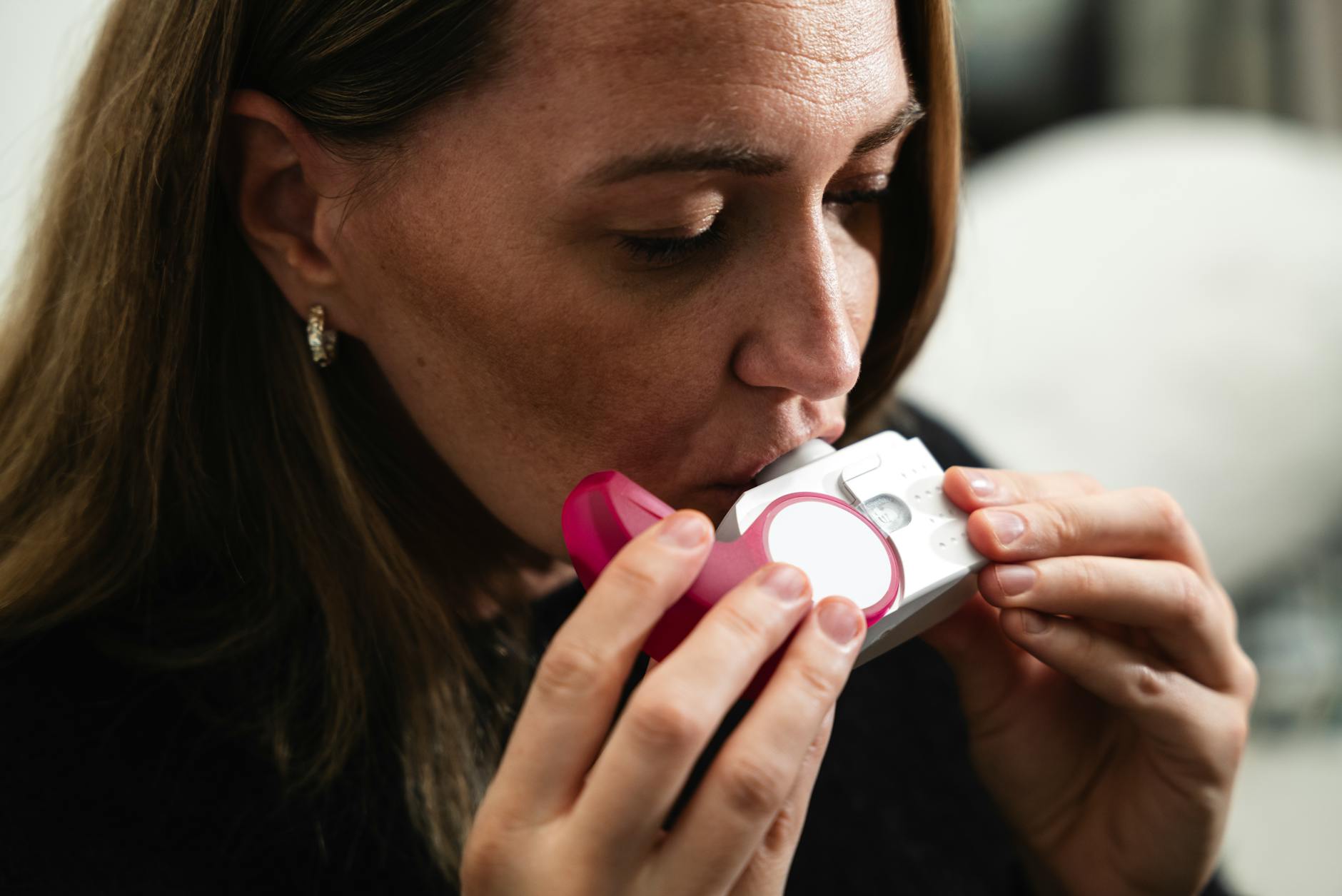
Poor technique amplifies every irritant effect. When a metered-dose inhaler is actuated directly into the mouth without a spacer, a large fraction of the dose impacts the back of the throat rather than reaching the lower airways. This concentrates the ethanol and other excipients on sensitive pharyngeal tissue, causing cough, throat irritation, and the perception that the inhaler is making things worse.
Studies consistently show that adding a valved holding chamber, commonly called a spacer, reduces oropharyngeal deposition by fifty to eighty percent, which means dramatically less irritant exposure to the throat even if the formulation still contains ethanol. For dementia patients, spacer use has the additional benefit of eliminating the need to precisely coordinate pressing the canister and breathing in simultaneously, which is a skill that degrades with cognitive decline. Caregivers should be trained in spacer-assisted technique and should observe the patient during every administration rather than handing the inhaler over and walking away.
Reformulation Efforts and What to Watch For
The pharmaceutical industry has been gradually moving toward cleaner inhaler formulations, driven partly by environmental pressure to reduce the global warming potential of HFA propellants. Several manufacturers are developing inhalers using low-carbon propellants that also happen to have better solvent properties, which may reduce or eliminate the need for ethanol as a co-solvent. Dry powder inhaler technology is also advancing, with newer devices requiring less inspiratory effort, which could make them viable for a broader range of elderly patients.
In the meantime, caregivers and clinicians should revisit inhaler choices at every medication review, particularly when a patient’s cognitive status changes. What worked well when someone could report symptoms and coordinate their breathing may become problematic as dementia progresses. Proactive reassessment is far better than reactive crisis management after a hospitalization for respiratory distress that could have been prevented.
Conclusion
The excipients in asthma inhalers, particularly ethanol, are a genuinely underrecognized cause of worsening respiratory symptoms, and the risk is magnified in people with dementia who cannot effectively communicate that their treatment is causing distress. Identifying the specific formulation of every inhaler in a patient’s regimen, understanding the inactive ingredients, and matching the delivery device to the person’s cognitive and physical abilities are all essential steps that too often get skipped in routine care.
Caregivers should not hesitate to bring this issue to a physician’s attention, especially if they observe a pattern of increased agitation, coughing, or breathlessness following inhaler use. Simple changes such as switching to an ethanol-free formulation, adding a spacer device, or transitioning to a nebulizer with preservative-free solution can make a meaningful difference in both respiratory comfort and overall quality of life. The goal is to ensure that every puff of medication helps rather than harms.
Frequently Asked Questions
How can I tell if my inhaler contains ethanol?
Check the “inactive ingredients” section of the prescribing information or the patient information leaflet included with the inhaler. You can also ask your pharmacist directly. Common ethanol-containing metered-dose inhalers will list “dehydrated alcohol” or “ethanol” among their excipients.
Are dry powder inhalers always ethanol-free?
Yes. Dry powder inhalers do not use liquid propellants or co-solvents, so they contain no ethanol. However, they require a sufficiently strong inhalation to draw the powder into the lungs, which may be a limitation for some older adults.
Can ethanol in inhalers affect someone with dementia beyond respiratory symptoms?
The amount of ethanol delivered per puff is very small and is unlikely to cause systemic effects. The concern is localized airway irritation, which can lead to coughing, bronchospasm, and behavioral changes in a person who cannot explain their discomfort.
Should I stop using an inhaler if I suspect it is causing paradoxical bronchospasm?
Do not stop a prescribed inhaler without consulting the prescribing physician, but do report the pattern promptly. If acute distress occurs immediately after inhaler use, seek emergency care. The physician can evaluate whether the reaction is related to the formulation and recommend an alternative.
Are nebulizer solutions free of irritating additives?
Not always. Some nebulizer solutions contain preservatives such as benzalkonium chloride or sulfites that can irritate airways. Ask specifically for preservative-free, unit-dose vials when this is a concern.