Yes, both yoga and tai chi can meaningfully improve sleep in people experiencing cognitive decline, and the evidence backing this claim has grown substantially in recent years. A 2016 pilot randomized controlled trial found that older adults with cognitive impairment who practiced tai chi qigong twice a week for two months gained an extra 48 minutes of sleep per night and improved their habitual sleep efficiency by 9.1 percent compared to a control group. A large 2025 network meta-analysis of 22 randomized clinical trials, affiliated with the BMJ, confirmed that yoga, tai chi, walking, and jogging all delivered significant improvements in total sleep time and sleep efficiency, with yoga specifically boosting sleep efficiency by nearly 15 percent.
These are not marginal gains. For someone with mild cognitive impairment who lies awake for long stretches or wakes repeatedly through the night, an extra 48 minutes of consolidated sleep can affect daytime alertness, mood stability, and even the pace of cognitive change. What makes yoga and tai chi particularly compelling is that they appear to work on multiple fronts simultaneously — reducing cortisol, easing anxiety, and improving physical function — rather than targeting a single sleep mechanism the way a medication might. This article examines the clinical evidence for both practices, explores how they compare, identifies limitations in the research, and offers practical guidance for caregivers and families considering these interventions for someone living with cognitive decline.
Table of Contents
- What Does the Research Say About Yoga and Tai Chi for Sleep in Cognitive Decline?
- How Tai Chi May Also Slow the Cognitive Decline Itself
- Why Sleep Matters So Much in Cognitive Decline
- Comparing Yoga and Tai Chi — Which Practice Fits Better?
- Limitations of the Evidence and When These Practices May Not Help
- How Caregivers Can Introduce These Practices Safely
- Where the Research Is Heading
- Conclusion
- Frequently Asked Questions
What Does the Research Say About Yoga and Tai Chi for Sleep in Cognitive Decline?
The most direct evidence comes from a pilot randomized controlled trial published in 2016, which enrolled 52 older adults with cognitive impairment. Participants in the tai chi qigong group attended two 60-minute sessions per week for two months. By the six-month follow-up, they had gained 48 minutes of additional sleep duration and showed a 9.1 percent improvement in habitual sleep efficiency compared to controls. That efficiency figure matters because it reflects the proportion of time spent actually sleeping while in bed, a metric that tends to deteriorate sharply as cognition declines. On the yoga side, a 2024 meta-analysis covering 57 studies and 6,057 participants found that yoga interventions produced a significant improvement in sleep disturbance with a moderate effect size among the geriatric population.
While that meta-analysis included older adults broadly rather than only those with diagnosed cognitive impairment, a 2025 review in Frontiers in Aging specifically examined yoga as an integrated mind-body intervention for people with Alzheimer’s disease. The authors noted yoga’s role in improving mood, relieving stress, and supporting cognitive health through serotonin pathway regulation — all mechanisms directly relevant to sleep disruption in dementia. A separate 2025 scoping review published in PMC reinforced these findings, showing that chronic yoga interventions across multiple studies improved sleep quality through reduced cortisol, better mood regulation, and stress relief. These are not isolated results. The pattern across studies is consistent: both practices produce measurable sleep improvements, even in populations where pharmacological options carry heightened risks of falls, confusion, and oversedation.

How Tai Chi May Also Slow the Cognitive Decline Itself
Sleep improvement alone would justify interest in these practices, but tai chi appears to offer an additional benefit that sets it apart: direct cognitive protection. A trial published in the Annals of Internal Medicine in 2023 enrolled 318 older adults with mild cognitive impairment and compared three groups — cognitively enhanced tai ji quan, standard tai ji quan, and stretching exercises — each practiced for one hour, twice weekly, over 24 weeks. The cognitively enhanced group improved their Montreal Cognitive Assessment scores by 1.5 points compared to standard tai chi and by 2.8 points compared to the stretching group. These benefits persisted at 48 weeks. Even more striking, a trial cited by the National Institute on Aging found that dementia progression rates were only 4.3 percent in the tai chi group compared to 16.6 percent in a western exercise group.
A 2023 scoping review confirmed that tai chi interventions lasting 12 to 24 weeks, with two to three sessions per week, showed moderate benefits in global cognition as measured by MoCA and MMSE scores, along with improvements in visuospatial skills, semantic memory, and verbal learning. However, these cognitive findings come with important caveats. Most of the trials involved participants with mild cognitive impairment, not moderate or advanced dementia. The degree to which tai chi can help someone in later stages remains unclear. Families should be cautious about extrapolating these results to a loved one with significant functional limitations. The physical demands of tai chi, even in simplified forms, may not be feasible for someone who struggles with standing balance or following multi-step instructions.
Why Sleep Matters So Much in Cognitive Decline
Poor sleep is not merely a symptom of dementia — it is increasingly understood as an accelerant. During deep sleep, the glymphatic system clears beta-amyloid and tau proteins from the brain, the very substances implicated in Alzheimer’s disease pathology. When sleep is fragmented or insufficient, this clearance process falters, potentially feeding a cycle where cognitive decline worsens sleep, and worsened sleep accelerates cognitive decline. Consider a 72-year-old woman with mild cognitive impairment who wakes four or five times a night, spending long stretches staring at the ceiling.
Her total sleep time might be five hours in a nine-hour window, yielding a sleep efficiency below 60 percent. If a tai chi program could raise her sleep duration by 48 minutes and her efficiency by nine percentage points, she would cross into a range that most sleep researchers consider functionally meaningful. She would likely feel less foggy in the morning, have fewer mood disturbances during the day, and place less strain on her spouse or caregiver who currently wakes each time she does. The December 2024 study published under PMID 39716129 examined exactly this connection, investigating the effects of tai chi on physical performance, sleep, and quality of life in older adults with mild to moderate cognitive impairment. While the full results underscore the intertwined nature of these outcomes, the broader point is that improving sleep in this population is not a luxury — it is a clinical priority that non-pharmacological approaches are well-positioned to address.

Comparing Yoga and Tai Chi — Which Practice Fits Better?
Both yoga and tai chi improve sleep, but they are not interchangeable, and the right choice depends on the individual. Tai chi is performed standing and involves continuous, flowing sequences of weight shifts and turns. It challenges balance and spatial awareness, which is precisely why it appears to benefit cognition — but also why it may be difficult for someone with moderate impairment or fall risk. Chair-based tai chi adaptations exist, though they have less research behind them. Yoga is more easily modified.
A session can be conducted entirely on a mat or in a chair, and the emphasis on breathwork and held postures may suit people who become anxious or overwhelmed by continuous movement. The 2025 BMJ-affiliated network meta-analysis found that yoga specifically increased total sleep time and improved sleep efficiency by nearly 15 percent. For someone whose primary issue is sleep, yoga may offer the more accessible entry point, particularly if a caregiver can guide the practice at home. The tradeoff is that yoga lacks the strong evidence tai chi has accumulated for directly slowing cognitive decline. A family weighing these options might reasonably start with yoga for its lower physical demands and sleep benefits, then transition to tai chi if the person’s balance and engagement permit. Neither practice requires equipment, gym memberships, or special facilities, which makes both realistic options for home-based routines.
Limitations of the Evidence and When These Practices May Not Help
The research supporting yoga and tai chi for sleep in cognitive decline is promising but far from definitive. The tai chi qigong pilot trial that showed a 48-minute sleep gain enrolled only 52 participants. Pilot studies are designed to test feasibility and generate preliminary data, not to establish clinical certainty. Larger confirmatory trials are still needed. The 2024 JAMA Network Open study that combined tai chi with repetitive transcranial magnetic stimulation introduces a confounding variable — it is difficult to isolate which component drove the observed benefits. There is also an adherence problem that clinical trials often understate. Practicing tai chi or yoga two to three times a week for 12 to 24 weeks requires sustained motivation, reliable transportation or a home practice setup, and enough cognitive function to learn and remember movement sequences.
For someone with moderate to advanced dementia, independent practice is unlikely. A caregiver must be willing and able to participate, or a community class with appropriate modifications must be available. In rural areas or under-resourced communities, these options may simply not exist. Finally, neither yoga nor tai chi should be treated as a replacement for medical evaluation of sleep problems. Obstructive sleep apnea, restless leg syndrome, medication side effects, and untreated depression all cause sleep disruption in older adults with cognitive impairment. A mind-body practice layered on top of an untreated sleep disorder will likely disappoint. The responsible approach is to address medical causes first, then introduce yoga or tai chi as a complementary strategy.

How Caregivers Can Introduce These Practices Safely
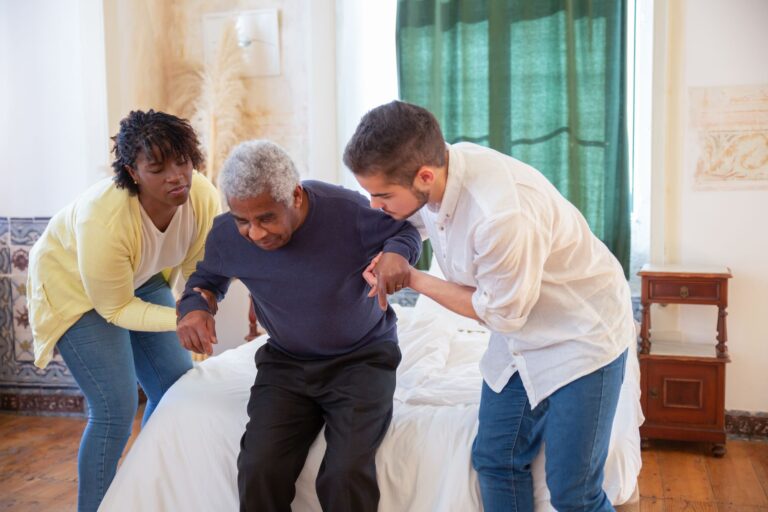
A practical starting point is a seated yoga routine of 15 to 20 minutes, performed in the late afternoon — early enough to avoid stimulation before bed, late enough to help transition toward the evening. A caregiver might sit alongside the person, demonstrating gentle neck rolls, seated forward folds, and diaphragmatic breathing. No prior experience is needed. The goal is not athletic performance but rhythmic, calming movement paired with focused breathing.
For tai chi, simplified forms designed for older adults — sometimes called “tai chi for health” programs — reduce the standard 108-movement sequence to eight or ten movements. These are widely available through community centers, senior programs, and online video platforms. The Annals of Internal Medicine trial used a video-delivered format, which suggests remote instruction can work. However, someone with cognitive impairment should not be left to navigate a video interface alone. A caregiver’s presence is essential, both for safety and for the social engagement that itself contributes to cognitive health.
Where the Research Is Heading
Several lines of investigation are converging. The 2024 JAMA Network Open trial exploring tai chi combined with brain stimulation represents a new frontier in multimodal interventions — pairing physical practice with neurostimulation to potentially amplify benefits for both sleep and cognition. Meanwhile, the 2025 Frontiers in Aging review highlights growing interest in yoga not just for patients but for their caregivers, recognizing that caregiver stress and burnout directly affect the quality of dementia care.
The July 2025 BMJ-affiliated network meta-analysis comparing yoga, tai chi, walking, and jogging for sleep outcomes marks a shift toward head-to-head comparisons that can guide clinical recommendations more precisely. As these studies mature and sample sizes grow, clinicians will be better equipped to prescribe specific movement practices — type, duration, frequency — the way they currently prescribe medications. That day has not arrived, but the trajectory of the evidence makes a strong case for integrating yoga and tai chi into dementia care planning now, rather than waiting for perfect data that may take another decade to materialize.
Conclusion
The evidence consistently supports yoga and tai chi as effective non-pharmacological interventions for improving sleep in people with cognitive decline. Tai chi qigong has shown the most direct results in cognitively impaired populations, with one trial demonstrating 48 additional minutes of sleep and a 9.1 percent improvement in sleep efficiency. Yoga offers comparable sleep benefits with greater accessibility, particularly for individuals with balance limitations or more advanced impairment.
Both practices carry the advantage of being low-cost, adaptable, and free from the sedation risks and drug interactions that make sleep medications especially hazardous in this population. For families and caregivers, the practical next step is straightforward: talk to the person’s physician about incorporating a structured yoga or tai chi routine, start with brief sessions that prioritize safety and enjoyment over complexity, and commit to consistency over intensity. Two sessions per week for at least 12 weeks is the minimum threshold most studies have used. Neither practice is a cure for dementia or a guaranteed solution for insomnia, but both represent some of the best tools available for improving sleep and quality of life in people navigating cognitive decline.
Frequently Asked Questions
How quickly can someone with cognitive impairment expect to see sleep improvements from yoga or tai chi?
Most studies show meaningful improvements after 8 to 12 weeks of consistent practice, with two to three sessions per week. The tai chi qigong pilot trial measured outcomes at six months. Expecting overnight results is unrealistic — these are gradual, cumulative interventions.
Is tai chi safe for someone who has fallen before?
Tai chi actually has strong evidence for reducing fall risk in older adults, but someone with a history of falls should start with a simplified, supervised form — ideally with a qualified instructor present. Chair-based modifications are available for those with significant balance concerns.
Can yoga or tai chi replace sleep medication for someone with dementia?
They should not be used as direct replacements without medical guidance. Some people may be able to reduce or discontinue sleep medications after establishing a consistent practice, but this decision must involve their physician. Abruptly stopping certain sleep medications can cause rebound insomnia or withdrawal effects.
Does it matter what type of yoga is used?
Gentle or restorative yoga styles are most appropriate for people with cognitive decline. Vigorous styles like power yoga or hot yoga are not suitable. The studies showing sleep benefits in older adults generally used gentle hatha yoga, chair yoga, or breathing-focused practices.
What if the person cannot remember the movements between sessions?
This is common and expected. Caregiver-led practice or following along with a video eliminates the need to memorize sequences. Repetition of the same simple routine helps build procedural memory, which is often preserved longer than other memory types in dementia.
You Might Also Like
- Can treating sleep apnea slow cognitive decline
- Can cognitive behavioral therapy help people with mild dementia
- What is the link between insomnia and cognitive decline
For more, see NIH MedlinePlus — cognitive testing.