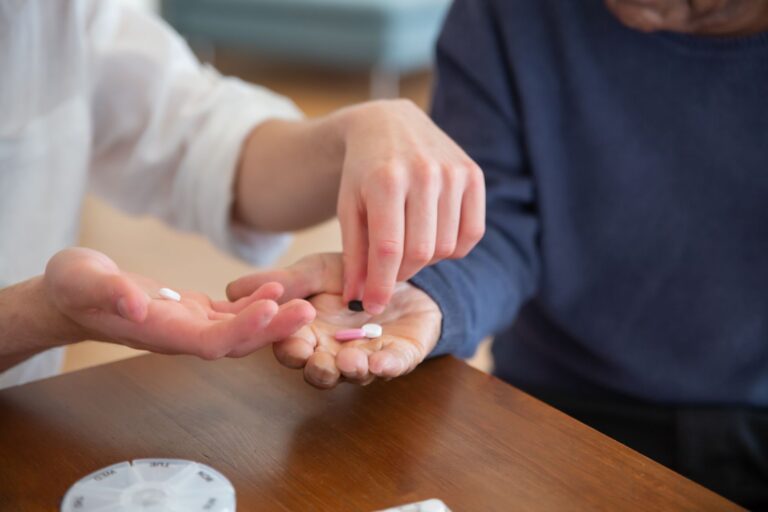
A person with dementia cannot cut food with a knife because the brain loses the ability to plan and guide learned hand movements. Poor grip is rarely the main cause; poor coordination, confusion about tools, vision changes, and lost safety judgment play a larger role.
Apraxia is the key term here. It means loss of purposeful movement despite normal muscles, clear instructions, and willingness to act. MedlinePlus lists dementia and neurodegenerative illness among its most common acquired causes, in its MedlinePlus guide to apraxia.
Medical information disclaimer: This article is for general educational purposes only and does not provide medical advice, diagnosis, or treatment. Always consult a physician or other qualified health professional about symptoms, medications, tests, or treatment decisions.
Table of Contents
- What happens between knowing and doing?
- Why do hands and eyes struggle at the table?
- When does a knife become unsafe?
- What makes eating easier without a knife?
What happens between knowing and doing?
The person may know what a knife is for but still cannot organize the cutting motion. Brain Injury Explanation describes ideomotor apraxia in this way, including holding a knife cutting-edge up or mashing instead of spreading. Sometimes the breakdown comes earlier.
Hampshire and Isle of Wight Healthcare guidance notes that trouble with cutlery, cups, or glasses can come from poor coordination or failure to recognize what the item is for. That is different from simple weakness. Muscles may still work, yet the sequence of grip, pressure, angle, and back-and-forth motion falls apart.
Why do hands and eyes struggle at the table?
Hands may fail to pick up or hold cutlery steady. The Alzheimer's Society UK points to grip and coordination difficulty as a specific reason to offer finger foods and pre-cut pieces, in its Alzheimer's Society UK factsheet on eating and drinking. Vision adds another layer.
Changes in visual and spatial ability can keep a person from telling food apart from the plate, or plate from table. The Alzheimer's Association recommends plain dishes and color contrast between plate and table, in its Alzheimer's Association food and eating guidance. Meals also become more distracting and harder to perceive. During middle-stage Alzheimer's, changes in perception, taste, and smell make eating harder, so the same Association advises quiet meals and simple table settings.
When does a knife become unsafe?
A knife becomes unsafe when judgment about hazards fades. A person may forget that blades cut skin, try to grab a falling knife, or use it for the wrong task.
EMDA, the Alzheimer's Association of Israel, advises supervision around kitchen tools, removal or locking away of sharp knives, and cutting food before serving, in its EMDA guide to safety in the patient's environment. Watch for pressing too hard, sawing toward fingers, carrying an open blade, or growing frustration at the table. Any one sign means the knife should leave the place setting.
What makes eating easier without a knife?
Set up the table for success. Use a plain, different-colored plate, clear away extra items, lower noise, and give one food at a time. Prepare food so cutting is unnecessary: Cutting food in the kitchen removes risk at the table while keeping meals familiar and independent.
- cut meat, sandwiches, fruit, and vegetables before serving
- offer finger foods that hold shape
- use cups and dishes that are easy to grip
- stay nearby and offer calm, short cues