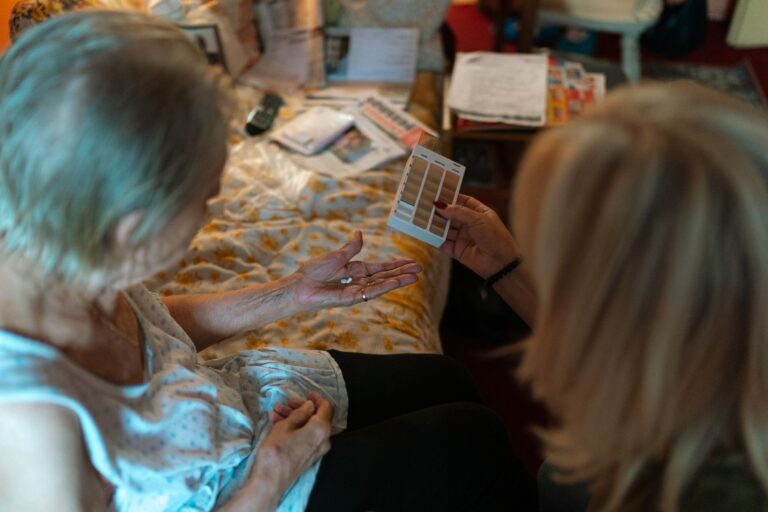
Dementia patients forget how to drink from a cup because dementia damages memory, recognition, attention, coordination, and swallowing. The learned sequence of seeing the cup, lifting it, sipping, and swallowing breaks apart. Apraxia means loss of a learned motor plan. In this case the person loses the automatic plan for opening the mouth, sipping, moving liquid back, and triggering a swallow.
Medical information disclaimer: This article is for general educational purposes only and does not provide medical advice, diagnosis, or treatment. Always consult a physician or other qualified health professional about symptoms, medications, tests, or treatment decisions.
Table of Contents
- How does the drinking sequence fall apart?
- Why does the cup itself become confusing?
- Why do they forget thirst or walk away?
- When does drinking become unsafe?
- What helps them drink safely?
How does the drinking sequence fall apart?
A sip looks simple but needs four timed steps. The person must open the mouth, take a sip, move liquid backward, then swallow. Dementia can cause feeding and swallowing apraxia that erases that plan.
A review in the U.S. National Library of Medicine describes this loss of the mouth-sip-swallow sequence in its review of dysphagia, dementia and frailty. The result looks like forgetting. The person may hold liquid, pause too long, or start but not finish.
Why does the cup itself become confusing?
Some people look straight at a cup or glass and do not know what it is. Visual and tactile agnosia means the brain no longer links the object to drinking, according to guidance from the Alzheimer's Society UK in its page on eating and drinking with dementia. Physical handling adds another barrier.
Weak grip, poor hand-eye coordination, and visuospatial problems make it hard to pick up a glass and bring it to the mouth. Clear liquid in a clear glass is especially hard to see. A colored cup that stands out from the table can be easier to notice and grasp.
Why do they forget thirst or walk away?
Thirst signals become blunted in dementia. People may forget to drink, forget they feel thirsty, struggle to ask for drinks, and forget they already drank, as described by the Alzheimer's Society UK in its guide to drinking and hydration in dementia. Attention and executive function also weaken.
The person may get distracted, put the cup down, wander from the drink, or stop mid-task. So drinking often needs prompting and company. Short, calm offers work better than leaving a full glass nearby and hoping it gets finished.
When does drinking become unsafe?
Later dementia can bring oral and pharyngeal dysphagia. Transit takes longer, liquid pools in the cheeks, fluid is held without swallowing, and swallows repeat. Coughing and choking during or after drinks are warning signs.
These problems chiefly affect moderate-to-severe and late-stage dementia and vary by dementia type. When swallowing fails, liquid can enter the lungs and cause aspiration pneumonia. The U.S. National Institute on Aging lists aspiration as a common cause of death in late Alzheimer's.
What helps them drink safely?
Offer drinks often instead of waiting to be asked. Stay close, reduce noise and distractions, and allow extra time for each sip.
Refer persistent coughing, choking, wet voice, or repeated chest infections to a speech-and-language therapist. Dementia UK recommends prompted drinks, suitable cups, cautious straw use, assessed texture changes, and specialist referral in its advice on eating and drinking with dementia.
- Use a high-contrast or clear cup that is light and easy to grip
- Offer small, frequent drinks rather than one large glass
- Do not use straws if a clinician has advised against them
- Change drink thickness only after professional assessment