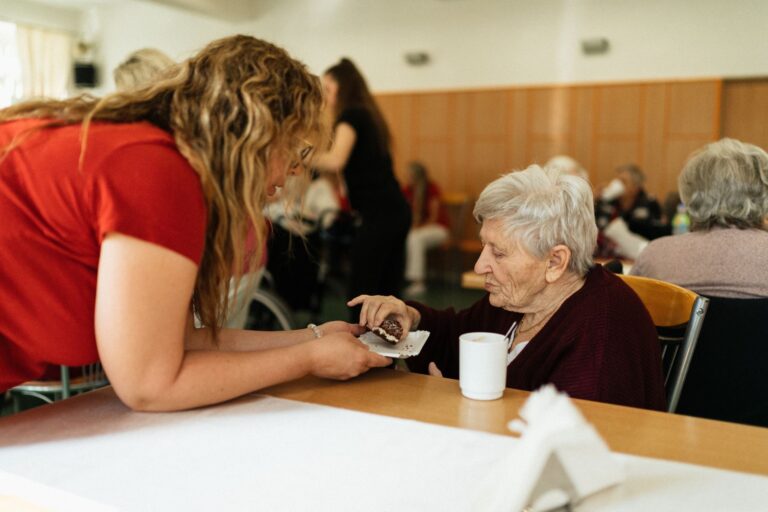
Air quality changes mood in memory care residents mainly through two routes: fine particles that reach the bloodstream and brain are linked to higher rates of depression and anxiety symptoms, and the breathing discomfort that dirty, stuffy air causes — cough, wheeze, breathlessness — makes agitation and distress more likely in people who cannot explain what is wrong. Short-term swings matter too, not just years of exposure: after smoke events, emergency visits for mood disorders rise within days.
Memory care is the setting where this matters most and has been measured least. The evidence on mood comes from studies of older adults generally, while the studies done inside nursing homes measured air and respiratory symptoms rather than behaviour. That gap is worth knowing before you act on it — but the practical steps are cheap, low-risk, and well documented.
Medical information disclaimer: This article is for general educational purposes only and does not provide medical advice, diagnosis, or treatment. Always consult a physician or other qualified health professional about symptoms, medications, tests, or treatment decisions.
Table of Contents
- What residents are actually breathing indoors
- Why stale air shows up as distress rather than a complaint
- The direct mood evidence, and whose it is
- Where the evidence stops
- What a family member or care team can do
- Frequently Asked Questions
What residents are actually breathing indoors
The air inside a long-term care building is its own exposure, separate from whatever the weather report says. A European multi-country project called GERIE objectively measured PM10, ultrafine particles, formaldehyde, nitrogen dioxide and ozone inside 50 nursing homes — eight randomly chosen homes in each of seven countries — among roughly 600 residents over age 70, and reported the results in the European Respiratory Journal in 2015. PM10 means particles under 10 micrometres across, small enough to be inhaled deep into the lungs.
In those homes, mean indoor PM10 averaged 29.8 µg/m³ and carbon dioxide averaged 572 ppm, which are unremarkable numbers. The striking finding was ventilation: only 19% of residents lived in a home the researchers judged adequately ventilated. That combination — acceptable pollutant readings, inadequate air exchange — is the shape of the problem in most buildings. Nothing looks alarming on a meter, and the air is still stale.
Why stale air shows up as distress rather than a complaint
GERIE's clinical findings were respiratory. The European Respiratory Society reported that higher PM10 and nitrogen dioxide tracked with breathlessness and cough, ultrafine particles with wheeze, and formaldehyde with COPD — and that these associations appeared even at concentrations below existing international guidelines, with the strongest effects in poorly ventilated homes and in residents over 80. Now put that in a memory care context.
A resident with moderate or advanced dementia often cannot say "my chest feels tight" or "this room smells wrong." Discomfort surfaces as behaviour instead: pacing, calling out, refusing care, resisting a bath, wanting to leave the room. So air quality can present as a mood or behaviour problem while being a breathing problem underneath. That reframing is useful on its own, because it points at a fixable cause rather than a medication adjustment.
The direct mood evidence, and whose it is
Separately from respiratory symptoms, particle exposure is linked to mood itself. A national US survey of older adults found that ambient PM2.5 exposure was associated with both depressive and anxiety symptoms, most strongly among people of lower socioeconomic status or with certain existing health conditions. That subgroup description — older, lower income, multiple chronic conditions — describes a large share of memory care residents. A retrospective Irish cohort published in Environmental Health in 2024 adds useful precision: long-term PM2.5 exposure was associated with depression and anxiety, but not with stress or worry outcomes.
The effect showed up on clinical symptom scales rather than on general distress measures, which argues against dismissing it as people simply disliking bad air. Short-term swings register too. During California's 2020 wildfires, Harvard researchers found each 10 µg/m³ rise in wildfire-specific PM2.5 was followed by more emergency department visits for depression, anxiety and other mood-affective disorders for up to seven days. A bad air week is not just a long-term risk — it is a seven-day window to watch.
Where the evidence stops
Three limits deserve plain statement, because the topic attracts overstatement. The honest summary: air quality affects breathing comfort in care homes, and affects mood in older adults broadly. Connecting those two inside a specific memory care unit is reasonable inference, not a measured result.
- The behavioural research is observational and general. A 2025 systematic review in Science of the Total Environment reported worsened cognitive function, higher dementia risk, depressive symptoms and anxiety with particulate exposure in elderly populations, while concluding more research is needed. None of it was conducted in memory care settings.
- The headline smoke-and-dementia finding was corrected. JAMA Neurology issued a notice of retraction and replacement for the 1.2-million-member Kaiser Permanente wildfire-smoke dementia study in 2025: after correction, the association was no longer statistically significant and the effect size was smaller. Claims built on the original version should not be repeated at that strength.
- Facility-level neuropsychiatric effects have not been measured directly. A 2025 cohort of older US adults linked smoke PM2.5 to respiratory hospitalizations but found no significant association with neuropsychiatric hospitalizations.
What a family member or care team can do
The strongest practical lever is ventilation during normal weeks and a cleaner-air room during smoke events. The US EPA's guidance on reducing smoke exposure indoors is specific: Questions worth asking a facility: how is air exchanged in resident rooms, are HVAC filters on a documented schedule, and what is the written plan for a smoke day.
Given that only 19% of GERIE's residents lived in adequately ventilated homes, ventilation is the question that separates buildings, not pollutant readings. One caution: a resident whose agitation rises on a smoky day may be short of breath, not newly anxious. Flag the breathing to a nurse before accepting a behavioural explanation, and note the date — the Harvard data says the window runs about a week past the smoke.
- Pick a room with few windows and no fireplace, ideally one the resident already spends time in.
- Run a portable air cleaner continuously on high, with a tobacco-smoke CADR rating at least two-thirds of the room's square footage. AHAM's own advice is a CADR equal to the room's area, which is the safer target.
- Close any fresh-air intake on the HVAC system, or set it to recirculate, during a smoke event.
- Buy and install the air cleaner before smoke arrives — they sell out locally once the sky changes.
Frequently Asked Questions
Does an air purifier in one room help if the rest of the building is stuffy?
Yes, for the hours spent in that room. The EPA's cleaner-air room approach is built on exactly that logic — one well-filtered space, sized correctly, used during the worst air.
Is poor air quality causing the dementia itself?
The particulate-and-dementia link is still being argued over, and the largest study claiming it was corrected in 2025 to a non-significant result. Treat air quality as a comfort and mood issue you can act on now, not as a cause you are reversing.
How would I know air quality is the problem and not a medication or infection?
You would not know from behaviour alone. The useful signal is timing: symptoms that track a smoke event, a hot stuffy stretch, or a specific room point at air. Infection and medication effects usually do not follow the outdoor air that closely.