Caregivers use interactive books — large-print picture books, life story books, and digital memory books on a tablet — as conversation tools, not treatments. You sit beside the person, open to one page at a time, let them point, turn or comment, and follow whatever they say rather than quizzing them on it.
That framing matters because the research is clear about what these books do and do not do. Trials show they support autobiographical memory, reminiscence and communication, while leaving symptoms and overall quality of life largely unchanged. Used as a shared activity, they are low-cost, low-risk and often the easiest route into a conversation when words have become hard.
Medical information disclaimer: This article is for general educational purposes only and does not provide medical advice, diagnosis, or treatment. Always consult a physician or other qualified health professional about symptoms, medications, tests, or treatment decisions.
Table of Contents
- What counts as an interactive book
- How to run a session
- What the trials actually found
- Paper or tablet?
- Starting early, and what happens as dementia advances
- Warning signs that the book is not helping
- Frequently Asked Questions
What counts as an interactive book
Three formats dominate, and they suit different stages. A life story book collects photographs, names, places and milestones from the person's own life, usually assembled with family help. A picture-led reminiscence book pairs a strong image with a line or two of text — the kind Pictures to Share publishes for people in mid-to-late-stage dementia, which UK libraries stock as conversation prompts and which can be shared even when the person can no longer speak. A digital memory book puts photos, audio and video on a tablet, so a page can play a voice or a song.
Activity booklets are a fourth, lighter option. The National Institute on Aging points caregivers to free activity books from the Rush Alzheimer's Disease Center, describing them as stimulating activities that encourage families to be creative in how they interact with someone experiencing memory loss. "Interactive" here means the person does something: points, turns, names, chooses, retells. A book being read at someone is not interactive, though reading aloud has its own value — NIA lists reading stories or books aloud among its adapted activities and pairs it with talking about fond childhood memories when visiting children is not possible.
How to run a session
Keep sessions short, repeatable and unhurried. The aim is a pleasant twenty minutes, not a completed book.
Tangible and multimedia versions can carry a session further. Researchers who built a tangible multimedia book and tested it in a care home examined how residents handled it, whether it mediated reminiscence and conversation, and how caregivers judged its use in sessions — a reminder that the caregiver's own read on whether the activity works is part of the evidence.
- Pick a quiet time of day when the person is usually at their best, and turn off the television.
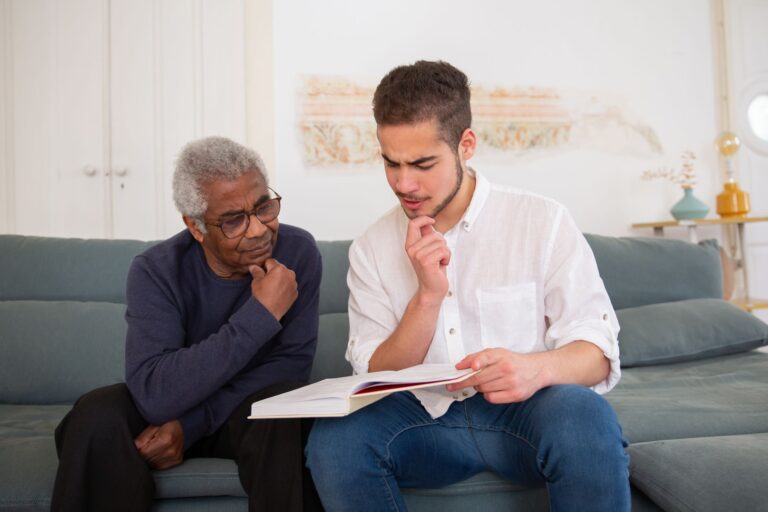
- Sit beside them, not across a table, so you are both looking at the same page.
- Open one spread at a time and let them set the pace; do not flip ahead to the "good" photo.
- Ask open questions — "what's happening here?" — rather than tests like "who is this?"
- Follow the thread they offer, even if it drifts from the page or the facts.
What the trials actually found
Expect communication gains, not clinical ones. A randomised controlled trial of life review plus a life story book for 23 people with mild-to-moderate dementia, comparing two book-making methods, found no quality-of-life difference on the QOL-AD six weeks after the books were given, though results were consistent with improved autobiographical memory versus usual care. The digital version tested much the same way. The Online Life Story Book trial randomised 42 people with very mild to mild dementia and their informal caregivers against a waitlist control, measuring outcomes three times, and reported no significant effects on neuropsychiatric symptoms, quality of life or caregiver burden.
The practical conclusion the authors draw is the one to hold onto: treat an interactive book as a communication aid, not a symptom treatment. Smaller studies look more encouraging and are correspondingly weaker. A study of digital life storybooks for people with dementia in care homes found five of six participants showed additional improvement on quality-of-life and autobiographical-memory measures, on a sample far too small to generalise from. A separate remote, multisensory reminiscence intervention, the Digital Life Story Book study, reached 25 participants with memory difficulties to support sense of self, with informal caregivers giving proxy reports of its effects.
Paper or tablet?
Choose by the person's communication, not by what looks modern. In a survey of 169 family caregivers of people with dementia, digital memory books were rated more useful by caregivers of people with communication deficits, and the authors argue the digital format can improve both the quality and the quantity of caregiver–patient communication. Audio, video and a recorded voice give a non-verbal person something to respond to that a still photograph does not. Paper wins on handling.
A large-format book needs no charging, no login and no screen-lock troubleshooting mid-session, and it survives being held, closed and reopened. Mid-to-late-stage readers in particular do better with one image and a few lines than with a dense page or a sliding interface. A mixed approach is reasonable: a printed life story book for daily use, a tablet for the clips and songs. Build the paper copy so it can be reprinted — losing the only copy of a life story book is a real loss, and a reprint costs nothing if the files are kept.
Starting early, and what happens as dementia advances
Uptake falls as the disease progresses, which is an argument for starting while the person can still help choose the photographs. A companion survey of 170 informal dementia caregivers found the gap in intent to use a digital memory book between the mild and the moderate-to-severe stages was significantly larger among Alzheimer's caregivers than among caregivers of other dementias. Plan for the format to change rather than for the activity to stop.
A detailed life story book made in the mild stage can become too much later; the same photographs, enlarged and reduced to one per page, keep working. Picture-led books are designed for exactly that point. Spiritual and musical material belongs in the same category. NIA recommends religious or other readings, sacred music and prayer as adapted spiritual activity, and these often hold when biographical detail no longer does.
Warning signs that the book is not helping
Watch for distress rather than for progress. Stop a session, change the page or put the book away if you see any of these: Loss, bereavement and estrangement sit in most life stories, and a life story book made by family can reopen them without warning. Review the pages before the first session, and if someone is living in a care home, tell the staff which photographs tend to upset them so the book does not get used cold.
- Visible agitation, tearfulness or anxiety when a particular person or period comes up.
- Repeated failed recall that the person notices and is embarrassed by — usually a sign the questions have become tests.
- A page that triggers grief you are not able to sit with; remove it from the book rather than skipping it each time.
- Fatigue, which often shows as the person closing the book or turning away before you do.
Frequently Asked Questions
Will a life story book slow down memory loss?
No. The randomised trials found no effect on symptoms, and the Online Life Story Book trial specifically found none on neuropsychiatric symptoms, quality of life or caregiver burden. Use the book for conversation and connection.
Who should make the book?
Family, ideally with the person's input while they can give it. The caregiver who will use the book in sessions benefits from knowing the stories behind the pages.
Where can I get a suitable book without making one?
Public libraries often stock large-format reminiscence titles such as Pictures to Share, and the Rush Alzheimer's Disease Center activity booklets are free through the National Institute on Aging.
How long should a session last?
Short enough to end on a good note — often fifteen to twenty minutes. Frequency matters more than length, and the same book can be reused indefinitely.