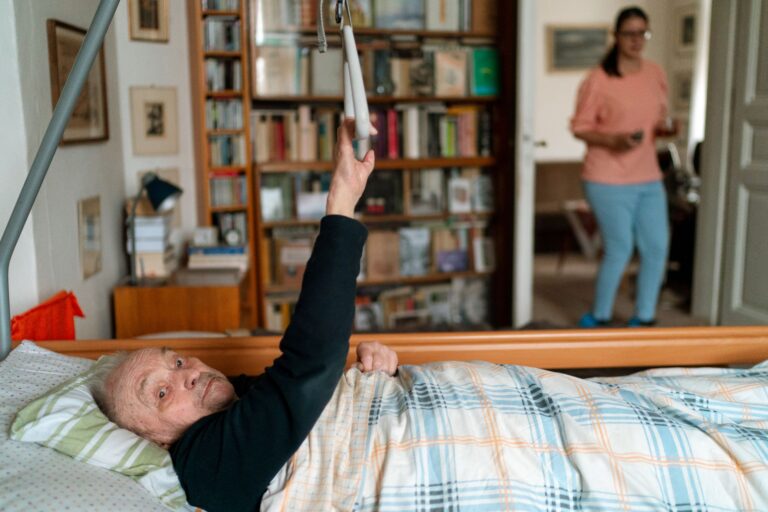
Researchers still need to learn whether LiBBY's lower agitation outweighs more serious infections and deaths in frail patients. For adult children, the trial does not show THC/CBD is safe for a parent with early dementia or outside supervised hospice care. LiBBY means Life's End Benefits of cannabidiol and tetrahydrocannabinol.
Cannabidiol (CBD) and tetrahydrocannabinol (THC) are cannabis compounds. The Alzheimer's Association describes LiBBY as a 12-week Phase 2 multicenter randomized double-blind placebo-controlled trial in 120 hospice-eligible patients with dementia-related agitation across 10 U.S. sites with home visits, reported in its AAIC trial summary.
Medical information disclaimer: This article is for general educational purposes only and does not provide medical advice, diagnosis, or treatment. Always consult a physician or other qualified health professional about symptoms, medications, tests, or treatment decisions.
Table of Contents
- What did LiBBY test?
- Why do serious infections and deaths matter?
- Can families copy LiBBY with store products?
- What should adult children ask the care team?
What did LiBBY test?
Participants received a purified oral oil with 2 mg THC plus 100 mg CBD twice daily. Dosing started at half dose in week 1, then full dose in weeks 2 through 12, according to Pennington Biomedical Research Center in its trial dosing description. Treatment reduced agitation on the Cohen-Mansfield Agitation Inventory by week 2, with separation sustained through week 12.
Agitation here means restlessness, aggression, shouting, pacing, or resisting care. Global improvement was also common on active treatment. NeurologyLive reports 83.9 percent improved at week 2 and 87.2 percent at week 12 on THC/CBD, versus 30.5 percent and 23.6 percent on placebo, in its results report.
Why do serious infections and deaths matter?
Overall adverse events looked similar, 46.7 percent on THC/CBD versus 42.4 percent on placebo. Serious adverse events were higher on THC/CBD, 23.3 percent versus 11.9 percent. The gap came mainly from serious infections, 11.7 percent versus 1.7 percent.
Deaths were also higher, 13.1 percent versus 5.1 percent. Researchers cannot yet say whether THC/CBD caused these events. Patients averaged 80 years old, qualified for hospice, and already faced high illness and infection risk. Larger trials must test whether the signal persists, who is most vulnerable, and how infections develop during treatment.
Can families copy LiBBY with store products?
No. Investigators stress the findings apply only to the supervised purified formulation and dosing system. Dispensary and over-the-counter CBD and THC products vary in strength, purity, THC content, and contaminants. That difference matters for older adults.
Stronger modern products can increase dizziness, confusion, falls, and worsened thinking. THC and CBD can also interact with other drugs, including blood thinners. Adult children should not start, swap, or adjust a cannabis product to match LiBBY. Bring the exact product label, dose, frequency, and reason for use to the prescribing clinician and pharmacist.
What should adult children ask the care team?
Use LiBBY as a prompt for a medication review, not a home trial. Ask about current causes of restlessness or aggression, such as pain, infection, constipation, poor sleep, or medication effects.
Document baseline sleep, agitation triggers, falls, and medications before any change. For hospice-eligible patients, include the hospice nurse in that plan because home visits and close follow-up were part of LiBBY.
- What is driving agitation right now, and what safer steps have we tried?
- What are the fall, thinking, and drug-interaction risks for this parent?
- How would we monitor benefit, sedation, confusion, fever, and infection?
- When would we stop the drug, and who should the family call first?
You Might Also Like
- AAIC 2026 p-tau217 Alzheimer’s Risk Prediction Research: What Researchers Still Need to Learn for Adult Children
- p-tau217 Findings a Decade Before Alzheimer’s Symptoms in 2026: What Researchers Still Need to Learn for Adult Children
- Strengths-Based Dementia Care in the 2026 NIA Report: Service Gaps That Matter to Long-Distance Caregivers