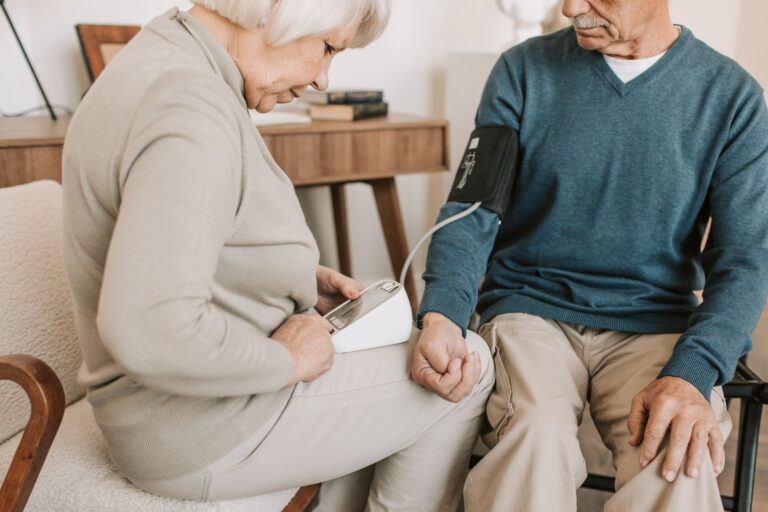
People with early Alzheimer's can now start Leqembi at home with a once-weekly autoinjector and no prior IV infusions. Injection training is still required, and MRI monitoring for brain safety risks has not gone away. Leqembi means lecanemab, a drug that targets amyloid buildup in the brain in mild cognitive impairment or mild dementia due to Alzheimer's. The 2026 at-home regimen changes where treatment begins, not who it is for or how safety oversight works.
Medical information disclaimer: This article is for general educational purposes only and does not provide medical advice, diagnosis, or treatment. Always consult a physician or other qualified health professional about symptoms, medications, tests, or treatment decisions.
Table of Contents
- Who can start treatment at home?
- What changed about starting Leqembi?
- What does injection training still require?
- What clinic safety checks did not change?
Who can start treatment at home?
The at-home option is for adults with mild cognitive impairment or mild dementia due to Alzheimer's. They must have confirmed amyloid buildup in the brain, the established early-Alzheimer's indication. That eligibility did not expand with the autoinjector.
A diagnosis based on symptoms alone is not enough. Amyloid confirmation, prior health review, and a treatment plan with the prescribing clinic still come first. Families should check eligibility before planning for home injections. Useful questions include what type of amyloid test the clinic uses, whether genetic testing is advised, and when the first MRI is scheduled.
What changed about starting Leqembi?
In August 2025, the subcutaneous form was approved only for maintenance after 18 months of IV therapy. In July 2026, regulators removed that IV-induction requirement entirely, according to Alzheimer Europe in its July 2026 approval summary. The new initiation dose uses 500 mg each week, given as two 250-mg injections.
Maintenance uses 360 mg each week, compared with 10 mg/kg by IV every two weeks over about one hour, as described by Medscape in its dosing comparison. BioSpace reporting on Eisai and Biogen placed FDA approval of the at-home initiation dose on July 13, 2026, in the FDA approval notice. For patients, the practical change is fewer infusion-center visits. For clinics, the practical change is more responsibility shifted to training and home follow-up.
What does injection training still require?
Home use does not begin with a prescription alone. Prescribing information calls for a health professional to directly supervise at least two consecutive doses. The supervisor must confirm that the patient or caregiver can inject correctly before home use.
Training covers device handling, dose preparation, injection sites, timing, storage, missed-dose steps, and when to call the clinic. Eisai and Biogen also offer added support through the LEQEMBI Companion program, with Nurse Educators providing in-person or virtual device-only education plus an app tracking tool. A practical home-start sequence often looks like this:.
- Complete amyloid confirmation, baseline MRI, and clinic consent
- Complete supervised injections until technique is confirmed
- Set a weekly injection day, site rotation, and symptom log
- Confirm who to contact for fever, headache, confusion, or injection-site problems
What clinic safety checks did not change?
Brain MRI monitoring for amyloid-related imaging abnormalities, called ARIA, remains required before starting and at specified points after starting. Practical Neurology reported that MRI surveillance continues as with IV lecanemab in its treatment availability update. ARIA means swelling or small bleeding in the brain linked to amyloid-clearing treatment.
Leqembi retains a boxed warning for ARIA, with highest risk in people with two copies of the ApoE-e4 gene. At-home dosing removes dozens of infusion visits but does not remove clinician oversight, genetic testing discussions, or MRI surveillance. Caregivers should keep MRI appointments even when injections feel routine. Report new headache, dizziness, nausea, vision changes, confusion, difficulty walking, or unusual fatigue promptly.
You Might Also Like
- At-Home Leqembi vs IV Infusions After the 2026 FDA Decision: What Changed and What Did Not for People With Early Alzheimer’s
- MRI and ARIA Monitoring With At-Home Leqembi in 2026: What Changed and What Did Not for People With Early Alzheimer’s
- Why the AAIC 2026 Soccer Study Does Not Prove Dementia: What Researchers Still Need to Learn for People With Mild Cognitive Impairment