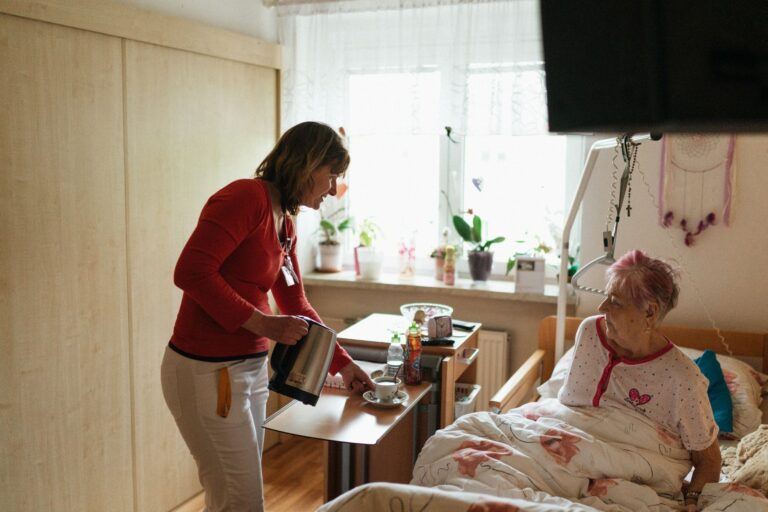
Introduce a picture choice board by showing two familiar, relevant images in a quiet setting and asking one simple either-or question. A picture choice board is a set of images that lets a person point to, touch, or look toward an option instead of finding the right word. Use the board as communication support, not as a test. The National Institute on Aging says visual alternatives can help with dementia-related word-finding and memory difficulties during everyday conversations in its communication guidance.
Medical information disclaimer: This article is for general educational purposes only and does not provide medical advice, diagnosis, or treatment. Always consult a physician or other qualified health professional about symptoms, medications, tests, or treatment decisions.
Table of Contents
- Build a simple first board
- Introduce the board without pressure
- Confirm what the person selected
- Adjust the format to the person
- Understand what the evidence can—and cannot—show
Build a simple first board
Start with one immediate decision, such as a snack or activity. Choose clear pictures of options the person knows, and avoid filling the board with unrelated choices. offer only two options at first.
For example, show photographs of tea and juice while asking, "Would you like tea or juice?" This follows National Institute on Aging guidance favoring concrete yes-or-no and either-or questions over broad, open-ended ones. Make each picture easy to distinguish. If the person normally uses glasses or another communication aid, ensure it is available before introducing the board.
Introduce the board without pressure
Sit at eye level and reduce background noise. Speak calmly, show the two pictures, and name each option with a short phrase.
A first attempt might look like this: Do not repeat the question rapidly or add more explanations during the pause. If there is no clear response, simplify the wording or try again later rather than treating silence as a decision.
- Place the board where the person can see it comfortably.
- Point to each picture as you name it.
- Ask one direct question.
- Pause and allow extra response time.
- Accept a clear point, touch, look, word, or gesture.
Confirm what the person selected
State the apparent choice plainly: "You chose music." Watch for agreement, hesitation, or rejection before acting. If the response remains unclear, ask a simple confirmation question or present the two options again. Avoid interpreting every glance as a firm choice, especially when the pictures sit close together.
Use structured choices during ordinary routines, including meals, clothing, and activities. In a four-person adult-day-care study, structured choices increased activity engagement for every participant according to Western Michigan University researchers. Because the study was very small, it supports careful trial use rather than predicting the same result for everyone.
Adjust the format to the person
Pictures are only one possible format. Test whether the person responds more clearly to spoken options, photographs, simple drawings, written words, or the actual objects. That comparison matters. In the same four-person study, verbal choices worked best for three participants, while tangible objects worked best for one.
A person who cannot identify a picture of an apple may still choose confidently when shown an apple and a banana. Check for barriers unrelated to dementia. Hearing loss, vision problems, language needs, and low health literacy can each interfere with communication. If the person struggles, change one feature at a time—such as image size, contrast, wording, distance, or choice format—and observe whether responses become clearer.
Understand what the evidence can—and cannot—show
Picture-based tools can make some conversations easier. A 2023 systematic review of six eligible studies found better conversation comprehension and decision-making than with usual communication, supporting pictorial tools as one way to elicit preferences in people with dementia. However, the review found only minimal improvement in preference consistency and could not determine the effect on discourse.
A choice may also change with comfort, fatigue, context, or the options presented, so the board should not be treated as proof of a permanent preference. The strongest recent randomized evidence was also cautious. A 2026 study of 101 Swedish home-care recipients with mild-to-moderate dementia found no significant improvement in self-reported involvement or satisfaction with Talking Mats, a picture-based tool, compared with usual conversations in the BMC Geriatrics report. If pictures create confusion, return to spoken choices or real objects and use the format that produces the clearest response.