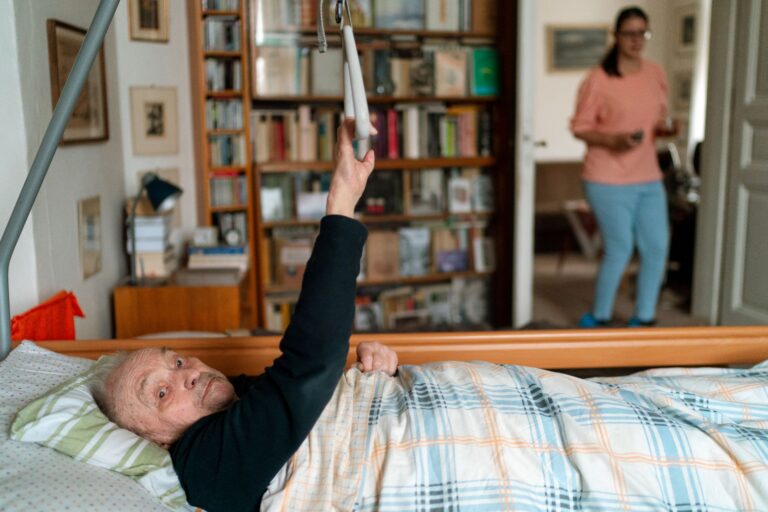
Help the person show where it hurts by reducing distractions, establishing a reliable yes/no response, and offering a body map, gestures, or written choices. Aphasia is a language disorder, so difficulty naming a painful area does not mean the person cannot recognize or communicate pain. Begin with the person's own answer, even if speech is limited. A systematic review reported by Sunnybrook Health Sciences Centre and the University of Toronto says self-report should come first when possible, with observation used to supplement it rather than replace it in dementia pain assessment.
Medical information disclaimer: This article is for general educational purposes only and does not provide medical advice, diagnosis, or treatment. Always consult a physician or other qualified health professional about symptoms, medications, tests, or treatment decisions.
Table of Contents
- Create the right conditions for an answer
- Establish a dependable yes-or-no response
- Narrow down the location visually
- Use behavior as supporting evidence
- Share the clearest evidence with clinicians
Create the right conditions for an answer
Choose a quiet, one-to-one setting. Face the person, speak slowly and clearly, and allow extra time for a response. Ask one question at a time. Address the person directly, even when a care partner is present.
The American Speech-Language-Hearing Association recommends confirming understanding and combining speech with individualized supports such as gestures, writing, drawings, pictures, boards, or technology to improve communication access. Avoid correcting unclear speech or rapidly rephrasing the question. Repeat what you believe the person communicated: "You pointed to your left knee. Is that where it hurts?" This gives the person a manageable opportunity to confirm or reject your interpretation.
Establish a dependable yes-or-no response
Aphasia may make spoken "yes" and "no" unreliable. Look for another consistent response, such as nodding, pointing, blinking, raising a thumb, or touching a YES or NO card. Before asking about pain, check whether the person can see and hear the choices.
Then test the response method with simple questions whose answers are already known. ASHA notes that pointing or partner-assisted scanning—showing or naming choices one by one—can establish a response method when speech is unavailable through communication aids. Once the method seems consistent, ask concrete questions: Repeat important answers in a different form. If the person first indicates "yes" to left-leg pain, point to that leg and ask, "This leg?" Do not assume every yes-or-no response is accurate if the pattern becomes inconsistent.
- "Are you hurting now?"
- "Is the pain above your waist?"
- "Is it on your left side?"
- "Is it here?" while pointing
- "Does moving make it hurt?"
Narrow down the location visually
Offer a body outline or point to broad areas on yourself without touching the person. Start with a few choices—head, chest, stomach, back, arms, or legs—then narrow the location after the person selects one. Useful supports include: The National Aphasia Association recommends communication boards, phrase sheets, images, gestures, and symptom labels for medical visits when a person has aphasia.
A care partner can present these choices and clarify the response, but should avoid answering before the person has time to respond. After identifying an area, record exactly how the person communicated it. For example: "Pointed twice to the right shoulder and confirmed with a nod," rather than "complained of shoulder pain.".
- A front-and-back body diagram
- Large cards naming body areas
- Pictures of common symptoms
- A simple pain scale
- Gestures or direct pointing
Use behavior as supporting evidence
When the person cannot identify a location, watch what happens during specific movements, activities, or times. Grimacing while standing, guarding an arm during dressing, or becoming irritable during a particular task may provide a clue.
The Alzheimer's Association notes that dementia can make pain difficult to report or recognize, making changes such as irritability or activity-linked grimacing important possible pain indicators. Keep observations specific: Do not treat behavior alone as proof of pain or of its location. Facial expressions, vocal sounds, pointing, and gestures can carry meaning when speech does not, but they still require careful interpretation and confirmation whenever possible.
- What expression, sound, or movement occurred
- Which body part the person guarded or avoided using
- What activity was happening
- Whether the behavior stopped when the activity stopped
- What the person indicated through words, gestures, or yes/no responses
Share the clearest evidence with clinicians
Bring the person's communication method, body map, phrase sheet, or YES and NO cards to appointments. Tell clinicians which responses are usually reliable, then allow them to speak directly to the person. Describe patterns instead of offering only a conclusion.
"She grimaces when lifting her left arm and points to her shoulder" gives a clinician more useful information than "Her shoulder hurts." When communication remains severely limited, clinicians may use structured observational tools. PAINAD, for example, considers breathing, negative vocalizations, facial expression, body language, and consolability. Such ratings partly depend on observer skill and may require training, so they should support—not erase—the person's own words, choices, expressions, and gestures.