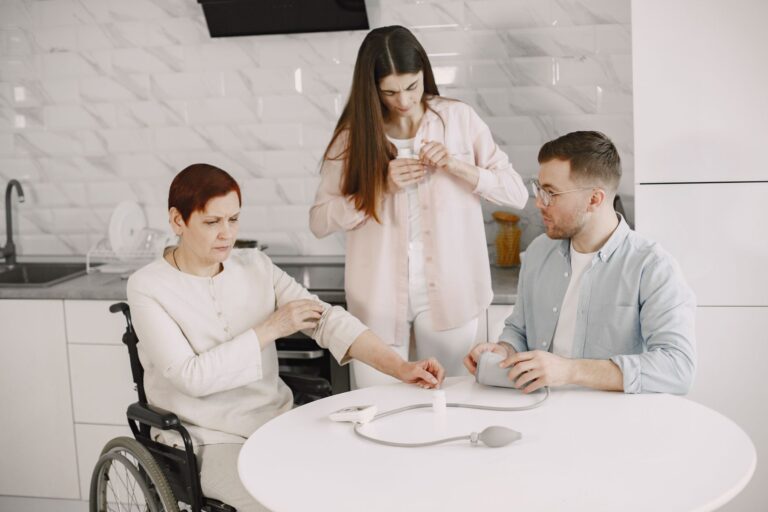
A busy dinner table can overwhelm someone with Parkinson's disease dementia when competing voices, background noise, and eating demands exceed their ability to focus. Parkinson's disease dementia, or PDD, means cognitive changes have become severe enough to interfere with daily life. The difficulty may involve attention and problem-solving before memory, making it hard to follow several speakers or shift between conversations. However, no dedicated study has established that busy dinner tables specifically overwhelm people with PDD; the closest research involved a small Parkinson's sample that was not limited to dementia.
Medical information disclaimer: This article is for general educational purposes only and does not provide medical advice, diagnosis, or treatment. Always consult a physician or other qualified health professional about symptoms, medications, tests, or treatment decisions.
Table of Contents
- Why conversation becomes difficult
- Eating adds another layer of work
- What the dinner-table evidence shows
- How to make dinner easier
- When a change needs medical attention
Why conversation becomes difficult
A group meal requires a person to identify who is speaking, understand the message, plan a response, and redirect attention when another person talks. PDD can disrupt these mental processes even when the person remembers everyone at the table. The Parkinson's Foundation's guidance on advanced thinking changes explains that attention and problem-solving may decline before memory.
someone may therefore manage a quiet, one-to-one conversation but lose track when several exchanges happen at once. Movement and cognitive symptoms can also limit participation in social settings. A person who responds slowly may still understand the conversation but need more time to process a question and organize an answer.
Eating adds another layer of work
Dinner is not only a conversation. The person must also handle utensils, manage food, and coordinate chewing and swallowing while deciding when to speak. Parkinson's can cause soft or slurred speech, trouble finding words, and swallowing difficulty, according to the Parkinson's Foundation's speech and swallowing fact sheet.
At a crowded meal, the effort of speaking clearly competes with the need to eat safely. This helps explain why "just join in" may not be a simple request. Listening, answering, and eating can become simultaneous tasks, and reducing one demand may make the others more manageable.
What the dinner-table evidence shows
A 2022 qualitative study included only eight people with Parkinson's and their partners. It was not a PDD-only study, so its findings cannot prove how every person with Parkinson's dementia will respond. Participants described background noise, larger groups, and managing eating or swallowing as barriers to mealtime conversation.
The Brain Sciences study reports lived experiences rather than testing whether particular changes reliably improve outcomes. Still, those experiences provide practical clues. Participants favored quieter restaurants, earlier dinners, smaller groups, face-to-face seating, and less multitasking. These options are reasonable to try, but the person's response should guide whether they help.
How to make dinner easier
Start by changing one or two demands rather than excluding the person from the meal. A quieter setting or smaller group can preserve social contact while making conversation easier to follow.
Useful adjustments include: These steps align with Parkinson's Foundation guidance for care partners, which recommends limiting distractions, simplifying communication, and allowing time to respond. Try adjustments separately when possible so you can see which ones make a meaningful difference.
- Turn off television or music during the meal.
- Seat the person where they can see the main speaker's face.
- Keep side conversations to a minimum.
- Ask one question at a time.
- Use short, simple cues.
When a change needs medical attention
Do not assume that every difficult dinner reflects the expected progression of dementia. Sudden confusion or a sharp decline in attention may be related to infection, medication effects, sleep problems, or delirium.
Seek prompt clinical evaluation when the change is abrupt or clearly different from the person's usual pattern. Note when it began, what medications were taken, recent sleep problems, and any other new symptoms so the clinical team receives a concrete account.