Families preserve travel souvenirs before Alzheimer's takes more memories by digitizing photos with location and date metadata, recording the person's own travel stories during early-stage illness, and organizing these materials into reminiscence therapy albums. This approach creates permanent records while the person with early-stage Alzheimer's can still articulate the details, memories, and emotions tied to past trips—before cognitive decline erases those contextual connections.
Travel souvenirs hold particular weight in Alzheimer's care because early-stage Alzheimer's primarily damages recent memory while preserving older autobiographical memories longer, allowing individuals to recall distant travel experiences even as they lose short-term recall. However, autobiographical memory decline causes loss of contextual details and personal details around experiences, leading to diminished sense of self and identity. Acting early captures both the broad memory and the specific context—who was there, what was felt, why the trip mattered—before that layer disappears.
Medical information disclaimer: This article is for general educational purposes only and does not provide medical advice, diagnosis, or treatment. Always consult a physician or other qualified health professional about symptoms, medications, tests, or treatment decisions.
Table of Contents
- Why Travel Memories Fade Differently in Alzheimer's
- The Optimal Time to Capture Travel Stories
- How to Digitize and Organize Travel Souvenirs
- Using Preserved Memories in Daily Care
- Starting When It Feels Too Early
- Frequently Asked Questions
Why Travel Memories Fade Differently in Alzheimer's
Alzheimer's doesn't erase all memories equally. The disease attacks short-term memory first, which means a person may remember a trip from 20 years ago but struggle to recall last week. This pattern gives families a window: older travel memories survive longer than recent ones, but only if the contextual details are locked down before decline accelerates.
The real loss isn't forgetting the trip happened—it's forgetting *who was there*, *what you felt*, *why it mattered*. These details are what anchors identity. When contextual memory fades, a photo becomes just an image rather than a story tied to a specific moment in the person's life. Recording these details while the person can still articulate them preserves the emotional and relational weight that makes travel memories valuable.
The Optimal Time to Capture Travel Stories
Early-stage Alzheimer's (mild cognitive impairment and mild dementia stages) can last 2 to 7 years, and this period is when families should prioritize recorded interviews. At this stage, the person can still participate in meaningful conversation about their experiences, even if short-term memory is noticeably affected. Waiting longer risks losing the ability to capture their own voice, perspective, and details about travels.
The best approach is a structured but conversational recording. Use travel photos as prompts and ask open questions: *Where did you go? Who was with you? What do you remember about that day?* Record audio or video, not just written notes. Many families later report that hearing a loved one's voice explaining a travel memory—even if other details fade—becomes irreplaceable as the disease progresses. Some services like StoryCorps or local aging organizations offer guidance on recording life stories specifically for dementia contexts.
How to Digitize and Organize Travel Souvenirs
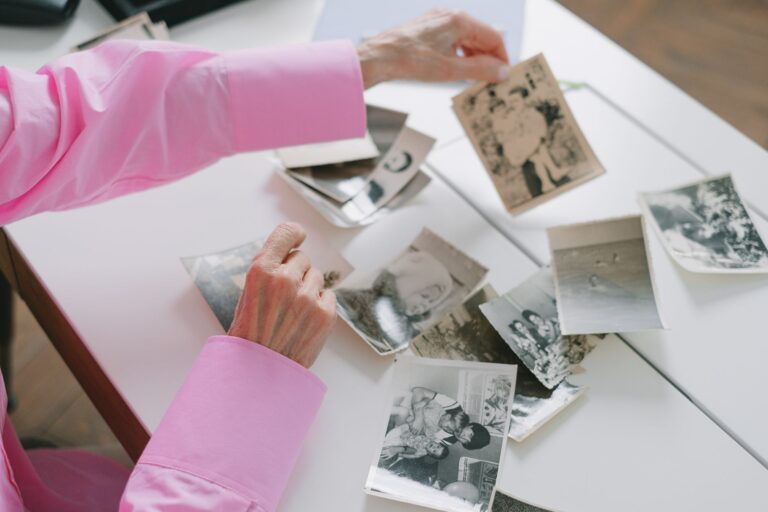
Start by gathering all travel photos, tickets, postcards, journal entries, or mementos tied to specific trips. Digitizing travel photos with detailed metadata—date, location, people present—creates permanent records that preserve memories independently of cognitive decline. Use a phone or scanner for physical items, and make sure the digital file includes location tags and dates. Organize digitized images chronologically by trip or year, not randomly.
Create folders for each major trip or travel period. Add written captions with names of people, places, and context directly into the file metadata or a spreadsheet linked to the images. This effort—tedious as it may feel—becomes essential once recall falters. A photo labeled "July 1998, Costa Rica, Jim and Margaret's anniversary trip" communicates far more than an undated image. If hiring help, companies specializing in photo digitization for seniors can handle scanning and basic organization, though you'll still want to add personal context notes yourself.
Using Preserved Memories in Daily Care
Once travel memories are digitized and organized, they become tools for connection rather than just archives. Reminiscence therapy—using photos, souvenirs, music, and sensory items to spark memories—is an evidence-based approach supported by the Alzheimer's Association that stimulates cognitive engagement and maintains dignity. For travel specifically, looking through photos or hearing recorded stories about a trip can reduce anxiety and confusion on difficult days.
Photo reminiscence therapy improves emotional wellbeing, reduces anxiety and agitation, and strengthens family bonds by enabling structured conversations about past travel experiences. Beyond individual moments, digital storytelling that includes travel narratives reduces depressive symptoms and neuropsychiatric distress while improving cognition and communication. This means a curated digital album or video of travel memories isn't sentimental overhead—it's part of an evidence-supported care approach that benefits the person's mood, behavior, and quality of life.
Starting When It Feels Too Early
Many families delay preservation, assuming they have time or that "it's not that bad yet." By the time memories noticeably slip, the window for recorded interviews and detailed context-gathering has narrowed significantly. If your family member has received an Alzheimer's or dementia diagnosis, or if you've noticed gaps in short-term memory alongside normal recall of older events, the time to start is now—not next year. You don't need expensive services or perfect photo quality.
A phone recording of a person explaining their favorite trip, labeled clearly with dates, is infinitely more valuable than pristine, undated photos. Start with one significant trip—a memorable vacation, honeymoon, or adventure—and build from there. The goal is capturing enough detail and voice that, years later, family members can step into that person's experience and maintain connection through shared memory, even if the person themselves cannot.
Frequently Asked Questions
What if we didn't start preserving memories early enough?
Reminiscence therapy still works with existing photos and family recollections, even if the person with Alzheimer's can no longer provide the original context. Use what you have—photos, tickets, journals from family members—to create albums now. The goal shifts from capturing their voice to using visual cues to prompt conversation and emotional engagement, which still benefit mood and connection.
How detailed does the metadata need to be?
Aim for at least date, location, and names of people present. If you can add brief context ("anniversary trip," "my first time abroad," "with college friends"), that's valuable but not essential. Start with the basics rather than waiting for perfection; something is far better than nothing.
Can we use this with someone in middle or late-stage Alzheimer's?
Yes. While the benefits look different than with early-stage reminiscence, photos and recordings still reduce agitation and create moments of connection. However, recorded interviews become more difficult as language and recall decline, so capturing the person's own voice during earlier stages is irreplaceable.