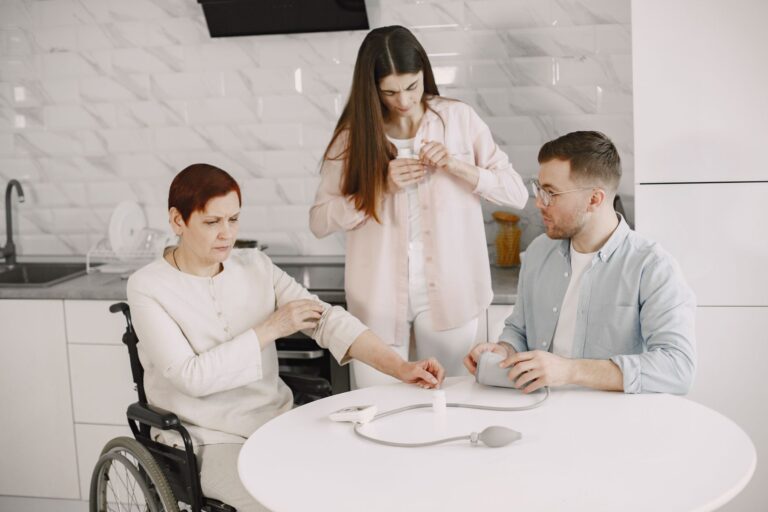
Rephrasing questions for someone with dementia means breaking down complex language into shorter, simpler sentences with one idea per question, using concrete words instead of abstract concepts, and giving more time for processing and response. The goal is to match how the person’s brain currently works—not how it worked before the diagnosis. For example, instead of asking “Would you prefer to attend the community center’s spring luncheon next Tuesday or would you rather we arrange something here at home?” you might ask “Do you want to go out for lunch?” and then follow up later about the specific time and place if they’re interested. The reason this matters is that dementia changes how the brain processes language, memory, and abstract thinking. Even someone with mild cognitive decline may struggle with questions that require holding multiple pieces of information at once, understanding hypothetical scenarios, or parsing complex grammar.
Open-ended questions often feel overwhelming, and yes-or-no questions sometimes feel like traps if the person isn’t sure what you’re really asking. A well-rephrased question gives your loved one the actual chance to respond authentically, rather than defaulting to confusion or frustration. Rephrasing is not dumbing down or losing respect for the person. It’s adjusting your communication to match their current reality, the same way you’d speak louder to someone who’s hard of hearing or use simpler words with a young child. Done well, it makes conversation feel less like interrogation and more like genuine connection.
Table of Contents
- Understanding How Dementia Changes Question Processing
- Questions to Avoid When Communicating With Dementia
- Rephrasing Techniques That Work in Real Conversations
- Pacing and Silence Matter as Much as Word Choice
- When Rephrased Questions Still Don’t Work
- Environment and Timing Shape Question Success
- Adjusting Your Questions Based on the Person’s Response
Understanding How Dementia Changes Question Processing
Dementia affects multiple language systems at once. A person might understand individual words but lose the ability to hold several ideas together. They may struggle with verb tenses, prepositions, and cause-and-effect relationships. They often lose access to recent memories while holding onto older ones, so asking “What did you have for breakfast this morning?” may be impossible to answer, but asking “What was your favorite breakfast food?” might unlock a vivid story.
The timing of the dementia’s progression matters, too—someone in early-stage dementia may handle fairly complex questions with preparation, while someone in middle or late stage may need radically simplified language every single day. The working memory—the part of the brain that holds and manipulates information temporarily—shrinks in most forms of dementia. This is why a question like “Should we call your sister, or would you rather wait until tomorrow and call your brother instead?” creates a cognitive overload. The person has to remember what you just said, weigh two options, consider timing, and access memories of both siblings. A simpler version—”Do you want to call your sister?”—uses the same effort but asks only for an affirmative or negative response, plus relies on semantic memory (knowing who the sister is) rather than working memory.
Questions to Avoid When Communicating With Dementia
Multiple-choice questions with more than two options almost always backfire, even with mild dementia. “Would you like coffee, tea, juice, or water?” sounds like a simple offer, but it requires the person to process, compare, and decide among four items in real time. A limitation of this rule: some people in early-stage dementia may actually prefer a few options because it feels respectful, while others find it paralyzing. You may need to experiment with your individual loved one. The safest bet is to start with two options and expand only if they seem engaged. Questions phrased in the negative or double-negative create enormous confusion.
“Wouldn’t you rather not wear the blue shirt?” or “Don’t you not want to stay inside?” force the brain to do extra mental gymnastics to parse the negation. By the time the person figures out what you asked, they’ve forgotten the context. A straightforward positive option is always clearer: “Do you want to wear the blue shirt?” or “Do you want to go outside?” Abstract, hypothetical, or philosophical questions are nearly impossible for most people with moderate-to-late dementia. “What do you think the future holds?” or “Would you have done anything differently?” tap into executive function and future-planning that dementia damages early. Even “Why do you think your daughter hasn’t visited?” assumes a level of cause-and-effect reasoning that may no longer be available. A warning: pushing for an answer to an abstract question often leads to frustration, confabulation (the person making up an answer to fill the gap), or withdrawal from the conversation. It’s better to redirect to concrete, present-moment questions.
Rephrasing Techniques That Work in Real Conversations
Use concrete nouns instead of pronouns. Instead of “She called yesterday and wants to know if you’re free Saturday,” say “Your daughter called yesterday and wants to know if you’re free Saturday.” The second version doesn’t require the person to remember who “she” is or track the switch in subject. Concrete language anchors the conversation in something tangible. Break compound sentences into separate questions. “Would you like to take a walk and then have a snack?” becomes “Do you want to take a walk?” followed by (after the walk or later) “Do you want a snack?” Each question stands alone and doesn’t require the person to hold multiple ideas. This is sometimes slower, but it’s far more likely to result in a genuine answer rather than a confused stare or a default “yes” or “no.” Use present-tense, active language. “Are you feeling hungry right now?” works better than “Would you be interested in eating something when you get a chance?” or “Did you eat lunch earlier?” The first version asks about the current moment and uses simple present tense.
The second creates hypothetical timing issues. The third requires episodic memory, which dementia attacks early. Add context before asking the question. “I’m thinking about lunch” followed by “Do you want to eat now?” gives the brain a moment to prepare for the topic shift. Without context, a sudden question can feel like it came out of nowhere, and the person has to first figure out what you’re talking about before they can answer. A specific example: if you want to ask whether your loved one would like to go to an appointment, first say “Dr. Martinez works here at the clinic” or show a picture of the doctor, then ask “Do you want to go see Dr. Martinez today?”.
Pacing and Silence Matter as Much as Word Choice
Speaking more slowly than feels natural is non-negotiable. Most of us speak at about 150 words per minute in casual conversation. When talking to someone with dementia, aim for 100 words per minute or less—that means longer pauses between words and between sentences. It sounds strange and feels artificial at first, but it gives the brain time to process each word before the next one arrives. The alternative is word salad: the person hears a jumbled stream and gives up trying to decode it. Equally important is the silence after you ask the question. Give at least five to ten seconds of quiet waiting time before you repeat or rephrase.
Many of us have an impulse to jump in, clarify, or ask something new after two seconds of silence. But someone with dementia needs that time to access the language center, form a response, and push the words out. A comparison: if someone asked you a question in a language you’re still learning, you’d want several seconds to think before answering. This is similar territory—the language system is working harder than usual. If no answer comes after ten to fifteen seconds, don’t assume the person didn’t understand or doesn’t want to answer. Try rephrasing the question in even simpler language or give a concrete option: “Do you want to sit here?” with a gesture toward the chair. Sometimes a physical cue—pointing, showing a picture, or moving the person gently toward an option—communicates more clearly than words alone.
When Rephrased Questions Still Don’t Work
Yes-or-no questions seem foolproof, but they can backfire if the person doesn’t understand what you’re asking or feels trapped by the binary choice. Some people with dementia default to “yes” to everything as a way to cooperate or avoid conflict, even if it’s not what they want. Others get stubborn and say “no” reflexively. Neither response tells you what the person actually needs or prefers. A warning: if you ask “Do you want breakfast?” and the person says yes but then refuses to eat, they may not have understood the question, or they may have said yes to appease you and now feel forced into an unwanted activity. Watch behavior, not just verbal answers. Open-ended questions (“How are you feeling?” or “What would you like to do?”) often produce silence or nonsensical answers in moderate-to-late dementia.
The person’s brain hasn’t organized an answer to such a broad prompt. But completely eliminating open-ended questions can make conversations feel robotic and disrespectful. A middle ground is the semi-open question: “What was your favorite job?” gives some direction but leaves room for a genuine answer. If the person doesn’t respond, you pivot to a yes-or-no: “Did you work in an office?” or “Did you work outside?” Repetitive questions are a specific challenge. Some people with dementia ask the same question dozens of times per day: “When is my sister coming?” or “Did I eat lunch?” Each time they ask, they’ve genuinely forgotten they asked it five minutes ago. Rephrasing your answer each time can help—the first time, “Your sister is coming at 3 PM.” The second time, “She’s coming after lunch.” The third time, “In a little while.” The technique reduces frustration because the person hears something new rather than the same robotic answer repeated. A limitation: this works only so many times before both of you are exhausted. There’s no perfect solution to repetitive questioning, and at a certain point, you have to accept it as part of the disease and focus on responding with gentleness rather than endlessly redirecting.
Environment and Timing Shape Question Success
The setting where you ask a question dramatically affects whether the person can process it. A quiet, well-lit room with minimal distractions sets up success. A noisy dining room with the TV on, family members talking, and background music makes even a simple rephrased question nearly impossible to answer. The person’s brain is already working hard to filter out irrelevant sound; adding cognitive load on top of that guarantees confusion. Fatigue and time of day matter enormously too. Most people with dementia are more alert and verbal in the morning or early afternoon and decline as the day goes on—a phenomenon called sundowning.
Asking important questions or having necessary conversations in the morning gives you the best chance of a clear response. The person’s emotional state before you ask a question sets the tone. If they’re agitated, scared, or overwhelmed, they’re less able to process language. A short period of reassurance, a few minutes of sitting quietly, or helping them feel safe first makes subsequent questions answerable. For example, if your loved one is anxious about going to a medical appointment, asking “Are you ready to go to the doctor?” while they’re in panic mode will produce anxiety-driven answers or avoidance, not genuine preferences. Better to ask after you’ve had five minutes of calm conversation or done a calming activity together.
Adjusting Your Questions Based on the Person’s Response
If someone consistently doesn’t understand your rephrased questions, that’s data—it means you need to rephrase further or shift to a different communication method. Some people stop relying on words earlier than others. If your loved one can no longer process spoken language reliably but responds to physical cues, pictures, or gestures, lean into those tools. Showing someone a photo of their favorite food is often more effective than asking “Do you want to eat?” in words. A music player might prompt a memory of a song better than asking “Do you remember this song?” If the person gives you nonsensical answers but seems engaged, they may understand more than their words suggest. They might feel pressure to answer so they say something rather than admit confusion.
In this case, move away from verbal questions and toward observation: “I notice you look tired” or “Let’s rest for a bit” instead of “Are you tired?” The person’s nonverbal cues—facial expression, body tension, eye contact—tell you more than their words can. As the disease progresses, even the simplest rephrased questions may become inaccessible. Eventually, someone in late-stage dementia may not process words at all, or they may use words but without clear meaning. At that point, communication shifts entirely to touch, tone of voice, music, smell, and presence. The goal of rephrasing questions—finding out what the person wants or needs—stays the same, but the method transforms into something beyond language. Asking “Do you want water?” as words alone doesn’t work, but offering water with calm presence and observing whether the person swallows and seems comforted does work.
- —