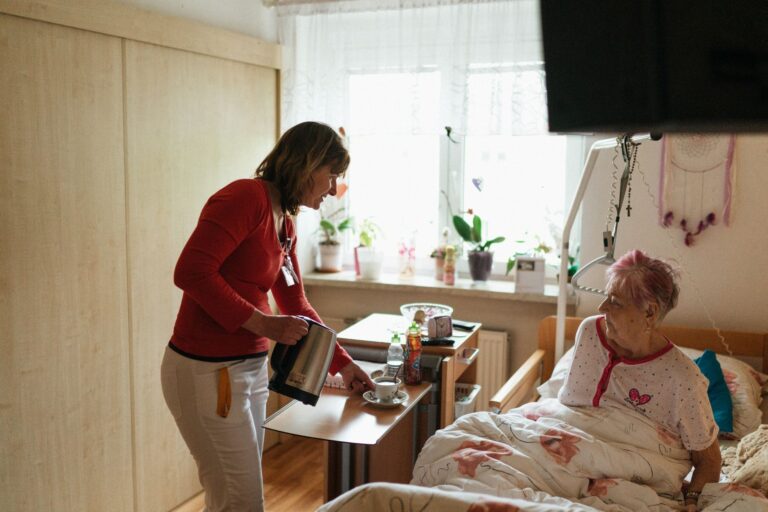
Toileting becomes one of the most challenging daily activities for people with dementia, as the disease damages the brain regions responsible for recognizing bladder signals, remembering where the bathroom is, and managing the physical sequence of using the toilet. Structured routines combined with environmental cues—like clear signage, consistent bathroom locations, and scheduled prompting—can reduce bathroom accidents by 30-50% according to dementia care research. When a person with mid-stage dementia starts having accidents, it’s rarely because they’ve “lost control”—it’s because they’ve lost the internal and external cues that guided them to the toilet successfully for decades. A daughter managing her mother’s care might notice that accidents happen most often in the afternoon, in unfamiliar spaces, or when the bathroom door is closed.
These aren’t random. Dementia erodes the ability to initiate toileting behavior without external triggers. By introducing a simple routine—guiding her mother to the bathroom every two hours, using a brightly colored toilet seat, and keeping the bathroom door open—many of these accidents can be prevented. The brain may be failing, but the routine bypasses that failure.
Table of Contents
- Why Dementia Disrupts Toileting and Bathroom Awareness
- Scheduled Toileting Routines—The Foundation of Accident Prevention
- Environmental Cues That Signal “Bathroom” to a Failing Memory
- Verbal and Non-Verbal Prompting Strategies
- Managing Refusal, Resistance, and Catastrophic Reactions
- Clothing and Physical Setup That Facilitate Independence
- When Toileting Becomes Impossible and Alternatives Emerge
Why Dementia Disrupts Toileting and Bathroom Awareness
Dementia damages three distinct brain systems that govern toileting: the systems that recognize the urge to urinate, the memory systems that store “where the bathroom is,” and the executive function networks that sequence the steps of toileting (finding the bathroom, pulling down clothing, sitting, wiping, flushing). Early-stage dementia might cause only occasional forgetfulness about bathroom location. Mid-stage dementia causes repeated accidents because the person stops recognizing the urge entirely and cannot initiate the trip independently. Late-stage dementia may involve complete loss of toileting awareness.
The incontinence that appears in dementia is different from age-related incontinence in people without cognitive decline. A person with dementia may have a perfectly functional bladder and bowel system but cannot access the signals their body sends. This means that typical incontinence treatments—like pelvic floor exercises or bladder training—do not help. Instead, the focus shifts to environmental design, routine, and cue-based prompting. someone with dementia who stops using the toilet successfully often regains that function when caregivers introduce consistent prompting and environmental modifications, even though their cognitive decline may continue.
Scheduled Toileting Routines—The Foundation of Accident Prevention
The most effective intervention is a predictable toileting schedule, typically every two hours during waking hours and once at night if the person is still mobile. This schedule does not depend on the person recognizing their need to urinate; instead, the caregiver initiates the trip before an accident can occur. For someone who has been having frequent accidents, starting with a two-hour schedule and gradually adjusting based on observed patterns usually eliminates daytime accidents within two to three weeks.
Timing matters: most dementia-related bathroom accidents happen in the late afternoon and early evening, when mental fatigue worsens and routine vigilance from caregivers may drop. Scheduling bathroom visits at predictable times—after breakfast, mid-morning, lunch, mid-afternoon, supper, and bedtime—removes the need for the person to remember or initiate. A limitation of this approach is that it requires consistent participation from caregivers or staff, which becomes unsustainable in under-resourced care environments. In facilities with minimal staffing, scheduled toileting is often abandoned in favor of adult briefs, which is why family members and professional caregivers emphasize the need for adequate staffing in dementia care settings.
Environmental Cues That Signal “Bathroom” to a Failing Memory
People with dementia rely heavily on visual and spatial cues when verbal instructions no longer register. A bathroom door painted a high-contrast color (such as bright blue or yellow against a white wall) is easier to locate than a door matching the hallway. Leaving the bathroom door open signals “here is the facility you need,” whereas a closed door obscures the room entirely. Inside the bathroom, a toilet seat in a contrasting color—white seat on a dark toilet, or a raised toilet seat in bright colors—makes the actual target clearer than a standard bowl. Signage works for some people but not others.
A simple, large-print sign reading “TOILET” works better than a pictogram for people who are still literate. Directional arrows on the floor leading to the bathroom help orient someone who is lost. Removing other doors along the hallway—or making non-bathroom doors less obvious—reduces the confusion of multiple possible destinations. A warning: these cues work best in early-to-mid-stage dementia. In late-stage dementia, when recognition of written or pictorial symbols is also lost, physical guidance by a caregiver becomes necessary instead.
Verbal and Non-Verbal Prompting Strategies
“It’s time to use the bathroom” stated simply and directly often triggers the motor sequence of walking and using the toilet, even when spontaneous toileting has stopped. The prompt works best when given in a calm, matter-of-fact tone rather than as a question (“Don’t you need the bathroom?”), which can prompt refusal. Accompanying the verbal prompt with a gentle hand touch or guidance toward the bathroom converts the prompt into a physical cue as well.
Some caregivers use a consistent phrase or ritual: “Let’s go visit the bathroom before we have lunch.” The routine of the phrasing and the timing creates a conditioned response over weeks. Others combine the prompt with a small reward—using the bathroom is followed by a preferred snack or activity, which reinforces the behavior through positive association. A tradeoff: over-reliance on verbal prompting can mask the gradual loss of the person’s ability to undress or sit down independently, so caregivers must remain attentive to whether physical assistance is being added to the routine.
Managing Refusal, Resistance, and Catastrophic Reactions
Some people with dementia refuse to use the bathroom or become agitated when a caregiver suggests it. This resistance often stems from fear, shame, or a genuine lack of recognition that anything is wrong. Forcing the issue typically escalates into a catastrophic reaction—extreme agitation, verbal refusal, or physical resistance that makes toileting impossible.
Instead, caregivers are taught to back away, wait 10-15 minutes, and try again, often using different language or a different caregiver. A person who becomes upset about being guided to the bathroom might accept it if a spouse rather than a hired caregiver makes the suggestion, or vice versa. If the phrase “bathroom” triggers refusal, some caregivers use substitute language: “Let’s go wash your hands,” or “Come with me.” These approaches work because they bypass the fear or shame associated with the direct term. A significant limitation is that these workarounds require trial-and-error learning and constant adjustment; what works on Tuesday may not work on Wednesday, and caregivers report that this emotional labor is often the hardest part of toileting assistance.
Clothing and Physical Setup That Facilitate Independence
Clothing that is easy to remove—elastic-waist pants rather than zippers and buttons, or pull-on dresses—allows a person to retain some independence in the final steps of toileting even as other abilities decline. A raised toilet seat reduces the strength required to sit and stand, which keeps someone mobile longer. A grab bar beside the toilet prevents falls, which are both dangerous and traumatic (a fall often triggers fear-based refusal of toileting in future).
Accessible clothing becomes particularly important in settings where caregivers cannot always be immediately present. A person wearing simple elastic pants and briefs can still manage partial undressing, whereas someone in complicated clothing cannot, leading to accidents in or near clothing rather than in the toilet. This practical detail—the choice of clothing—accounts for a meaningful difference in dignity and independence during the toileting process.
When Toileting Becomes Impossible and Alternatives Emerge
In late-stage dementia, even a consistent routine and environmental cues may not prevent accidents, because the person can no longer undress, sit, or cooperate with guidance. At this stage, caregivers must transition to alternatives: absorbent briefs, frequent changing of briefs to prevent skin breakdown, and meticulous hygiene to avoid urinary tract infections, which are common in people who are incontinent and immobile.
Attempting to maintain toileting when someone is no longer capable of participating often results in injury, frustrated caregivers, and distressed persons with dementia. The shift to briefs is not a failure of the routine—it is a recognition that the disease has progressed beyond what environmental or behavioral interventions can address.
- —