Seven exercises that reliably build lower back strength include the bird dog, glute bridge, dead bug, partial curl, wall sit, side plank, and the prone back extension. These movements target the muscles along the spine, the deep stabilizers of the trunk, and the glutes, which together form the foundation of lumbar support. For older adults, especially those living with cognitive decline, maintaining a strong lower back is not merely about avoiding pain. It is about preserving the ability to stand up from a chair, walk without shuffling, and reduce fall risk, which remains the leading cause of injury-related hospitalization in people over sixty-five.
Research from the Journal of Aging and Physical Activity has shown that adults who engage in regular trunk-strengthening exercises experience fewer episodes of acute low back pain and demonstrate better balance during functional tasks like reaching for objects on a high shelf or turning to look behind them. A 2022 study published in Dementia and Geriatric Cognitive Disorders found that structured physical exercise, including core and back work, slowed the decline of activities of daily living in participants with mild to moderate Alzheimer’s disease. This article walks through each of the seven exercises in detail, explains the specific muscles involved, discusses modifications for people with limited mobility or cognitive challenges, and addresses when these exercises may not be appropriate. Beyond the exercises themselves, this piece covers how caregivers can safely guide someone through a routine, the relationship between spinal strength and fall prevention, and the often-overlooked connection between chronic back pain and behavioral symptoms in dementia. Not every exercise suits every person, and knowing when to modify or skip a movement matters as much as knowing how to perform it.
Table of Contents
- Why Do These Seven Exercises Specifically Strengthen the Lower Back?
- How to Perform Each Exercise Safely and Effectively
- The Connection Between Lower Back Strength and Fall Prevention in Dementia
- Adapting Exercises for Different Stages of Cognitive Decline
- When Lower Back Pain in Dementia Is Not What It Seems
- Building a Realistic Weekly Routine
- The Emerging Research on Exercise and Cognitive Preservation
- Conclusion
- Frequently Asked Questions
Why Do These Seven Exercises Specifically Strengthen the Lower Back?
The lower back does not operate in isolation. The lumbar spine is stabilized by a network of muscles that includes the erector spinae running along the vertebral column, the multifidus tucked deep beside each vertebra, the transverse abdominis wrapping around the trunk like a corset, and the gluteus maximus and medius acting as the power base for upright posture. Weakness in any one of these groups forces the others to compensate, which is how strain and injury begin. The seven exercises listed above were selected because together they address all of these muscle groups without requiring heavy loads or gym equipment. The bird dog, for instance, trains the multifidus and erector spinae while simultaneously engaging the glutes and challenging balance. The dead bug targets the transverse abdominis and teaches the body to stabilize the spine while the limbs move, a skill that translates directly to walking.
The glute bridge isolates the gluteus maximus, which in many older adults has become inhibited from prolonged sitting. Each exercise serves a distinct mechanical purpose, and performing them as a group creates a more complete strengthening effect than any single movement could achieve alone. Compare this approach to the common advice of simply walking more. Walking is valuable for cardiovascular health and general mobility, but it does very little to strengthen the deep spinal stabilizers. A person can walk ten thousand steps a day and still have a weak multifidus, which is one reason why back pain persists even in otherwise active older adults. Targeted strengthening fills that gap.

How to Perform Each Exercise Safely and Effectively
The bird dog begins on hands and knees. You extend the opposite arm and leg simultaneously, hold for three to five seconds, and return to the starting position. The key is keeping the hips level and the lower back from arching. For someone with dementia who may not process verbal cues easily, a caregiver can gently place a hand on the lower back as a tactile reminder to keep the spine neutral. Start with two sets of six repetitions per side. The glute bridge is performed lying on the back with knees bent and feet flat on the floor. You press through the heels to lift the hips until the body forms a straight line from knees to shoulders, hold briefly, and lower back down.
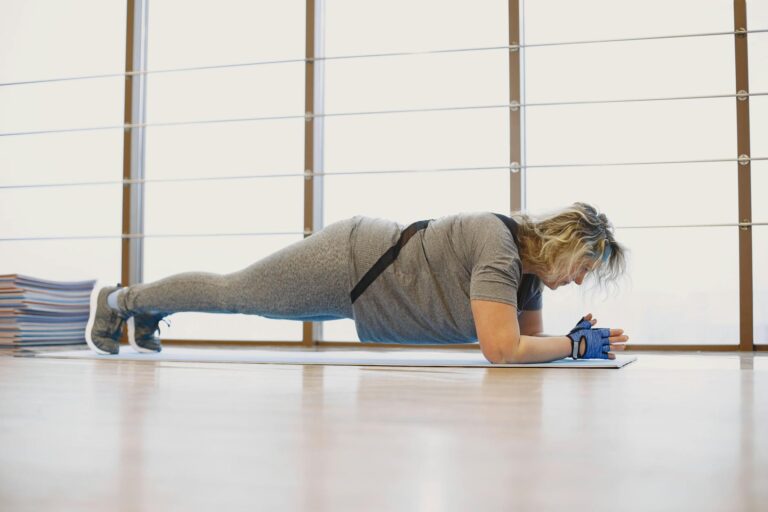
The dead bug also starts on the back, with arms extended toward the ceiling and knees bent at ninety degrees. You slowly lower one arm overhead and the opposite leg toward the floor, then return. The partial curl is a modest abdominal contraction where you lift only the head and shoulders off the floor rather than performing a full sit-up, which places excessive force on the lumbar discs. However, if someone has osteoporosis with vertebral compression fractures, prone back extensions and even partial curls may be contraindicated. Flexion and extension under load can worsen fracture pain or cause new fractures in severely osteoporotic bone. In these cases, isometric exercises like the wall sit and side plank are safer alternatives because they strengthen muscles without moving the spine through ranges that stress fragile vertebrae. Always consult with a physician or physical therapist before starting a new exercise program when bone density is a concern.
The Connection Between Lower Back Strength and Fall Prevention in Dementia
Falls in people with dementia occur at roughly twice the rate of cognitively healthy older adults. A study in the journal Age and Ageing reported that community-dwelling individuals with Alzheimer’s disease had a fall rate of approximately 60 percent over a six-month period, compared to about 30 percent in age-matched controls. The reasons are multifactorial. Cognitive decline impairs spatial awareness and reaction time, medications cause dizziness, and the disease itself may affect motor planning areas of the brain. But one modifiable factor is trunk and lower back strength. When the lumbar stabilizers are weak, the body’s center of gravity shifts forward.
This creates a stooped posture that makes recovery from a stumble far more difficult. A strong lower back allows a person to maintain an upright trunk, shift weight efficiently during walking, and engage the posterior chain muscles quickly when balance is disrupted. In a practical sense, the difference between catching yourself after tripping on a rug and falling hard onto a hip often comes down to how fast the erector spinae and glutes can fire. At a memory care facility in Portland, Oregon, a physical therapist introduced a simplified three-exercise routine of glute bridges, wall sits, and bird dogs for residents with moderate dementia. Over twelve weeks, the group showed a 35 percent reduction in falls compared to the previous quarter. The exercises were performed seated or on mats with one-on-one guidance, three times per week for fifteen minutes. This is not a clinical trial, but it illustrates what is achievable when back strengthening is woven into daily care rather than treated as optional.

Adapting Exercises for Different Stages of Cognitive Decline
The practical challenge with exercise programs for people with dementia is not the exercises themselves but the delivery. In early-stage cognitive impairment, most individuals can follow verbal instructions, watch a demonstration, and perform movements independently with occasional cueing. A wall-mounted poster showing each exercise with simple illustrations can serve as a visual reminder, reducing the need for constant verbal repetition. In moderate stages, the person may not remember the sequence or may become confused by multi-step instructions. Here, hand-over-hand guidance becomes valuable. Rather than saying “extend your right arm and left leg,” a caregiver physically guides the limb through the motion while offering brief encouragement.
The dead bug exercise can be simplified to moving only the legs while the arms remain stationary. The glute bridge often works well at this stage because it involves a single intuitive motion, pressing the hips upward, that most people can perform with minimal instruction. In advanced dementia, active exercise becomes limited, but passive range of motion and supported standing still provide some benefit to the lower back musculature. The tradeoff here is real. A more complex exercise like the bird dog offers greater strengthening but demands cognitive engagement that may not be available. A simpler exercise like the wall sit offers less targeted strengthening but is easier to execute with assistance. Matching the exercise to the person’s cognitive capacity is more important than adhering rigidly to a seven-exercise protocol.
When Lower Back Pain in Dementia Is Not What It Seems
One of the most underrecognized problems in dementia care is that chronic pain, including back pain, often goes undiagnosed. People with moderate to advanced dementia may not be able to articulate that their back hurts. Instead, pain manifests as agitation, aggression, resistance to care, or withdrawal. A 2019 study in the journal Pain Medicine found that up to 50 percent of nursing home residents with dementia had undertreated pain, and musculoskeletal pain was the most common type. This matters for exercise programming because pain can both motivate and complicate the work. A person who grimaces during a glute bridge may not be refusing to cooperate.
They may be experiencing a herniated disc, spinal stenosis, or facet joint arthritis that makes the movement painful. Caregivers and family members should watch for nonverbal pain indicators during exercise: guarding of the lower back, facial grimacing, changes in breathing patterns, or sudden resistance to a movement that was previously tolerated. The limitation here is significant. Without the ability to get reliable verbal feedback, determining exercise tolerance requires close observation and, ideally, collaboration with a physical therapist who has experience in geriatric and dementia care. Pushing through pain in the name of strengthening can cause injury and erode trust, making future exercise sessions more difficult. When in doubt, reduce the range of motion, decrease the hold time, and monitor the response over several sessions before progressing.

Building a Realistic Weekly Routine
A practical schedule for lower back strengthening is three sessions per week on nonconsecutive days, each lasting ten to twenty minutes. Monday, Wednesday, and Friday mornings work well for many households because they establish a predictable rhythm, which is particularly helpful for people with dementia who benefit from routine. Within each session, choose four to five of the seven exercises, rotating the selection across the week to prevent boredom and ensure balanced muscle development. For example, Monday might include the bird dog, glute bridge, dead bug, and wall sit.
Wednesday could feature the partial curl, side plank, prone back extension, and glute bridge. Friday might repeat the Monday routine or introduce slight variations such as holding the bridge for a longer count. A caregiver in Austin, Texas, described pairing each exercise with a familiar song to make the routine more engaging for her husband with Lewy body dementia. The bird dog was always performed during “Stand By Me,” and he began to associate the music with the movement, reducing the need for verbal instruction over time.
The Emerging Research on Exercise and Cognitive Preservation
The relationship between physical exercise and brain health continues to generate compelling data. A 2023 meta-analysis in the British Journal of Sports Medicine concluded that resistance and balance training, which includes the types of exercises discussed here, was associated with a 20 to 30 percent reduction in cognitive decline over follow-up periods ranging from six months to two years. The mechanism likely involves increased blood flow to the hippocampus, reduced systemic inflammation, and improved sleep quality, all of which are disrupted in dementia.
This does not mean that lower back exercises will reverse Alzheimer’s disease. That claim would be irresponsible. But the evidence suggests that maintaining physical strength, including spinal stability, contributes to a longer period of functional independence and may slow the progression of disability even as the underlying neurodegenerative process continues. For families navigating a dementia diagnosis, exercise is one of the few interventions that costs nothing, has minimal side effects when done properly, and offers benefits that extend well beyond the lower back.
Conclusion
Strengthening the lower back through targeted exercises like the bird dog, glute bridge, dead bug, partial curl, wall sit, side plank, and prone back extension addresses a critical and often neglected aspect of dementia care. These movements reduce fall risk, support daily functioning, and may contribute to slower cognitive decline. The key is matching the complexity of the exercise to the individual’s cognitive and physical capacity, watching for signs of pain that the person may not be able to verbalize, and building the routine into a consistent weekly schedule.
For caregivers, the next step is to consult with a physical therapist familiar with geriatric populations to establish a baseline assessment and personalized plan. Start with two or three exercises performed gently and progress only when the person tolerates the current level without discomfort. Lower back strength is not built in a week, but the cumulative effect of consistent, modest effort over months can meaningfully change the trajectory of mobility and independence for someone living with dementia.
Frequently Asked Questions
Can someone with moderate dementia do these exercises without a caregiver present?
Generally, no. People with moderate dementia often have impaired judgment about their own physical limits and may not remember the correct form, increasing injury risk. A caregiver or trained aide should be present to guide movements, monitor for pain, and ensure safety during transitions from standing to floor exercises.
How long does it take to see improvement in lower back strength?
Most people notice improved ease with daily tasks like standing from a chair or turning in bed within four to six weeks of consistent training, three times per week. Measurable strength gains on clinical tests typically appear by eight to twelve weeks. Progress may be slower in people with advanced age or significant deconditioning.
Are these exercises safe for someone with spinal stenosis?
Some are, and some are not. Prone back extensions, which involve arching the back, can worsen symptoms in people with lumbar spinal stenosis because extension narrows the spinal canal further. Flexion-based exercises like the partial curl and positions like the glute bridge, which place the spine in a neutral or slightly flexed position, are generally better tolerated. A physical therapist should evaluate which movements are appropriate.
What if the person refuses to exercise or becomes agitated during the routine?
Refusal and agitation are common, especially in mid-stage dementia. Do not force participation. Instead, try again later in the day when the person may be in a calmer state. Shortening the session to just one or two exercises can reduce overwhelm. Some people respond better to exercise disguised as a game or paired with music rather than presented as a structured workout.
Is walking enough to strengthen the lower back?
Walking maintains general fitness and supports cardiovascular health, but it does not adequately strengthen the deep spinal stabilizers like the multifidus or transverse abdominis. People who walk regularly can still have significant lower back weakness. Targeted exercises are necessary to address the specific muscle groups that support the lumbar spine.