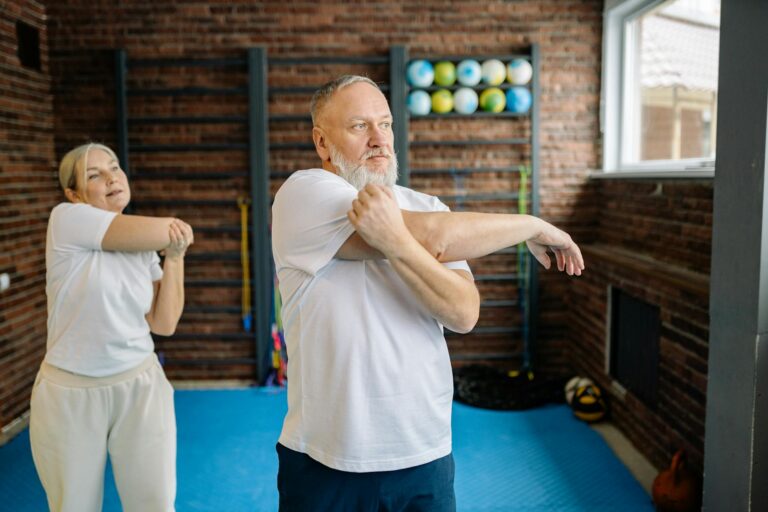
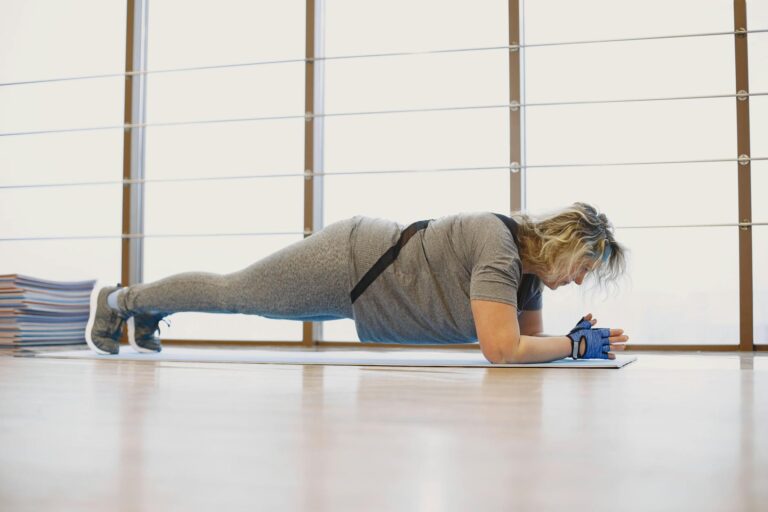
Seven exercises that reliably build core stability include the dead bug, bird dog, pallof press, glute bridge, modified plank, seated march, and farmer’s carry. These movements strengthen the deep muscles of the trunk — the transverse abdominis, multifidus, pelvic floor, and diaphragm — that work together to keep you upright, balanced, and less likely to fall. For older adults, and particularly those living with cognitive decline, these exercises serve double duty: they reduce fall risk while also supporting the kind of coordinated movement that keeps the brain engaged.
A 2019 study in the Journal of Aging and Physical Activity found that adults over 65 who performed structured core training three times a week reduced their fall incidence by 34 percent over six months. This article walks through each of the seven exercises in detail, explains why core stability matters more than raw core strength for aging adults, and addresses how cognitive impairment changes the way these exercises should be taught and supervised. You will also find guidance on when to modify or skip certain movements, how to pair core work with balance training, and what the research says about the connection between physical stability and cognitive function.
Table of Contents
- Why Does Core Stability Matter More Than Core Strength for Older Adults?
- The Seven Exercises Explained Step by Step
- How Dementia Affects Movement Patterns and Exercise Selection
- Building a Weekly Core Stability Routine That Sticks
- When Core Exercises Can Do More Harm Than Good
- The Link Between Physical Stability and Cognitive Health
- What Emerging Research Tells Us About Exercise and Fall Prevention in Dementia Care
- Conclusion
- Frequently Asked Questions
Why Does Core Stability Matter More Than Core Strength for Older Adults?
There is an important distinction between core strength and core stability, and it matters a great deal for people over 60. Core strength refers to how much force your abdominal and back muscles can produce — think of a sit-up or a crunch. Core stability, on the other hand, is the ability of those muscles to activate at the right time and in the right sequence to keep your spine and pelvis steady during movement. A person can have strong abdominal muscles and still fall because those muscles fail to fire quickly enough when they trip on a rug. For someone with dementia or mild cognitive impairment, this distinction becomes even more critical.
Reaction time slows as cognitive function declines, and the automatic stabilizing responses that most people take for granted — the split-second tightening of the trunk when you stumble — become delayed or disorganized. Training core stability essentially retrains those reflexive patterns, making them more automatic and less dependent on conscious thought. Compare this to doing crunches on the floor, which builds surface-level abdominal strength but does almost nothing to improve the anticipatory muscle activation that prevents falls. Research from the University of British Columbia published in 2021 showed that stability-focused core training improved both balance confidence and actual balance performance in adults with mild cognitive impairment, while traditional strength-only training showed improvements in muscle force but not in functional balance measures. The takeaway is straightforward: if the goal is to keep someone on their feet and moving safely, stability training wins.

The Seven Exercises Explained Step by Step
The dead bug is performed lying on your back with arms extended toward the ceiling and knees bent at 90 degrees. You slowly lower one arm overhead while extending the opposite leg, keeping your lower back pressed into the floor. This exercise teaches the core to stabilize the spine while the limbs move independently, which mirrors real-world activities like reaching for something while walking. For someone with cognitive difficulties, the coordination demand also provides a mild cognitive challenge, which is a benefit rather than a drawback. Start with just the leg movement if the arm-and-leg combination is too complex. The bird dog works from a hands-and-knees position. Extend one arm forward and the opposite leg back, hold for two to three seconds, then return.
The glute bridge has you lying on your back with knees bent and feet flat, pressing your hips toward the ceiling while squeezing your glutes. The pallof press uses a resistance band anchored at chest height — you press both hands straight out in front of you and resist the band’s pull to rotate your trunk. The modified plank is held from the forearms and knees rather than the toes, reducing spinal load while still demanding sustained core activation. The seated march is performed in a sturdy chair, alternately lifting each knee while keeping the trunk still. The farmer’s carry simply involves walking a set distance while holding a weight in each hand, challenging the core to keep the body upright and steady. However, if the person you are working with has significant balance impairment or is in the moderate to advanced stages of dementia, the bird dog and farmer’s carry may need to be replaced with seated alternatives. Attempting exercises that require kneeling or walking with weights can increase fall risk in individuals who lack the baseline balance to perform them safely. Always assess the person’s current ability before introducing a new movement, and have a spotter or physical therapist present during the first few sessions.
How Dementia Affects Movement Patterns and Exercise Selection
Dementia does not only affect memory. It disrupts motor planning, spatial awareness, and the ability to sequence movements — all of which are involved in exercise. A person with Alzheimer’s disease may understand the instruction to “lift your right leg” but struggle to initiate the movement or may lift the left leg instead. This is not a muscle problem; it is a brain-to-body communication problem known as apraxia, and it becomes more pronounced as the disease progresses. This means that exercise selection for someone with dementia must account for cognitive load, not just physical difficulty. The seated march, for example, is both physically simple and cognitively straightforward — lift one knee, put it down, lift the other.
The dead bug, by contrast, requires coordinating opposite limbs simultaneously, which some individuals in mid-stage dementia may find frustrating or impossible. A physical therapist working with a 74-year-old woman with moderate Alzheimer’s at a memory care facility in Portland found that simplifying the dead bug to single-leg-only movement — no arm component — allowed the patient to perform the exercise independently after three sessions of guided practice. Cueing strategies also matter enormously. Verbal instructions alone are often insufficient. Tactile cues, such as gently tapping the leg that should move, or visual demonstrations performed alongside the person, tend to be far more effective. Mirror exercises, where the caregiver performs the movement facing the person so they can copy it, leverage a type of motor learning that remains relatively intact even in moderate dementia.

Building a Weekly Core Stability Routine That Sticks
The most effective routine is the one that actually gets done, which means simplicity and consistency matter more than variety or intensity. A practical schedule is three sessions per week, each lasting 15 to 20 minutes, with two to three exercises per session rather than all seven. Rotating through the exercises across the week prevents boredom without overwhelming the person. A Monday-Wednesday-Friday rotation might look like this: Monday includes the dead bug, glute bridge, and seated march. Wednesday features the bird dog, pallof press, and farmer’s carry.
Friday repeats the dead bug, modified plank, and glute bridge. Each exercise is performed for two sets of eight to ten repetitions, or in the case of the plank and farmer’s carry, two sets of 15 to 30 seconds. Rest periods of 30 to 60 seconds between sets give the muscles time to recover without losing the person’s attention or engagement. The tradeoff between doing fewer exercises with better form and doing more exercises with declining quality always favors fewer and better. A caregiver who tries to rush through all seven exercises in a single session will almost certainly see form deteriorate by exercise five or six, which both reduces the effectiveness of the training and increases injury risk. For individuals with dementia, session fatigue also has a cognitive component — attention and cooperation tend to drop off sharply after about 20 minutes, so planning shorter, focused sessions yields better results than longer comprehensive ones.
When Core Exercises Can Do More Harm Than Good
Not every core exercise is appropriate for every person, and there are specific situations where certain movements should be avoided or significantly modified. Anyone with osteoporosis should avoid exercises that involve spinal flexion under load — traditional crunches and sit-ups are the main offenders, but even the dead bug can aggravate vertebral compression fractures if performed with too much range of motion. The modified plank is generally safe for people with osteoporosis because the spine stays in a neutral position, but it should be held for shorter durations if the person reports any back discomfort. Individuals who have had a recent hip replacement need to be cautious with the glute bridge, particularly if their surgical protocol restricts hip flexion beyond 90 degrees. The seated march also involves hip flexion, though typically within a safe range.
Always check with the person’s orthopedic surgeon or physical therapist before starting any new exercise program after joint replacement surgery. A less obvious concern is blood pressure. The pallof press and plank both involve sustained muscular effort without movement, which can cause significant spikes in blood pressure through what is known as the Valsalva effect — holding your breath while straining. For older adults on blood pressure medication or those with uncontrolled hypertension, these isometric holds should be kept short, and the person should be coached to breathe continuously throughout the hold. If blood pressure is poorly controlled, isometric exercises may need to be temporarily removed from the program altogether.
The Link Between Physical Stability and Cognitive Health
A growing body of research suggests that exercises requiring coordination and balance — rather than simple repetitive movements like walking on a treadmill — provide additional cognitive benefits. A 2022 meta-analysis in the British Journal of Sports Medicine found that motor-cognitive dual-task training, which includes exercises like the dead bug and bird dog that demand simultaneous coordination of multiple body parts, was associated with improvements in executive function and processing speed in older adults with mild cognitive impairment.
The mechanism appears to involve the cerebellum and prefrontal cortex, brain regions that are active during both complex movement and higher-order thinking. When a person performs a bird dog and has to think about which arm and which leg to extend while keeping their trunk still, they are essentially giving these brain regions a workout alongside their muscles. This does not mean that core stability exercises will prevent or reverse dementia — that claim would be irresponsible — but the evidence does suggest that physically engaging exercises offer a modest cognitive bonus that purely passive activities do not.
What Emerging Research Tells Us About Exercise and Fall Prevention in Dementia Care
The field is moving toward more personalized, technology-assisted approaches to fall prevention in people with dementia. Wearable sensors that detect changes in gait stability are being tested at several academic medical centers, with the goal of identifying increased fall risk weeks before a fall actually occurs. This would allow caregivers and therapists to intensify core stability training during high-risk periods rather than relying on a fixed schedule.
There is also growing interest in combining virtual reality with physical exercise for people in early-stage dementia. Early trials at the University of Exeter have used VR environments that require reaching, stepping, and trunk rotation — essentially embedding core stability challenges into an engaging, game-like experience. The results are preliminary, but adherence rates in these studies have been notably higher than in traditional exercise programs, which matters because the single biggest predictor of whether exercise prevents falls is whether the person keeps doing it.
Conclusion
Core stability training built around the dead bug, bird dog, pallof press, glute bridge, modified plank, seated march, and farmer’s carry offers a practical and evidence-supported approach to reducing fall risk in older adults. For people living with dementia, these exercises carry the added advantage of engaging the brain through coordination demands, and they can be adapted to a wide range of physical and cognitive abilities. The key principles are to prioritize stability over strength, match exercise complexity to the person’s cognitive capacity, and keep sessions short and consistent rather than long and ambitious.
If you are a caregiver beginning this process, start with the simplest exercises — the seated march and glute bridge — and add complexity gradually over weeks. Work with a physical therapist for the initial assessment and first few sessions if possible, particularly if the person has osteoporosis, recent joint surgery, or moderate to advanced cognitive impairment. Consistency over months matters far more than intensity on any given day, and even modest improvements in core stability can meaningfully reduce the likelihood of the falls that so often accelerate decline in people with dementia.
Frequently Asked Questions
How long does it take to see results from core stability exercises?
Most older adults begin to notice improved balance confidence within four to six weeks of consistent training, three sessions per week. Measurable reductions in fall risk typically appear after eight to twelve weeks. However, individuals with moderate to advanced dementia may take longer to show improvement because learning new movement patterns requires more repetition when cognitive function is impaired.
Can someone with advanced dementia still do core stability exercises?
Yes, but the exercise selection needs to be heavily simplified. The seated march and supported glute bridge are usually appropriate even for individuals in later stages, as long as they can follow basic one-step instructions or copy a demonstrated movement. Exercises requiring multi-step coordination, like the dead bug or bird dog, are generally not feasible in advanced dementia and should be replaced with simpler alternatives.
Are these exercises safe to do without a physical therapist?
The seated march, glute bridge, and modified plank are generally safe for most older adults to perform with caregiver supervision. The bird dog, dead bug, and pallof press involve more coordination and balance, so having a physical therapist teach proper form during the first few sessions is strongly recommended. The farmer’s carry requires good baseline balance and should not be attempted unsupervised by anyone with a recent fall history.
Should core stability exercises replace walking or other aerobic activity?
No. Core stability training and aerobic exercise address different aspects of health and fall prevention. Walking improves cardiovascular fitness and lower-body endurance, while core stability work improves trunk control and balance reactions. The best outcomes in fall prevention research come from programs that combine both types of exercise rather than relying on either one alone.
What if the person refuses to exercise or becomes agitated during sessions?
This is common, particularly in mid-to-late stage dementia. Never force exercise. Instead, try changing the time of day — many people with dementia are more cooperative and alert in the morning. Embedding exercises into familiar routines, such as doing seated marches while watching a favorite television program, can also reduce resistance. If agitation persists, consult the person’s care team to rule out pain or medication side effects as underlying causes.