Core strength sits at the center of this dementia and brain health question.
Five exercises — the pelvic tilt, bird dog, dead bug, modified side plank, and glute bridge — form the core of what spine specialists now recommend for patients looking to reduce pressure on injured discs. These movements share a common principle: they activate the deep stabilizing muscles of the trunk without forcing the spine into the flexion or heavy loading positions that tend to aggravate disc herniations. For someone dealing with a lumbar disc injury, which affects roughly 1 to 3 percent of the global population and is most concentrated in adults aged 30 to 50, this distinction between safe stabilization and harmful movement is not academic — it determines whether exercise helps or makes things worse. The clinical evidence behind these exercises has grown substantially.
A 2025 systematic review and meta-analysis of randomized controlled trials published in Frontiers in Medicine confirmed that exercise therapy enhances core muscle strength, relieves lower back and leg pain, and improves quality of life for patients with lumbar disc herniation. Three of the five exercises listed above come directly from the research of Dr. Stuart McGill, Professor Emeritus of Spine Biomechanics at the University of Waterloo, whose “Big 3” protocol has shown statistically significant improvements in pain, functional disability, and active back extension range of motion in clinical trials. This article walks through each exercise in detail, explains the research behind it, covers critical safety warnings that many general fitness resources get wrong, and addresses what to do when these foundational moves are no longer enough.
Table of Contents
- Why Do Spine Specialists Recommend Specific Core Exercises for Injured Discs?
- The Pelvic Tilt and Dead Bug — Building a Foundation Without Spinal Load
- McGill’s Big Three — The Bird Dog and Modified Side Plank in Practice
- The Glute Bridge — Why Posterior Chain Strength Matters for Disc Health
- Common Mistakes That Undermine Disc Recovery — and When to Stop
- What the Clinical Evidence Shows About Exercise Duration and Outcomes
- The Shifting Demographics of Disc Injury and What It Means Going Forward
- Conclusion
- Frequently Asked Questions
Why Do Spine Specialists Recommend Specific Core Exercises for Injured Discs?
The answer comes down to how disc injuries actually work mechanically. A herniated disc typically protrudes posteriorly — toward the back of the spine — which means any exercise that rounds the lower back forward under load can push the disc material further into the spinal canal or nerve root. Full sit-ups, toe touches, and many popular “core” exercises do exactly this. Spine specialists recommend the five exercises above because they train the muscles that brace and stabilize the spine without requiring the spinal flexion that worsens most herniations. The goal is not to build a stronger core in the traditional gym sense but to build a more enduring one.
As McGill’s research emphasizes, core endurance — not peak strength — is what helps people avoid the injury-causing postures and movement lapses that happen during a long day on your feet or at a desk. This is a meaningful distinction that separates clinical exercise prescription from what you will find in most fitness content online. A person recovering from a disc herniation who follows a standard core workout from a fitness app could easily make their condition worse. Lumbar stabilization exercises combined with the Abdominal Drawing-in Maneuver, or ADIM, have been shown to reduce lumbar segmental translation, essentially keeping spinal segments from shifting in ways that irritate the disc and surrounding nerves. The five exercises recommended here all incorporate this stabilization principle in different positions and loading patterns, which is why they work as a set rather than in isolation.

The Pelvic Tilt and Dead Bug — Building a Foundation Without Spinal Load
The pelvic tilt is where most spine specialists start because it teaches the fundamental skill that every other exercise on this list depends on: pressing the lower back flat against the floor by engaging the transverse abdominis, the deepest layer of the abdominal wall. Lying on your back with knees bent, you tilt the pelvis slightly upward until the lumbar curve flattens. There is no visible movement to an observer. The entire exercise happens internally, and that is the point. It decompresses the lumbar spine and builds the conscious connection between brain and core that patients with chronic back pain frequently lose. NJ Spine & Ortho and multiple spine rehabilitation centers recommend this as the entry point for disc herniation recovery.
The dead bug progresses this skill by adding limb movement while maintaining that same flat-back position. Lying on your back, you slowly extend the opposite arm and leg away from the body while keeping the lower back pressed into the floor. The exercise targets deep core stabilizers without spinal flexion or extension loading, making it particularly valuable for patients who are flexion-intolerant — which includes the majority of people with posterior disc herniations. However, if you cannot maintain the flat-back position while extending your limbs, you are not ready for this exercise. Performing the dead bug with an arching lower back defeats the purpose entirely and can increase disc pressure rather than reduce it. Scale back to the pelvic tilt until you can hold that position consistently before adding limb movement.
McGill’s Big Three — The Bird Dog and Modified Side Plank in Practice
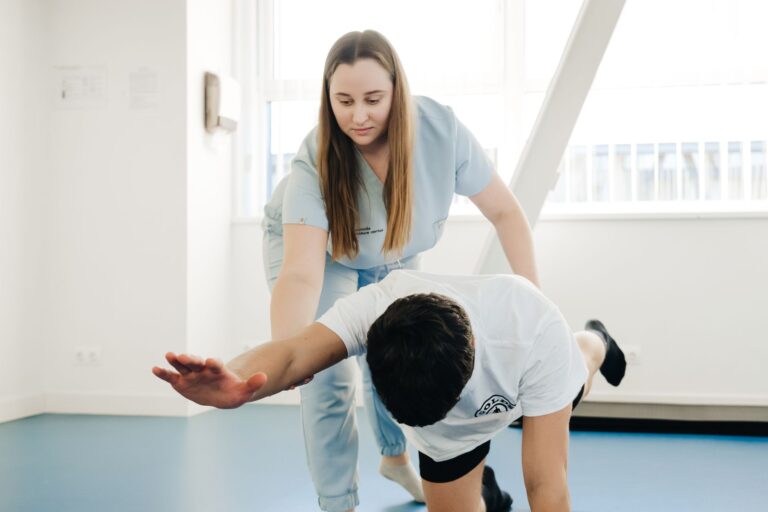
Dr. Stuart McGill’s Big 3 — the bird dog, side plank, and curl-up — emerged from decades of spine biomechanics research at the University of Waterloo, and two of these exercises appear on our list for good reason. The bird dog, performed from a hands-and-knees position by extending the opposite arm and leg while keeping the core engaged and the back neutral, trains the posterior chain and core simultaneously in a way that mimics real-world demands on the spine. You hold each repetition for three to five seconds per side, focusing on preventing any rotation or sagging through the trunk. A clinical study on McGill’s stabilization exercises found they provide additional benefit over conventional physiotherapy for chronic low back pain, particularly for pain reduction and functional disability.
The modified side plank builds lateral core endurance, a component most people neglect entirely. Standard core programs focus almost exclusively on the front and back of the trunk while ignoring the quadratus lumborum and obliques that prevent the spine from buckling sideways under uneven loads — which is what happens every time you carry a bag of groceries in one hand or lean to open a car door. The modified version, performed from the knees rather than the feet, places minimal compressive load on the spine while still building meaningful lateral endurance. For someone with a disc injury, the modification matters. Jumping to a full side plank too soon can create enough compressive force to aggravate symptoms, particularly if the lateral stabilizers have atrophied during a period of inactivity or pain avoidance.

The Glute Bridge — Why Posterior Chain Strength Matters for Disc Health
The glute bridge rounds out the five exercises by targeting a muscle group that many disc herniation patients overlook: the glutes. Performed lying on your back with knees bent and feet flat on the floor, you lift the hips by squeezing the glutes and hold for five to ten seconds at the top. This strengthens the posterior chain — glutes, hamstrings, and the muscles that support the lumbar spine from behind — and directly reduces disc pressure by improving how load distributes through the pelvis and lower back. Weak glutes force the lumbar spine to absorb forces that should be handled lower in the kinetic chain, which is one reason disc problems so often recur even after the initial injury heals. The tradeoff with the glute bridge is that it can be done incorrectly in a way that overloads the lower back.
If the glutes are weak or inhibited, people often compensate by hyperextending through the lumbar spine to get the hips higher. This is the opposite of what you want. A properly performed glute bridge should feel like the work is happening in the buttocks, not the lower back, and the top position should form a straight line from knees to shoulders — not an exaggerated arch. Compared to more advanced posterior chain exercises like Romanian deadlifts or hip thrusts with a barbell, the glute bridge offers a much lower-risk entry point. For someone dealing with an active disc herniation, this lower ceiling is a feature, not a limitation.
Common Mistakes That Undermine Disc Recovery — and When to Stop
The single most common mistake people make with disc herniation exercise programs is treating stretching as a universal good. It is not. For flexion-intolerant patients, which covers a large portion of those with posterior lumbar disc herniations, stretching the lower back often exacerbates the problem rather than relieving it. Dr. McGill has written and spoken extensively about this misconception: the instinct to stretch a painful back by pulling the knees to the chest or rounding into a child’s pose can push disc material further into the canal.
This does not mean stretching is always harmful, but it means a blanket recommendation to “stretch more” is genuinely dangerous for a specific and common subset of back pain patients. Another critical warning from specialists: all five of these exercises should be performed under the guidance of a healthcare professional, especially during the acute phase of a disc herniation when inflammation is high and the nerve root may be actively compressed. The fact that these exercises are safe relative to other options does not make them risk-free for everyone in every situation. If any exercise consistently increases radiating leg pain — pain that travels below the knee, numbness, or tingling in the foot — that is a signal to stop and consult your provider. Centralization of pain, where it moves from the leg toward the lower back, is generally a positive sign. Peripheralization, where it moves further down the leg, is not.

What the Clinical Evidence Shows About Exercise Duration and Outcomes
An eight-week Dynamic Neuromuscular Stabilization program studied in a randomized controlled trial demonstrated what is possible with consistent core training in disc herniation patients. Women with chronic lumbar disc herniation who followed the program saw significant reductions in pain, improved lumbar mobility, decreased functional disability, and enhanced trunk muscle endurance compared to the control group.
Trunk flexor endurance increased by approximately 24 seconds and extensor endurance by roughly 13 seconds in the training group. These numbers matter because they give a realistic timeline and magnitude of improvement — this is not a one-week fix, and the gains are measured in seconds of endurance rather than dramatic transformations. But those seconds of additional endurance translate directly into the ability to maintain safe spinal postures through a full workday, a grocery run, or a long drive.
The Shifting Demographics of Disc Injury and What It Means Going Forward
One trend worth noting: lumbar disc herniation has historically been considered a condition of middle age, but researchers have documented a significant upward trend among younger adults aged 18 to 35. Sedentary work, prolonged sitting, and reduced overall physical activity likely contribute to this shift. This has implications for how core stabilization exercise is prescribed and discussed.
Younger patients may be more physically capable but also more likely to push past safe limits or gravitate toward high-intensity training that loads the spine in ways incompatible with disc recovery. The five exercises outlined here are not age-dependent, but the coaching around them — particularly the emphasis on endurance over intensity and controlled movement over speed — becomes increasingly important as the patient population broadens. As research continues to refine stabilization protocols, the direction points toward individualized programming guided by clinical assessment rather than one-size-fits-all routines, which is why working with a spine specialist or physical therapist remains the most reliable starting point.
Conclusion
The five exercises spine specialists recommend — pelvic tilt, bird dog, dead bug, modified side plank, and glute bridge — work because they target the deep stabilizing muscles of the trunk without placing the spine in positions that aggravate disc herniations. The clinical evidence supporting core stabilization for disc injury is strong and growing, with multiple randomized controlled trials confirming improvements in pain, function, and endurance. The key principles to carry forward are that core endurance matters more than core strength, that spinal flexion exercises should be avoided in most posterior disc herniations, and that stretching is not universally beneficial for back pain.
If you are dealing with a disc injury, the most practical next step is to bring this list to a physical therapist or spine specialist who can assess your specific condition, determine which exercises are appropriate for your current phase of recovery, and help you progress safely. These five exercises are a starting point — a well-supported, clinically validated starting point — but they are not a substitute for professional evaluation. The gap between doing these exercises correctly and doing them in a way that looks correct but reinforces harmful patterns is exactly the kind of gap that professional guidance closes.
Frequently Asked Questions
Can I do these exercises during an acute disc herniation flare-up?
Not without professional clearance. During the acute inflammatory phase, even low-load exercises can aggravate nerve compression. Most spine specialists recommend waiting until the sharpest symptoms subside before beginning a stabilization program, and starting under direct supervision when you do.
How often should I perform these five exercises?
Most protocols studied in clinical trials use daily practice during the initial phase, typically for six to eight weeks. Dr. McGill’s approach emphasizes frequency over volume — short sessions done consistently matter more than occasional intense workouts.
Are full sit-ups ever safe for someone with a disc herniation?
Spine specialists broadly advise against them for patients with posterior disc herniations. Full sit-ups create significant flexion loading on the lumbar spine, which can push disc material further into the canal. The dead bug and pelvic tilt target the same muscles with far less spinal risk.
What if my pain gets worse while doing these exercises?
Pay attention to the direction of pain. If pain centralizes — moves from the leg toward the lower back — that is typically a positive indicator. If pain peripheralizes — travels further down the leg or causes new numbness or tingling — stop the exercise and consult your healthcare provider. Increased pain during exercise is not something to push through without professional assessment.
Can core exercises replace surgery for a herniated disc?
For many patients, yes. The majority of lumbar disc herniations resolve with conservative treatment including exercise, physical therapy, and time. However, some cases involving severe neurological deficits, progressive weakness, or cauda equina syndrome require surgical intervention. Core stabilization exercises are not a blanket alternative to surgery but are the first-line approach for most presentations.
How long before I notice improvement?
The randomized controlled trial on Dynamic Neuromuscular Stabilization showed measurable improvements in endurance, pain, and function after eight weeks. Some patients report reduced pain within the first two to three weeks, but meaningful functional gains typically require consistent effort over at least six to eight weeks.
You Might Also Like
- 5 Core Strength Exercises Spine Specialists Recommend to Reduce Pressure on Injured Discs
- 8 Exercises for Spine Strength
- 5 Physical Therapy Exercises Doctors Commonly Recommend for Stabilizing Herniated Discs Without Surgery
For more, see National Institute on Aging.