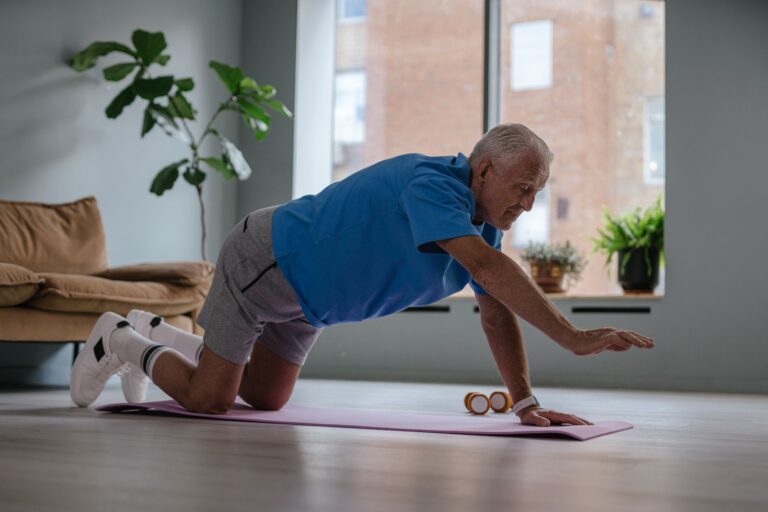
Spine stability sits at the center of this dementia and brain health question.
Spine stability is essential for injury prevention because the human spine cannot support its own weight without active muscular reinforcement. Without the coordinated action of muscles around the spine, the vertebral column collapses under as little as 20 pounds of load—roughly the weight of a small child or a bag of groceries. This fragility explains why seemingly minor falls or awkward movements can cause significant injury, and why maintaining strong, functional spinal stability is one of the most fundamental steps in protecting yourself from acute trauma and chronic pain.
For older adults and those experiencing cognitive decline, spinal stability becomes even more critical, as balance becomes compromised and fall risk increases substantially. Spinal stability depends on three interconnected systems working together: the active system (muscles), the passive system (bone, discs, and ligaments), and the neural system (your central nervous system coordinating everything). Injury prevention hinges on maintaining all three, which is why addressing spine stability requires more than just isolated exercises. This article examines how spinal stability works, what happens when it fails, and how multifaceted training approaches can reduce your risk of injury across daily activities and throughout aging.
Table of Contents
- What Exactly Is Spine Stability and Why Does It Matter So Much?
- The Three-Component System—How Your Spine Stays Protected
- The Reality of Spinal Injury—Statistics That Show Why Prevention Matters
- Core Stability Training—What Actually Works for Injury Prevention
- When Standard Approaches Fall Short—Understanding Limitations and Red Flags
- Additional Stabilization Methods—Beyond Exercise
- Spine Stability and Aging—Why This Becomes More Critical Over Time
- Conclusion
What Exactly Is Spine Stability and Why Does It Matter So Much?
Spinal stability refers to the spine’s ability to maintain its structural alignment and control movement under load. Your spine has 33 vertebrae stacked on top of each other, separated by discs and connected by ligaments—a delicate architecture that nature never intended to work alone. The three-component spinal stabilization system includes the passive subsystem (the bones, discs, and ligaments that provide structural scaffolding), the active subsystem (the muscles and tendons that dynamically support and control movement), and the neural subsystem (your brain and spinal cord that coordinate everything). When any component weakens or malfunctions, the entire system becomes vulnerable.
The consequences of compromised spinal stability extend far beyond the spine itself. Poor spinal stability leads to abnormal movement patterns that place excessive stress on joints, discs, and soft tissues throughout the body. A person with weak core stability might unconsciously shift their weight asymmetrically while standing or walking, causing one hip to bear more load, which eventually stresses the knee on that side. This cascade of compensation explains why addressing spinal stability can prevent injuries that appear to occur at the ankle, knee, or hip—they often originate with an unstable spine forcing other joints into compromised positions.

The Three-Component System—How Your Spine Stays Protected
The passive subsystem provides the foundational structure: vertebrae, the intervertebral discs (which act as shock absorbers), and ligaments (which restrict excessive motion). However, passive structures alone cannot maintain stability—they are simply not designed for it. Discs degenerate over time, ligaments lose elasticity with age, and bone density declines, particularly in women after menopause. This is why relying solely on passive structures leads inevitably to instability and injury risk as you age. The active subsystem—your muscles—is where dynamic protection lives. Multiple layers of deep and superficial muscles, particularly the core stabilizers (transversus abdominis, multifidus, and others), contract and adjust continuously to keep your spine centered and protected during movement.
These muscles must be trained with specificity; general fitness activity is not sufficient. A person might be able to run a half-marathon but still have dangerously weak spinal stabilizers if those muscles have never been specifically targeted. However, even strong muscles cannot work without proper neural control, which is why the neural subsystem matters so much. Your central nervous system must rapidly sense spinal position and load, then signal the right muscles to contract at the right time and intensity. This happens largely outside conscious awareness—you don’t think about bracing your core before reaching for a heavy pot. When the neural component fails (often due to disuse, injury, or neurological conditions), muscles may be strong but uncoordinated, and stability suffers. This interconnection means that an effective injury prevention strategy must target all three components, not just muscle strength alone.
The Reality of Spinal Injury—Statistics That Show Why Prevention Matters
Spinal cord injuries are far more common than many people realize. Globally, the incidence of spinal cord injury (SCI) is 23.77 per million people, with traumatic injuries occurring at a rate of 26.48 per million and non-traumatic injuries at 17.93 per million. Over the past two decades (2000-2021), this represents millions of individuals worldwide now living with the consequences of spinal injury. The United Kingdom alone has approximately 105,000 people currently living with spinal cord injury, and India has an estimated 1.5 million. Globally, spinal cord injury accounts for nearly 2.9 million years lived with disability, making it a significant and growing public health concern. Falls are the leading cause of spinal cord injury across all populations, accounting for more injuries than motor vehicle accidents or violence.
This is particularly relevant for aging populations and anyone with balance impairment or cognitive decline—falls become increasingly likely, and the consequences for the spine become increasingly severe. Another striking statistic: 80% of spinal cord injuries occur in males, suggesting that differences in activity patterns, risk-taking behavior, and perhaps occupational exposure contribute substantially to injury risk. However, a remarkably simple intervention—consistent seatbelt use—reduces spinal cord injury risk by more than 50%, demonstrating that prevention is highly actionable. What these statistics underscore is that catastrophic spinal injury is not rare or unlikely—it is a realistic outcome of falls, motor vehicle accidents, and high-impact trauma. While you cannot prevent every accident, maintaining strong spinal stability dramatically reduces your vulnerability when accidents do occur. A spine that is well-stabilized and positioned correctly absorbs impact better, limits excessive motion that damages neural tissue, and recovers better from trauma.

Core Stability Training—What Actually Works for Injury Prevention
Research on core stability training effectiveness provides clear evidence that targeted training prevents injuries across multiple contexts. In meta-analyses examining soccer players—a population with high injury rates and extensive research—core stability training reduced overall knee injury rates by 56%, with an even more dramatic 65% reduction in female players and a 46% reduction in male players. These numbers represent substantial protection from one of the most common and debilitating sports injuries. The reduction applies not just to acute traumatic injuries but also to overuse injuries, which suggests that improved spinal stability prevents both sudden trauma and the cumulative stress that leads to chronic pain. However, the research also reveals an important limitation: no single type of exercise has proven superior to all others. Stretching programs, strengthening programs, yoga, pilates, motor control exercises, and functional training all show benefit, but none consistently outperforms the others across all populations and injury types.
This means that the most effective approach is multifaceted programming that combines elements of strengthening, flexibility, motor control training, and functional movement integration. A person doing only stretching or only isolated strengthening will not achieve optimal spinal stability. The body requires varied stimulus to build resilient, coordinated stability across multiple movement planes and contexts. This finding has a practical implication: if you are designing your own injury prevention program or working with a trainer, be skeptical of anyone claiming that one specific method (pilates is best, or yoga is best, or core boards are essential) will solve your stability problems. Sustainability and compliance matter tremendously, so the best program is genuinely the one you will actually do consistently—as long as it incorporates multiple training modalities. A person who does 20 minutes of varied core work three times weekly will see better injury prevention results than someone who does intensive sessions only once monthly, regardless of the specific exercises chosen.
When Standard Approaches Fall Short—Understanding Limitations and Red Flags
Core stability training is remarkably effective for most people, but several populations require modified or additional approaches. Individuals with acute spinal cord injury, existing neurological conditions (such as Parkinson’s disease or multiple sclerosis), or severe osteoporosis need specialized programming designed by healthcare professionals rather than standard fitness protocols. Attempting standard core training without professional guidance in these populations can exacerbate existing problems rather than improve them. Additionally, someone with significant muscle weakness from extended bed rest or inactivity may need a more gradual progression than typical core programs provide; starting too intensely can cause injury rather than prevent it.
Another limitation to recognize: spinal stability training protects you primarily from injuries that occur during movement or under load. It does not meaningfully reduce risk from high-velocity impacts (such as being struck by a vehicle), extreme falls from heights, or trauma that exceeds the spine’s structural capacity. A person with excellent spinal stability will still suffer severe injury from a serious motor vehicle accident or a fall from a significant height. This is why stability training must be combined with other prevention strategies: seatbelt use, fall-proofing your environment, addressing balance impairments, and—particularly for older adults—managing vision problems and medication side effects that contribute to falls.

Additional Stabilization Methods—Beyond Exercise
While muscular training is the cornerstone of spinal stability, additional methods can provide meaningful support, particularly for individuals with compromised active systems. Abdominal belts and corsets, when worn properly, can independently improve lumbar spine stability by increasing intra-abdominal pressure, which acts like an internal corset bracing the spine. These devices are most useful as temporary supports during periods of high activity or recovery from injury, or for individuals who cannot generate sufficient muscular stability on their own.
However, overreliance on external supports can lead to weakness and atrophy of stabilizing muscles over time, so they should be used strategically alongside active training rather than as a replacement for it. Proper ergonomics and movement patterns also serve as stabilization methods in the practical sense. A person who lifts correctly, sits with appropriate posture, and avoids repeated end-range spinal movements (excessive bending, twisting, or hyperextension) will experience fewer destabilizing forces even with identical muscular capacity to someone with poor mechanics. This highlights that stability is not purely a matter of muscle strength—it is also about how you use your body throughout daily life.
Spine Stability and Aging—Why This Becomes More Critical Over Time
Spine stability becomes increasingly critical as we age because all three components of the system decline naturally. Passive structures lose elasticity and resilience; discs degenerate; bone density decreases; muscle mass decreases at approximately 3-5% per decade after age 30; and neural coordination becomes less precise. Simultaneously, fall risk increases due to balance changes, vision changes, medication side effects, and neurological changes associated with normal aging or conditions like dementia.
The combination means that at the precise life stage when spinal stability matters most—older adulthood—it is most difficult to maintain through passive means alone. For individuals experiencing cognitive decline, spinal stability takes on even greater urgency because behavioral factors that maintain stability (remembering to exercise, using proper body mechanics, avoiding risks) become compromised. This underscores why caregivers and healthcare providers for older adults and people with dementia should prioritize assessment and maintenance of spinal stability early, before decline accelerates. A person with strong, ingrained movement patterns and muscular stability may maintain safer function even as cognitive capacity declines, whereas someone beginning from a deficit will deteriorate more rapidly.
Conclusion
Spine stability is essential for injury prevention because the human spine is fundamentally designed to work with active muscular support—it cannot protect itself on structure alone. The three-component system (active muscles, passive structures, and neural coordination) must all function together to prevent injuries ranging from minor strains to catastrophic spinal cord injury. Evidence shows that multifaceted core stability training reduces injury rates by up to 56%, and that spinal instability contributes to injury cascades affecting joints far from the spine itself. Falls, which are the leading cause of spinal cord injury globally, become increasingly likely with age and cognitive decline, making proactive stability training crucial for anyone over 50 or at elevated fall risk.
The path forward is to assess your current spinal stability through professional evaluation, then commit to consistent, multifaceted training that includes strengthening, flexibility, motor control, and functional movement. For older adults and those experiencing cognitive decline, this assessment and training should begin before problems develop. Whether you work with a physical therapist, a qualified trainer, or a structured program, the goal is the same: maintain the muscular coordination and neural control that allows your spine to support itself and protect your entire body throughout life. In doing so, you reduce not only your risk of acute injury but also your risk of chronic pain, disability, and falls that compromise independence and quality of life.
You Might Also Like
- The Spine Strengthening Routine Used in Rehab Clinics
- The Spine Stabilization Routine Often Used for Back Pain
- The Physical Therapy Routine Often Used for Pelvic Stability
For more, see Alzheimer’s Association — clinical trials.