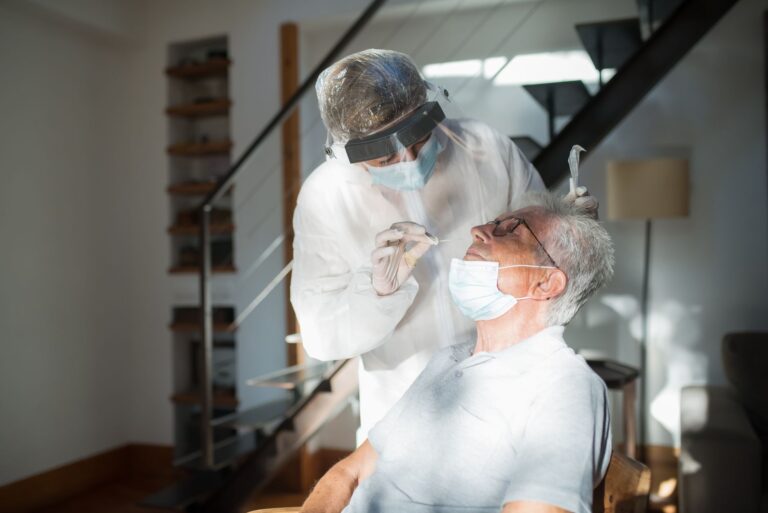
Speech therapy helps dementia patients with swallowing problems by teaching compensatory techniques, strengthening muscles involved in swallowing, and reducing the risk of aspiration—when food or liquid enters the lungs instead of the stomach. A speech-language pathologist (SLP) works with patients and caregivers to modify food textures, adjust eating positions, eliminate mealtime distractions, and practice targeted exercises like the Masako maneuver, which has shown the greatest improvement in swallowing severity according to recent research. For someone with moderate Alzheimer’s disease who has started coughing while drinking water or taking longer to swallow solid food, speech therapy intervention can mean the difference between maintaining safer eating habits and facing serious complications like aspiration pneumonia. More than half of older adults with dementia—approximately 58% according to meta-analysis data—develop swallowing disorders as the disease progresses.
In Alzheimer’s dementia specifically, the prevalence reaches 46% when measured through clinical assessment and climbs to 58% when detected through instrumental assessment like videofluoroscopy. The problem worsens dramatically with disease severity: between 84% and 93% of people in moderate to severe Alzheimer’s stages have measurable swallowing impairments. Even in earlier stages of cognitive decline, such as mild cognitive impairment (MCI), swallowing changes appear in 38% to 63% of patients, making early identification and intervention critical. Speech therapy addresses this widespread issue not by curing the underlying dementia but by providing practical strategies that keep people safer during meals and maintain their ability to eat and drink normally for as long as possible. The therapy combines behavioral interventions, physical exercises, and dietary modifications tailored to each person’s specific swallowing abilities and cognitive level.
Table of Contents
- How Common Are Swallowing Problems in Dementia?
- What Speech Therapy Techniques Actually Work for Dementia Swallowing?
- How Speech Therapists Assess Swallowing in Dementia Patients
- Practical Strategies Caregivers and Families Can Use
- Barriers That Prevent People With Dementia From Receiving Speech Therapy
- Silent Aspiration and Why Early Detection Matters
- What Recent Research Reveals About Swallowing Treatment in Dementia
How Common Are Swallowing Problems in Dementia?
Swallowing difficulties in dementia are far more prevalent than many families realize, and they emerge at different stages depending on the type of dementia. Alzheimer’s disease shows a 46% prevalence of swallowing disorders using standard clinical methods of detection, though that number jumps to 58% when doctors use more sensitive instrumental assessment tools that can visualize the swallowing mechanism in action. This gap between clinical detection and instrumental detection matters because it means some swallowing problems exist without obvious signs—a person might be aspirating silently, without coughing or showing distress, which makes professional assessment essential. As dementia progresses from mild to moderate to severe, swallowing problems escalate sharply.
In moderate to severe Alzheimer’s disease, between 84% and 93% of patients have some degree of swallowing impairment. The underlying cause is damage to the neural pathways that control the complex coordination required for safe swallowing: oral phase dysfunction (difficulty moving food in the mouth), pharyngeal reflex delays (slower triggering of the protective swallow), and reduced ability to clear food from the throat all become common. Even in mild cognitive impairment—the stage before a formal dementia diagnosis—between 38% and 63% of patients show measurable changes in swallowing function, suggesting that swallowing problems can begin early in cognitive decline. These statistics matter because they highlight why swallowing assessment should be part of routine dementia care. A patient who receives professional evaluation and intervention early has the opportunity to learn compensatory strategies before swallowing becomes severely impaired, maintaining safer eating and a better quality of life for longer.
What Speech Therapy Techniques Actually Work for Dementia Swallowing?
Speech-language pathologists use two main categories of intervention for dementia swallowing: compensatory strategies and rehabilitative exercises. Compensatory strategies—the most commonly prescribed approach according to practice pattern studies—focus on changing how and what someone eats rather than attempting to restore lost swallowing function. These include modifying food texture (thickening liquids, pureeing solid foods), positioning the head or body differently during swallowing, taking smaller bites, eating more slowly, and removing mealtime distractions that divide attention. Texture modification and fluid thickening are among the most frequently recommended interventions because they require no physical effort from the patient and provide immediate safety benefits. Rehabilitative exercises aim to strengthen or retrain the muscles and neural pathways involved in swallowing.
The Masako maneuver—which involves holding the tongue between the teeth while swallowing—emerged from a 2025 systematic review as showing the greatest improvement in dysphagia severity. Expiratory Muscle Strength Training (EMST), which strengthens the muscles used during exhalation and has protective effects during swallowing, significantly reduced aspiration risk in a 2025 meta-analysis. However, rehabilitative exercises require cognitive engagement and physical ability that not all dementia patients possess, which is why speech therapists often combine exercises with compensatory strategies tailored to what each person can realistically do. A limitation of current research is that while these techniques show effectiveness in general populations, the evidence base specifically for dementia patients remains limited. Studies demonstrate that interventions work, but they don’t yet provide clear guidance on which specific treatments work best for which stages of dementia or which individuals will benefit most, meaning SLPs must assess each person individually and adjust approaches based on response.
How Speech Therapists Assess Swallowing in Dementia Patients
Before recommending any intervention, a speech-language pathologist conducts a comprehensive swallowing assessment that combines clinical observation with, when appropriate, instrumental testing. During a clinical assessment, the SLP watches the patient swallow saliva, water, and foods of varying textures while listening for signs of aspiration such as wet voice quality (sounding hoarse after swallowing), difficulty controlling liquids in the mouth, or coughing. The clinician checks for problems during the oral phase (manipulating food in the mouth), pharyngeal phase (the reflex swallow itself), and esophageal phase (movement down the throat). Instrumental assessment uses videofluoroscopy—a modified barium swallow study where the patient swallows barium-coated foods while an X-ray camera records the movement—to visualize exactly where swallowing breaks down.
A patient might appear to swallow normally during clinical assessment yet show significant aspiration on videofluoroscopy, especially silent aspiration where the protective cough reflex fails and liquid enters the airway without any sign. For someone with dementia who cannot communicate subtle symptoms or follow complex instructions, instrumental assessment often provides crucial information that shapes the entire treatment plan. The challenge in dementia is that cognitive impairment complicates assessment. A patient with moderate dementia might not understand instructions to “hold the barium in your mouth and then swallow,” making it difficult to conduct a reliable assessment. Speech therapists must adapt their approach—using shorter instructions, repeating demonstrations, or simplifying the testing protocol—which means assessment itself requires expertise specific to dementia populations.
Practical Strategies Caregivers and Families Can Use
Behavioral interventions form the foundation of daily swallowing management and are strategies families can implement immediately with SLP guidance. These include eliminating mealtime distractions (turning off television, reducing background noise), serving small meals with hydration breaks rather than large volumes at once, ensuring good oral hygiene before and after meals, and consulting with a dietitian to ensure the person receives adequate calories and nutrition despite dietary modifications. A caregiver might transform a chaotic family dinner into a calm, focused mealtime where the person with dementia eats smaller portions more slowly—a simple change that can significantly reduce aspiration risk. Positioning is another critical factor.
Someone with swallowing difficulty should sit upright or slightly forward during meals, not reclined or slouched, because gravity and body positioning affect how safely food moves down the throat. After eating, the person should remain upright for at least 20 to 30 minutes to allow gravity to help food reach the stomach and prevent reflux. For someone with advanced dementia who cannot sit upright independently, this might mean eating only when two caregivers can position and support them safely—a practical tradeoff that clarifies why swallowing problems increase care demands as dementia progresses. A speech therapist also teaches caregivers the specific techniques for their family member: how to thicken liquids to the right consistency (thin, nectar, honey, or pudding thickness depending on swallowing ability), how to recognize early warning signs of aspiration such as changes in breathing after meals or new respiratory symptoms, and when to seek medical attention. Training is essential because improper technique—mixing thickener incorrectly or feeding too quickly—can negate the safety benefits of the modifications themselves.
Barriers That Prevent People With Dementia From Receiving Speech Therapy
Despite growing evidence for speech therapy’s effectiveness, significant barriers prevent many people with dementia from accessing swallowing therapy. A 2025 survey published in the International Journal of Geriatric Psychiatry found that healthcare providers were less likely to initiate dysphagia therapy for individuals with dementia compared to those without dementia—a troubling therapeutic bias rooted in concerns about quality of life, prognosis, and whether treatment would meaningfully improve outcomes. This bias means that a person with dementia and a swallowing problem might not be referred to a speech therapist at all, even when intervention could prevent serious complications. Resource constraints compound the problem. Many healthcare systems have insufficient SLP staffing, making referrals difficult to fulfill; referral processes are often inefficient, creating delays between identifying a problem and receiving assessment; and caregivers frequently lack knowledge about dysphagia in dementia, so they may not recognize warning signs or advocate for professional evaluation.
A family member might attribute coughing during meals to normal aging rather than recognizing it as a sign of aspiration that requires intervention. In long-term care facilities, understaffing means caregivers sometimes lack time to implement the feeding modifications a speech therapist recommends, creating a gap between treatment plan and actual care delivery. Another barrier is the limited efficacy evidence base. While interventions show promise, current research reveals that the quality and strength of evidence for dysphagia treatments specifically in dementia populations remains limited compared to studies in stroke survivors or other populations. This uncertainty sometimes discourages referrals or creates hesitation about pursuing aggressive intervention in advanced dementia, even though early intervention—before swallowing becomes severely impaired—is most likely to be effective.
Silent Aspiration and Why Early Detection Matters
Silent aspiration—when food or liquid enters the airway without triggering a cough—represents one of the most dangerous aspects of dementia swallowing problems. Normally, when something enters the airway, the protective cough reflex triggers immediately, expelling the foreign material. But in dementia, this reflex often fails or becomes delayed, so a person can aspirate without any awareness or obvious sign. They might not cough, feel discomfort, or show any indication that aspiration has occurred, yet the aspirated material is now in the lungs, creating conditions for pneumonia.
This is clinically significant because aspiration frequently leads to pneumonia—specifically, aspiration pneumonia—which ranks as a leading cause of death in frail elderly populations including those with advanced dementia. A family member who doesn’t recognize silent aspiration might think their loved one is managing meals safely when, in reality, repeated small aspirations are silently accumulating in the lungs. Regular coughing, new respiratory symptoms, or fever after meals should trigger medical evaluation, but silent aspiration can progress unnoticed until pneumonia develops. This is why professional assessment using videofluoroscopy—which can detect aspiration even without coughing—is so valuable for dementia patients.
What Recent Research Reveals About Swallowing Treatment in Dementia
Recent research from 2024 and 2025 has expanded the evidence base for swallowing management in dementia. A 2025 systematic review and network meta-analysis published in Disability and Rehabilitation examined the effectiveness of various swallowing rehabilitation approaches, comparing different exercise protocols and compensatory strategies to determine which interventions produce the most improvement. This meta-analysis specifically identified the Masako maneuver as showing the greatest improvement in dysphagia severity and confirmed that Expiratory Muscle Strength Training significantly reduced aspiration risk—findings that guide current clinical practice.
A 2024 multi-center randomized controlled trial examined nurse-delivered stepwise swallowing training on Alzheimer’s disease patients, investigating whether systematic training protocols implemented by nursing staff could improve swallowing outcomes in a dementia population. Simultaneously, 2025 research in Frontiers in Neurology used fluoroscopic videofluoroscopy to study dysphagia in mild cognitive impairment and early dementia stages, contributing to understanding of when and how swallowing problems emerge during cognitive decline. This research supports the case for early identification and intervention: if swallowing changes are already present in MCI stages (38-63% prevalence), then assessment during this earlier period—before dementia is fully diagnosed—could enable preventive intervention that maintains swallowing function longer.
- —