Pulmonologists have reason to be genuinely optimistic in 2026, and the excitement centers on three developments that address different corners of respiratory care: the first-ever generic version of Flovent HFA, approved by the FDA on March 3, 2026, which cracks open a $520.1 million market to affordable competition; a meaningful label expansion for Airsupra, the only dual-action rescue inhaler available; and Ohtuvayre, a maintenance COPD treatment that represents the first novel inhaled mechanism of action in more than two decades. For the millions of Americans managing asthma or chronic obstructive pulmonary disease — conditions that frequently coexist with cognitive decline and dementia in older adults — these are not incremental tweaks. They are structural shifts in how patients access and respond to treatment. The connection to brain health is more direct than many people realize.
Chronic respiratory disease reduces oxygen delivery to the brain, and repeated asthma or COPD exacerbations have been linked in observational research to accelerated cognitive decline. When patients skip doses because an inhaler costs too much, or when they lack the lung capacity to properly use a device, the downstream consequences extend well beyond the lungs. This article walks through each of the major inhaler developments of the past year, explains what makes them significant, and examines the practical limitations patients and caregivers should understand before assuming these advances solve everything. The landscape is also shifting in the research pipeline, with inhaled JAK inhibitors and dry powder devices entering later-stage trials. For caregivers supporting someone with both dementia and a respiratory condition, understanding these changes is not optional — it is part of providing competent, informed care.
Table of Contents
- What New Inhaler Approvals Are Making Pulmonologists Rethink Asthma Treatment in 2026?
- How Airsupra’s Label Expansion Changes the Rescue Inhaler Conversation
- Why Ohtuvayre Represents More Than Just Another COPD Inhaler
- Comparing the New Options — Which Inhaler Fits Which Patient?
- What Caregivers Should Know About Inhaler Use in Dementia Patients
- The Respiratory-Cognitive Connection That Makes These Advances Matter for Brain Health
- What the Inhaler Pipeline Looks Like Beyond 2026
- Conclusion
- Frequently Asked Questions
What New Inhaler Approvals Are Making Pulmonologists Rethink Asthma Treatment in 2026?
The approval that carries the most immediate impact for the largest number of patients is Glenmark Pharmaceuticals’ generic version of Flovent HFA, a fluticasone propionate inhalation aerosol at 44 mcg per actuation. The FDA determined it to be bioequivalent and therapeutically equivalent to the branded product, which means physicians can prescribe it with the same clinical confidence. Glenmark received 180-day Competitive Generic Therapy exclusivity, making it the sole generic supplier through at least September 2026. For context, the branded Flovent HFA 44 mcg market generated approximately $520.1 million in annual U.S. sales according to IQVIA data covering the twelve months ending January 2026. That is the size of the pricing problem this generic is positioned to address. The branded Flovent HFA was voluntarily withdrawn from the U.S.
market by GSK in early 2024, leaving an authorized generic as the only option and doing little to bring prices down for uninsured or underinsured patients. Glenmark’s approval reopens genuine price competition. For older adults on fixed incomes — particularly those managing both asthma and early-stage cognitive impairment — the difference between affording a controller inhaler and skipping it can determine whether they end up in an emergency room. Pulmonologists have watched this affordability gap widen for years, and a true generic with FDA-confirmed therapeutic equivalence is the kind of development that changes prescribing conversations. What makes this different from a simple market event is the population it serves. The 44 mcg strength is the lowest dose of Flovent HFA, commonly used in children aged four and older and in adults with mild persistent asthma. It is the maintenance backbone for patients who do not need high-dose corticosteroids — exactly the group most likely to abandon treatment when cost becomes a barrier.

How Airsupra’s Label Expansion Changes the Rescue Inhaler Conversation
Airsupra, the combination of albuterol 90 mcg and budesonide 80 mcg, was originally approved on January 11, 2023, for adults 18 and older with asthma. It remains the first and only rescue inhaler that pairs a short-acting beta-agonist with an inhaled corticosteroid in a single device. In 2026, the FDA updated its prescribing information to include evidence from the BATURA trial, which demonstrated a reduction in exacerbation risk specifically in patients with mild asthma. This is a meaningful expansion because it moves Airsupra from a treatment reserved for moderate-to-severe cases into the conversation for a much broader patient population. The clinical logic is straightforward. When a patient reaches for a rescue inhaler, inflammation is already active. Delivering an anti-inflammatory corticosteroid at the same moment as a bronchodilator addresses both the symptom and part of the underlying process simultaneously.
clinical trials showed that Airsupra reduced the risk of severe exacerbations compared to albuterol alone, and pulmonologists now recommend it especially for patients who have experienced at least one asthma exacerbation per year requiring oral corticosteroids. However, the cost remains a significant barrier. The retail price of Airsupra averages $729 per inhaler without insurance. With employer or commercial insurance, out-of-pocket costs average around $52 per month. Medicare Part D patients pay approximately $89 per month, and Medicaid covers it for between $0.99 and $13 per month. A manufacturer savings card can reduce costs to as low as $0 for eligible commercially insured patients, but that card does not help Medicare beneficiaries — the very population most likely to also be managing cognitive decline. For caregivers of older adults with both asthma and dementia, the insurance math matters enormously, and the sticker price without coverage is prohibitive for most.
Why Ohtuvayre Represents More Than Just Another COPD Inhaler
Ohtuvayre, the brand name for ensifentrine, is the development that has pulmonologists using words like “paradigm shift” without sounding hyperbolic. It is a first-in-class selective dual PDE3 and PDE4 inhibitor, which means it combines bronchodilator effects with non-steroidal anti-inflammatory activity in a single molecule. The FDA approved it for maintenance treatment of COPD in adults, and it is the first inhaled product with a novel mechanism of action for COPD maintenance therapy in more than twenty years. The last time the field saw this kind of mechanistic novelty was the introduction of long-acting muscarinic antagonists. Ohtuvayre is delivered via a standard jet nebulizer, which eliminates two problems that plague older COPD patients: the need for high inspiratory flow rates and the complex hand-breath coordination required by metered-dose inhalers and some dry powder devices. For a patient with advanced COPD and comorbid dementia who cannot reliably time an inhaler actuation with a deep breath, a nebulized treatment that works with passive tidal breathing is a practical game-changer.
The drug met its primary endpoints in both the ENHANCE-1 and ENHANCE-2 trials, showing statistically significant improvements in lung function. There is a caveat that deserves direct acknowledgment. Ohtuvayre was associated with increased psychiatric adverse reactions in clinical studies. For patients already managing neuropsychiatric symptoms related to dementia — agitation, anxiety, depression — this is a factor that cannot be hand-waved away. Pulmonologists and geriatricians will need to weigh the respiratory benefit against the psychiatric risk on a case-by-case basis, and caregivers should be informed that mood or behavioral changes after starting this medication warrant immediate medical attention. Verona Pharma, the original developer, was acquired by Merck & Co. effective October 7, 2025, which gives the drug the distribution infrastructure of a major pharmaceutical company but also means pricing and access decisions now sit with Merck.
Comparing the New Options — Which Inhaler Fits Which Patient?
The three major developments serve different populations with different needs, and conflating them does patients a disservice. Generic Flovent HFA addresses affordability for mild persistent asthma, primarily benefiting patients who need a daily low-dose controller and have been priced out of consistent use. Airsupra addresses the rescue inhaler gap for patients whose asthma flares involve significant inflammation, with the 2026 label update now supporting its use in mild asthma as well. Ohtuvayre addresses COPD maintenance for adults who need a mechanistically distinct option, particularly those who have not responded adequately to existing bronchodilators or who cannot use traditional inhaler devices. The tradeoffs are real.
Generic Flovent HFA is the most accessible option from a cost perspective but is limited to the 44 mcg strength for now and treats only asthma, not COPD. Airsupra offers clinical elegance in combining rescue and anti-inflammatory action but costs $729 without insurance and is approved only for asthma in adults 18 and older. Ohtuvayre fills a genuine unmet need in COPD treatment and works well for patients with poor inhaler technique, but its psychiatric side effect profile adds a layer of monitoring complexity that is especially burdensome in dementia care settings. For caregivers managing an older adult with overlapping respiratory and cognitive conditions, the practical question is often not “which is best” but “which can this person actually use consistently and safely.” A nebulized treatment requires sitting with the device for several minutes — manageable in a supervised setting, difficult for someone living alone. A rescue inhaler that costs $89 per month on Medicare may be worthwhile if it prevents a $15,000 hospitalization, but only if the patient can be reminded to use it instead of an older albuterol-only inhaler.
What Caregivers Should Know About Inhaler Use in Dementia Patients
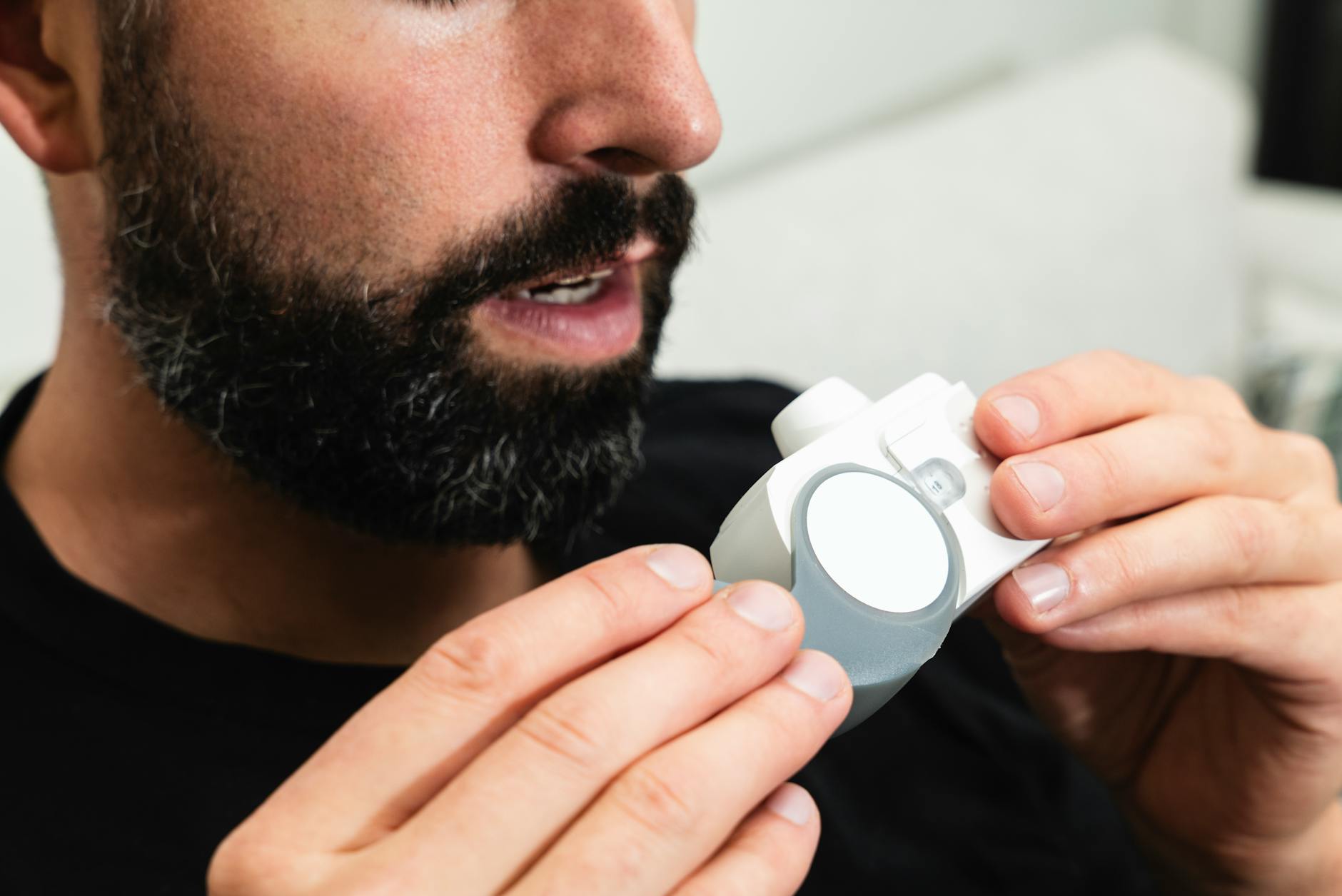
Inhaler misuse rates are staggeringly high in the general population — studies consistently find that 50 to 80 percent of patients use metered-dose inhalers incorrectly. In patients with cognitive impairment, the problem compounds. The multi-step coordination required to shake an inhaler, exhale fully, actuate while inhaling slowly, and hold the breath for ten seconds is a sequence that degrades early in dementia. This is not a trivial concern. Incorrect inhaler technique means the drug deposits in the mouth and throat rather than reaching the lower airways, turning an effective medication into an expensive placebo with oral side effects.
This reality is precisely why Ohtuvayre’s nebulizer delivery and the potential emergence of dry powder LAMA-LABA inhalers matter for this population. Dry powder inhalers require an adequate inspiratory flow rate but eliminate the coordination problem, and recent data showed that dry powder LAMA-LABA combinations carried a 14 percent lower COPD exacerbation risk compared to metered-dose inhalers. Whether that difference reflects the device, the drug formulation, or both is still debated, but the practical implication is clear: device selection is a clinical decision, not a pharmacy convenience. Caregivers should also be aware that switching inhaler devices without medical guidance can be dangerous. Different devices have different dose delivery characteristics, and a patient who has been stable on a metered-dose inhaler should not be moved to a dry powder device simply because it seems easier unless the prescribing physician has confirmed the switch. Similarly, adding Airsupra to a regimen that already includes a separate inhaled corticosteroid could result in corticosteroid overexposure if the medications are not reconciled.

The Respiratory-Cognitive Connection That Makes These Advances Matter for Brain Health
The relationship between chronic respiratory disease and dementia risk is supported by a growing body of epidemiological evidence. COPD in particular has been associated with a 1.5- to 2-fold increased risk of cognitive impairment in multiple large cohort studies, with hypoxemia and systemic inflammation proposed as mediating mechanisms. Every severe exacerbation that sends a COPD patient to the hospital involves a period of significant oxygen desaturation — and the aging brain tolerates hypoxic insults poorly.
Effective maintenance therapy that prevents exacerbations is therefore not just a respiratory intervention. For a 72-year-old with moderate COPD and mild cognitive impairment, avoiding two hospitalizations per year may matter as much for preserving remaining cognitive function as any dementia-specific medication currently available. This is the lens through which these inhaler advances should be evaluated on a brain health website: not as pulmonology news that happens to be interesting, but as developments with direct implications for the trajectory of cognitive decline in a substantial subset of older adults.
What the Inhaler Pipeline Looks Like Beyond 2026
The pipeline beyond currently approved therapies suggests the pace of innovation is accelerating. Frevecitinib, developed by Kinaset Therapeutics, is a first-in-class inhaled pan-JAK inhibitor targeting JAK1, JAK2, JAK3, and TYK2, delivered via a single-capsule dry powder inhaler. A Phase 2b dose-ranging trial is underway for 2025 through 2026.
If successful, it would introduce an entirely new class of inhaled anti-inflammatory therapy that could benefit patients with severe asthma who do not respond to existing treatments. Depemokimab, a biologic injection rather than an inhaler, has been reported to significantly reduce severe asthma attacks and hospitalizations in selected patients. While biologics are not inhalers, they represent the broader context in which inhaler innovation is occurring — a field that is finally moving beyond the same three or four drug classes that have dominated for decades. For patients and caregivers, the practical takeaway is that the respiratory treatment options available in 2028 may look substantially different from what exists today, and staying engaged with a pulmonologist rather than simply refilling the same prescriptions year after year is increasingly important.
Conclusion
The inhaler landscape in 2026 is genuinely different from what it was even two years ago. A generic Flovent HFA opens affordable access to maintenance asthma therapy across a $520 million market. Airsupra’s label expansion to mild asthma validates the dual-action rescue approach for a broader population. And Ohtuvayre introduces the first novel inhaled COPD mechanism in more than twenty years, delivered through a nebulizer that sidesteps the coordination challenges that plague cognitively impaired patients.
None of these advances is without limitations — cost, psychiatric side effects, insurance coverage gaps — but together they represent the most meaningful year of inhaler progress in recent memory. For caregivers and families navigating the intersection of respiratory disease and cognitive decline, the actionable step is straightforward: schedule a medication review with the treating pulmonologist or primary care physician. Ask specifically whether generic fluticasone propionate, Airsupra, or Ohtuvayre might be appropriate, and discuss inhaler technique honestly. The best new drug in the world is useless if the patient cannot use the device that delivers it, and in dementia care, that practical reality deserves as much attention as the pharmacology.
Frequently Asked Questions
Is generic Flovent HFA identical to the brand-name version?
Yes. The FDA determined Glenmark’s generic fluticasone propionate 44 mcg inhalation aerosol to be bioequivalent and therapeutically equivalent to branded Flovent HFA. It contains the same active ingredient at the same dose and can be substituted with clinical confidence.
Can Airsupra replace both a rescue inhaler and a controller inhaler?
Not exactly. Airsupra is approved as a rescue inhaler and contains a small dose of budesonide, but it is not designed to replace a dedicated maintenance controller therapy in patients with persistent asthma. Pulmonologists recommend it especially for patients experiencing at least one exacerbation per year, often as part of a broader regimen.
Is Ohtuvayre safe for patients with dementia?
Ohtuvayre was associated with increased psychiatric adverse reactions in clinical trials. For patients already experiencing neuropsychiatric symptoms related to dementia, this requires careful evaluation by both the pulmonologist and the neurologist or geriatrician managing the cognitive condition. It is not automatically contraindicated, but close monitoring is essential.
Why does inhaler device type matter for someone with cognitive impairment?
Metered-dose inhalers require precise hand-breath coordination that deteriorates with cognitive decline. Nebulizers like the one used for Ohtuvayre allow passive breathing during treatment, and dry powder inhalers eliminate the coordination step but require adequate inspiratory force. Matching the device to the patient’s abilities directly affects whether the medication actually reaches the lungs.
How much does Airsupra cost on Medicare?
Medicare Part D patients pay an average of approximately $89 per month for Airsupra. The manufacturer savings card that can reduce costs to $0 is available only to commercially insured patients and does not apply to Medicare, Medicaid, or other government insurance programs.
Are there environmental benefits to newer dry powder inhalers?
Yes. Dry powder inhalers do not use hydrofluoroalkane propellants, which are potent greenhouse gases. Recent data also showed that dry powder LAMA-LABA combinations carried a 14 percent lower COPD exacerbation risk compared to propellant-based metered-dose inhalers, suggesting the environmental and clinical benefits may align.