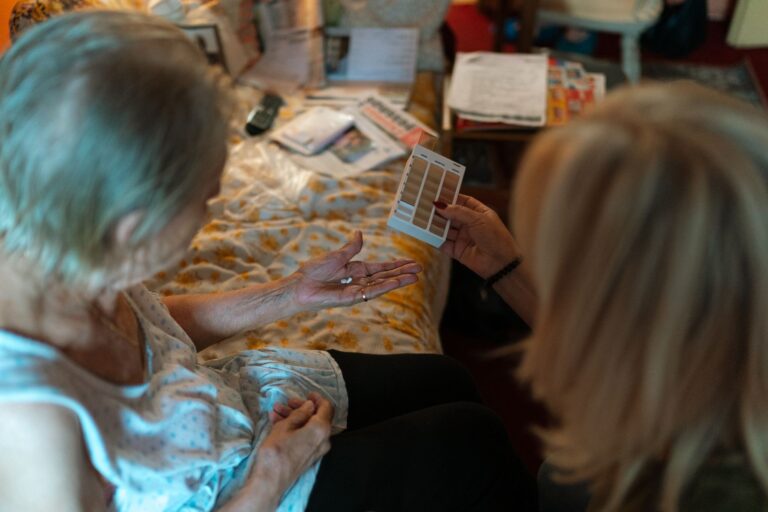
Guilt in dementia families stems from an impossible gap between what caregivers feel they should be doing and what circumstances allow them to actually do. The disease forces families into situations with no good choices—moving a parent into care, making medical decisions they never discussed, managing behaviors that feel deeply personal even when they’re not. This guilt isn’t weakness or self-indulgence; it’s a predictable response to role reversal, unresolved past conflicts, and the weight of decisions that will outlast the moment you make them. A daughter might feel guilty that she couldn’t keep her mother at home full-time while working, even though that arrangement was medically impossible.
A son might carry guilt about feeling frustrated during a parent’s repetitive questions, even though irritation is a documented survival response to sleep deprivation and caregiving strain. A spouse might feel guilty about moments of relief when the person they’ve cared for finally falls asleep, as if that moment of quiet makes them a bad partner. These feelings don’t signal moral failure—they signal how much is being asked of the family system. Guilt becomes particularly entrenched because dementia creates ambiguous loss: the person is still alive but no longer themselves, and families grieve while still providing care. This combination keeps guilt in constant circulation, never resolved by death or recovery, only by learning to recognize it as part of the process rather than proof of inadequacy.
Table of Contents
- What Changes When a Parent or Spouse Develops Dementia
- Placement Decisions and the Myth of Home Care
- Buried Family Conflicts and the Weight of Unresolved History
- The Impossible Standard of Comparison
- Grief, Anticipatory Loss, and the Long Goodbye
- When Burnout Wears the Face of Guilt
- Recognizing When Guilt Is Information versus When It’s Just Exhaustion
- Frequently Asked Questions
What Changes When a Parent or Spouse Develops Dementia
dementia reverses the fundamental hierarchy of family relationships. Adults who spent decades being independent, making decisions, and managing their own lives become dependent on children who now must make decisions for them. This inversion triggers deep guilt because it contradicts decades of learned behavior. You were taught to respect your parent’s autonomy, to listen to their advice, to not question their judgment. Now you’re checking whether they’ve eaten, reminding them of your name, overruling their wishes about medical care. The guilt intensifies because the relationship has no precedent in your family history.
Your parent never had a parent with dementia; you’ve never had a parent with dementia. There’s no script, no family story about how this is supposed to go. A spouse caring for a partner faces similar disorientation: you married an equal, and now you’re managing their hygiene, medications, and meals. The person you agreed to share a life with is becoming more like a dependent, and the guilt of that thought can be as painful as the practical burden. One concrete limitation of this dynamic: awareness doesn’t stop the guilt. Knowing intellectually that dementia causes the behavioral changes, that your parent isn’t choosing to repeat the same question for the hundredth time, that your anger is a reasonable response to an unreasonable situation—none of that stops the guilt from surfacing when it happens. The gap between intellectual understanding and emotional experience remains wide.
Placement Decisions and the Myth of Home Care
Placing a loved one in a care facility represents one of the highest-guilt decisions dementia families face, despite being sometimes medically necessary or financially unavoidable. The cultural narrative says “good families keep their parents at home,” which makes moving someone into care feel like a personal failure rather than a practical one. Many families enter the placement decision already exhausted, already at the breaking point, already feeling they’ve failed because they couldn’t make home care work indefinitely. The reality is that home care has hard limits. A person with advanced dementia may need 24-hour supervision, medication management, specialized mobility assistance, and behavioral support that no family member can safely provide alone. A primary caregiver working full-time cannot also shower a parent with dementia, monitor them for wandering, manage aggressive behavior, and maintain employment.
Yet families consistently report guilt about placement even when they’ve documented that home care became dangerous—dangerous for the person with dementia, dangerous for the caregiver, dangerous for other family members. The facility admission feels like abandonment because the cultural expectation hasn’t caught up to the medical reality. A warning: this guilt often persists even after placement proves to be the right decision. Some families report that their loved one actually improved in a facility—better nutrition, medication adherence, social engagement—yet the guilt about “putting them away” remains. The guilt exists independently of outcome, which means families may second-guess facility care even when evidence clearly shows it was necessary. Recognizing this pattern can help caregivers separate realistic concerns (Is the facility safe? Is their parent receiving good care?) from guilt-driven spirals (Could I have done more? Did I give up too early?).
Buried Family Conflicts and the Weight of Unresolved History
Every dementia family also carries history. Perhaps you had a distant relationship with your parent, or unresolved anger from years of emotional neglect. Perhaps you didn’t get an apology for something that mattered. Perhaps your parent favored a sibling, or was harsh during your childhood, or abandoned the family for years. Dementia doesn’t erase any of that—it amplifies guilt about it because now the opportunity to repair the relationship is gone.
Caregivers often report that guilt intensifies the moment a parent stops remembering them, or stops being able to understand an explanation or apology. One adult son described his guilt as being “about a relationship that was never what I wanted it to be, and now I’m caring for someone who can’t even know I’m trying to make it better.” His guilt wasn’t about failing in care tasks; it was about the impossibility of fixing relational damage after cognitive decline has made comprehension and conversation impossible. He was grieving a parent, providing care for a parent, and simultaneously realizing he’d never get the parent-child relationship he’d hoped for. This type of guilt carries a hidden limitation: caregiver support groups and therapeutic interventions can address guilt about placement, burnout, or unmet care needs, but guilt rooted in unresolved family history is harder to resolve because it’s anchored in something that happened years ago and cannot now be changed. A therapist can help reframe the guilt, but the underlying loss—the relationship that never was—remains real. Some families find that focusing on present caregiving tasks, done well and with attention, provides the only available resolution: you cannot fix the past relationship, but you can show up fully for the person in front of you now.
The Impossible Standard of Comparison
Guilt often arrives through comparison. Families see other families who seem to be managing better, coping without complaint, keeping their parent at home, visiting more frequently, or remembering the parent’s history more vividly. Dementia caregiving has become partially visible through social media, and that visibility creates a measuring stick. If another family member seems less stressed, or if a friend’s parent with similar dementia appears happier in their current arrangement, the primary caregiver’s guilt may intensify: “Why can’t I make this work as well as they do?” This comparison guilt is particularly dangerous because it’s often based on incomplete information. You may see the public version of another family’s care—the good visit, the smiling photo at the facility—without seeing the private struggles, the medications adjusted for behavior, the difficult morning hygiene routine, the financial strain.
You may hear that a sibling visits twice a week and feel guilty about visiting three times, without knowing whether that sibling’s visits include care tasks or are primarily emotional presence. You may watch a professional caregiver manage a dementia patient’s behavior beautifully and forget that professional caregivers also sometimes struggle, and they don’t have the added weight of love and history that family members carry. A comparison worth noting: dementia caregiving has measurable costs to the caregiver’s own health. Research documents that primary dementia caregivers have higher rates of depression, anxiety, and physical illness than the general population. When you’re comparing your caregiving to someone else’s and feeling inadequate, you may not account for the fact that you’re also more likely to be sleep-deprived, financially strained, and medically vulnerable. The comparison itself is often made from a position of exhaustion and reduced capacity, which means the internal judgment is both harsher and less reliable than it would be if you were rested and resourced.
Grief, Anticipatory Loss, and the Long Goodbye
Dementia families grieve in an unusual pattern. You begin grieving the person’s cognitive decline—the loss of conversation, shared memory, recognition—while also providing care for the same person. Most grief happens in response to death, after which mourning can proceed. Dementia grief happens in real-time, alongside caregiving, which means guilt and grief become entangled. You’re mourning someone who is still alive, and that creates an unsettling emotional double-bind: sadness about who they’ve lost plus responsibility for who they are now. Anticipatory grief—the grief you experience before death—carries its own guilt mechanisms.
Some caregivers feel guilty about moments when they’ve thought, consciously or half-consciously, “I hope this ends soon,” or “I’m exhausted,” or “I don’t know how long I can sustain this.” That thought feels like wishing death on someone, which feels murderous, which creates intense guilt. Others feel guilty about the relief that comes when a person finally dies after years of decline—as if the relief proves they didn’t love their parent or spouse enough. The relief is actually a natural response to the ending of exhaustion, but guilt reinterprets it as moral failing. A warning specific to this phase: grief can mimic depression and burnout so closely that family members may not recognize it as grief. A caregiver who becomes withdrawn, loses interest in activities, feels hopeless, or experiences changes in sleep and appetite may be experiencing anticipatory grief, caregiver burnout, clinical depression, or some combination of all three. Without professional assessment, families may incorrectly assume the caregiver’s emotional state is a personal problem (“You need to be more resilient”) when it’s actually a normal response to an abnormal situation. The guilt then multiplies: guilt about needing support, guilt about not being strong enough, guilt about the grief itself.
When Burnout Wears the Face of Guilt
Caregiver burnout and guilt are so closely related they’re often confused. A caregiver experiencing burnout—emotional exhaustion, depersonalization, reduced sense of accomplishment—frequently interprets these symptoms as personal moral failure. They feel guilty because they’re tired, guilty because they’re irritable, guilty because they snapped at their parent or felt resentful about a task they’re required to do. Burnout makes it harder to access compassion for yourself, so the response to fatigue is typically self-blame rather than self-care.
One significant distinction: guilt is about a specific action or failure (“I didn’t visit enough,” “I lost patience,” “I made a bad decision”). Burnout is a state of depletion that makes everything feel like failure. A parent experiencing burnout might simultaneously feel guilty about not visiting, guilty about not calling enough, guilty about feeling resentful about caregiving, guilty about needing help. Each guilt feels legitimate and specific, but the underlying problem isn’t moral—it’s exhaustion. The solution isn’t harder work or more virtue; it’s rest and resource redistribution.
Recognizing When Guilt Is Information versus When It’s Just Exhaustion
Not all guilt in dementia caregiving is problematic. Some guilt can serve as useful information—it may signal that a boundary has been crossed, or a value has been compromised, or a genuine mistake has been made. If you feel guilty about yelling at your parent, that guilt might be useful feedback: you crossed a line you value, and that’s worth acknowledging and changing. If you feel guilty about a decision you made without consulting siblings, that guilt might reflect a real problem in family communication that needs addressing.
Learning to distinguish useful guilt from exhaustion-based guilt is one of the most practical skills a dementia caregiver can develop. The distinction sometimes comes down to a simple question: “Is this guilt telling me I did something I genuinely regret, or is this guilt telling me I’m exhausted?” If the answer is exhaustion, the intervention isn’t self-blame—it’s rest, support, and resource reallocation. If the answer is genuine regret, the intervention is apology, restitution, or behavior change. Most dementia caregivers experience guilt from both sources simultaneously, which is why the emotional landscape remains so complicated even after years of caregiving. A primary caregiver can make a genuinely good decision about placement or care while still feeling guilty about it; both things can be true.
Frequently Asked Questions
Is it normal to feel relieved when a parent with dementia finally dies?
Yes. After years of caregiving and anticipatory grief, relief at the end of that burden is a natural response. It doesn’t mean you didn’t love them; it means you were exhausted by an exhausting situation.
How do I stop feeling guilty about placing my parent in a care facility?
Guilt about placement often doesn’t fully resolve, even when placement was medically necessary. Working with a therapist to separate realistic concerns (Is the care adequate?) from guilt-driven spirals can help. Some families also find it useful to reframe placement as a care decision, not an abandonment.
Should I feel guilty about not visiting enough?
“Enough” is difficult to define in dementia caregiving. The question to ask is whether you’re visiting at a frequency that’s sustainable for you while also meeting your parent’s needs for connection. Guilt-driven over-visiting is unsustainable and can lead to burnout.
Can therapy or support groups actually reduce caregiver guilt?
Therapy and support groups can help reframe guilt and connect it to exhaustion or grief rather than moral failure. However, guilt rooted in unresolved family history or genuine mistakes may require ongoing work rather than resolution.
How do I explain my guilt to family members who think I should be coping better?
Guilt is a predictable response to caregiving strain, role reversal, and grief—not a personal weakness. You can share research showing that dementia caregivers experience higher rates of depression and anxiety, and that guilt is part of the documented psychological impact of the role.
What’s the difference between caregiver burnout and depression?
Burnout is exhaustion from sustained caregiving demands; depression is a clinical condition. Both can occur together. A mental health professional can assess which is present, since the intervention differs: burnout may resolve with rest and support, while depression typically requires treatment.