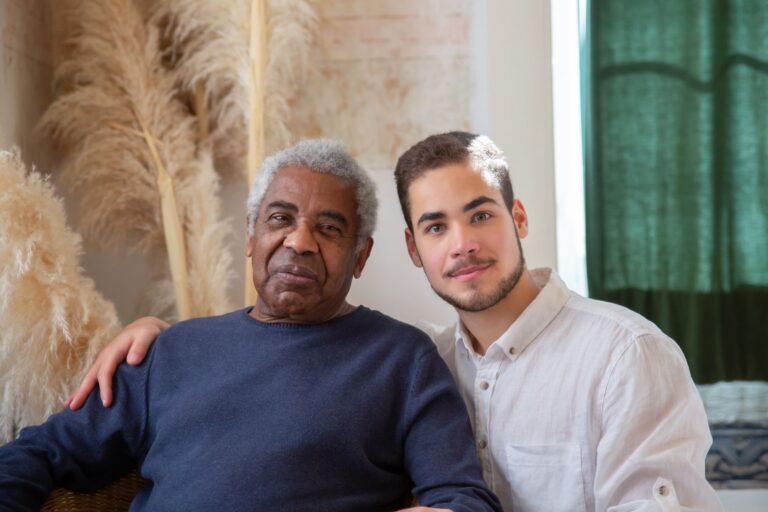
Dementia doesn’t erase what we know about the world—it disconnects the knowledge from the words we’ve used our entire lives to name it. A person with dementia might look directly at a fork and know exactly what it’s for, how to use it, and what it means, but the word “fork” has become unreachable, as if filed in a locked drawer they can no longer open. This phenomenon, called anomia, is not forgetting—it’s a retrieval failure where the neural pathways connecting meaning to sound have degraded, leaving someone trapped between understanding and expression.
Word loss in dementia happens because the disease damages the specific brain regions that store and retrieve language—not the regions that hold meaning. The left temporal lobe, crucial for connecting the sounds and shapes of words to their meanings, deteriorates as dementia progresses. A person can still point to a cow and moo when asked “what does this animal sound like,” proving they know the concept, but asking them to say the word “cow” may draw a complete blank. This split between knowing and naming is one of the most frustrating and visible early signs of cognitive decline, and understanding why it happens can help families navigate the experience with less confusion and more compassion.
Table of Contents
- How Does Dementia Target the Language System?
- The Difference Between Forgetting Meaning and Losing Words
- Word Loss Looks Different Across Types of Dementia
- Strategies That Work When Words Become Unreachable
- Early Word-Finding Problems Often Masquerade as Absent-Mindedness
- The Hidden Cost of Losing Familiar Words
- How Word Loss Escalates as Dementia Progresses
- Frequently Asked Questions
How Does Dementia Target the Language System?
The brain stores words not as single files, but as networks of connections between sound, spelling, meaning, and sensory memory. When you see a hammer, your brain instantly retrieves its name by activating a complex web: the sound pattern (HAM-er), the visual shape, the feel of the handle, and the memory of using it. dementia corrodes the neurons in these networks, starting often with the weakest connections and working outward. Studies using PET scans show that people with Alzheimer’s disease have reduced blood flow in the left temporal and parietal regions—exactly where these language networks live. The damage is gradual but cumulative, and it follows a pattern: easier words (high-frequency words like “the” or “go”) tend to survive longer than rare ones (like “spatula” or “abacus”).
This degradation explains why someone might remember a word on one day but not the next, and why they often grasp at related words instead. Presented with a picture of a penguin, they might say “bird… the black and white one… the one that swims,” cycling through pieces of information they still possess but cannot lock onto the target word. The word hasn’t disappeared from the universe—it’s still there, in some form—but the neural machinery to retrieve it is no longer reliable. Anomia is not an all-or-nothing event; it’s a gradual loosening of the grip on language that gets progressively worse over months and years.
The Difference Between Forgetting Meaning and Losing Words
There’s a critical distinction that often confuses families: when someone with dementia can’t name something, it doesn’t mean they’ve forgotten what it is. Anomia targets the retrieval system, not the knowledge base. A neuroimaging study comparing anomia (word-finding failure) to semantic dementia (loss of meaning) showed these conditions light up different regions of the brain. In anomia, the knowledge is there—they can describe the object, use it, gesture toward it—but the word is locked away. In semantic dementia, the loss goes deeper: the person might not know what a fork is for at all.
This distinction matters enormously for communication. If someone can’t remember the word for their grandchild, that doesn’t mean they’ve forgotten the grandchild. They may become deeply frustrated, even angry, at the apparent contradiction: “I know who this is, I love them, why can’t I say their name?” That frustration can mask what’s actually happening—a system failure in retrieval, not loss of affection or recognition. A related challenge is circumlocution, where people talk around the missing word: “the thing you cut with… the metal…” They’re still reasoning, still thinking, just detoured from the direct path to the word they need. However, in later-stage dementia, circumlocution itself becomes harder as the broader language network deteriorates, leaving only fragments or silence.
Word Loss Looks Different Across Types of Dementia
Alzheimer’s disease typically starts with anomia and gradually spreads outward—first nouns, then verbs, then small connecting words. A person with Alzheimer’s might struggle to name “tree” but still say “leaves fall down” in a garbled attempt to describe it. In contrast, frontotemporal dementia often hits the prefrontal cortex first, affecting how people understand and produce sentences. Someone with frontotemporal dementia might produce fluent speech full of words, but the sentences become jumbled or nonsensical. Lewy body dementia often causes fluctuating language problems, tied to the fluctuations in attention and alertness that characterize the disease; word-finding might be sharp one hour and nearly impossible the next.
Primary progressive aphasia (PPA), a variant of frontotemporal dementia, presents the most dramatic word-loss pattern. In the non-fluent variant, speech becomes halting and effortful; in the semantic variant, the meaning of words erodes faster than the ability to say them. Someone with semantic-variant PPA might say “fork” fluently but have no idea what a fork does. These differences matter because they change the trajectory: Alzheimer’s word loss tends to follow a fairly predictable course, while FTD variants can progress at different speeds and in different directions within the same person. Knowing which type of dementia someone has—or suspecting which one—helps predict how language will change.
Strategies That Work When Words Become Unreachable
When someone with dementia struggles to find a word, the instinct to jump in and finish the sentence often backfires; it can interrupt their own retrieval attempt and frustrate them further. A better approach is to wait—sometimes for 30 seconds or more—while they search. Many people can retrieve the word if given time and a calm space to retrieve it. If waiting doesn’t work, asking open-ended questions (“What is it used for?” “What does it look like?”) engages their intact knowledge and often leads them to the word themselves, or to a description you can both work with.
Writing or drawing can bypass the retrieval block entirely. Someone who can’t say “doctor” might be able to point to the word on a printed list, or to draw a stethoscope. Using objects, pictures, or gestures communicates the concept directly, sidestepping the word-finding struggle. For repeated word-loss on the same item—a common pattern in mid-stage dementia—establishing a consistent phrase or description with the person during a good moment makes retrieval easier later: “We’ll call this your water bottle” becomes the anchor, replacing the elusive word “bottle.” This preemptive strategy leverages memory for routine language, which often stays more stable than spontaneous retrieval. However, the tradeoff is time: these strategies require patience and presence, and they’re exhausting for caregivers in crisis mode or managing multiple people.
Early Word-Finding Problems Often Masquerade as Absent-Mindedness
In the early stage of dementia, word-finding difficulty is easily mistaken for normal aging or simple tiredness. “I’m just tired today” or “It’s on the tip of my tongue” are phrases many people use in their 60s and 70s. The key difference is frequency and consistency: does this person struggle every time they talk, or was it a one-time event? Someone with early dementia anomia typically becomes noticeably frustrated; they might make multiple attempts to retrieve the same word and fail each time in a single conversation. They also often substitute the wrong word, then realize it’s wrong—a self-awareness that can be painful. “I meant to say… no, that’s not right…
ugh, I can’t find it.” A critical warning: not all word-finding difficulties are dementia. Depression, anxiety, sleep deprivation, medication side effects, and stroke can all cause anomia without progressive dementia. Thyroid problems, B12 deficiency, and normal aging can mimic the early signs. The red flag that points toward dementia, rather than a temporary state, is that the word-finding gets worse over months, not better with rest or reduced stress. It also tends to be paired with other cognitive changes: problems remembering recent conversations, difficulty following complex instructions, or getting lost in familiar places. Isolated word-finding without these other signs warrants a doctor’s visit, but doesn’t necessarily indicate dementia.
The Hidden Cost of Losing Familiar Words
Beyond the practical frustration of not being able to name things, losing familiar words carries an emotional weight that’s often invisible to outsiders. Words are tied to identity and relationships in ways we rarely examine until they’re gone. When someone can’t say their spouse’s name, or their own job title, they lose a piece of how they think about themselves. A retired teacher who spent 40 years using classroom language might become deeply confused and sad when the word “student” becomes unreachable.
The loss feels like a small death of that former self, even though the person and their memories of teaching remain. Families often report that the person with dementia becomes quieter as anomia worsens—not because they have nothing to think, but because speaking has become exhausting and unreliable. The effort to find words, combined with the frustration of failing, can lead to withdrawal from conversation. Some people adapt by becoming comfortable with gesture and shorter phrases; others seem to internalize the shame of word-loss and simply stop trying.
How Word Loss Escalates as Dementia Progresses
In early dementia, anomia is frustrating but predictable. Someone might forget the word “umbrella” but remember it tomorrow, or remember it if you give them a hint. In mid-stage dementia, the word-finding becomes more severe and word production shrinks overall; conversations grow shorter because the effort to retrieve words becomes exhausting. By late-stage dementia, language often collapses into fragments, single words, or complete non-fluency.
Some people retain high-frequency words—”yes,” “no,” “I don’t know”—long after they lose the ability to name objects or have coherent conversations. Others retain emotional language, like curse words or beloved phrases from the past, even when newer, everyday words are gone. This pattern of progressive word loss correlates with advancing brain damage: anomia in early dementia signals damage to the temporal-parietal language network, while the shrinking of overall speech in mid-stage reflects broader cortical atrophy. In late-stage dementia, word loss becomes less relevant to daily living because the person’s communication has shifted almost entirely to gesture, emotion, and nonverbal cues. A person who cannot say a single word may still show you through their actions and face what they need or feel.
- —
Frequently Asked Questions
Is word-finding difficulty a sign of dementia?
Word-finding difficulty becomes a dementia concern when it happens frequently, worsens over months, and pairs with other cognitive changes like memory loss or confusion. Occasional word-finding is normal at any age. If you’re unsure, a doctor can assess whether anomia is part of a pattern that suggests dementia or another condition.
Can someone with dementia-related word loss still understand what people say to them?
Usually, yes. Anomia typically affects word retrieval more than word comprehension. Someone who can’t say “fork” can usually understand it if you say it to them. However, as dementia progresses, comprehension can decline too. Dementia is progressive and unpredictable, so loss of understanding may follow word-finding loss.
If someone can’t say a word, does that mean they’ve forgotten the concept?
No. Anomia is a retrieval failure, not a loss of knowledge. The person may still understand what the object is for, how to use it, and what it looks like—they just can’t access the word. This distinction is important for communication and for understanding what the person has and hasn’t lost.
Does practicing words or playing word games help slow down anomia?
Word games or naming practice might temporarily boost retrieval for those specific words, but there’s no strong evidence that practice slows the underlying dementia progression. Mental stimulation has value for overall quality of life, but it’s not a treatment. The goal is usually to adapt communication rather than to recover lost words.
Why do some people with dementia remember songs or certain phrases even when they can’t speak?
Songs and deeply learned phrases are stored in different brain regions than spontaneous language retrieval. The right hemisphere, which is involved in music and emotion, often remains more intact longer than the left-hemisphere language regions affected by dementia. This is why someone might sing along to a familiar song but not be able to have a conversation.
Should I correct someone with dementia when they use the wrong word?
Usually, no. If the wrong word doesn’t affect communication, let it pass; correcting creates frustration without benefit. If the wrong word is confusing (they call you by another family member’s name, for example), a gentle correction is appropriate, but delivered calmly without repeated corrections on the same day. —