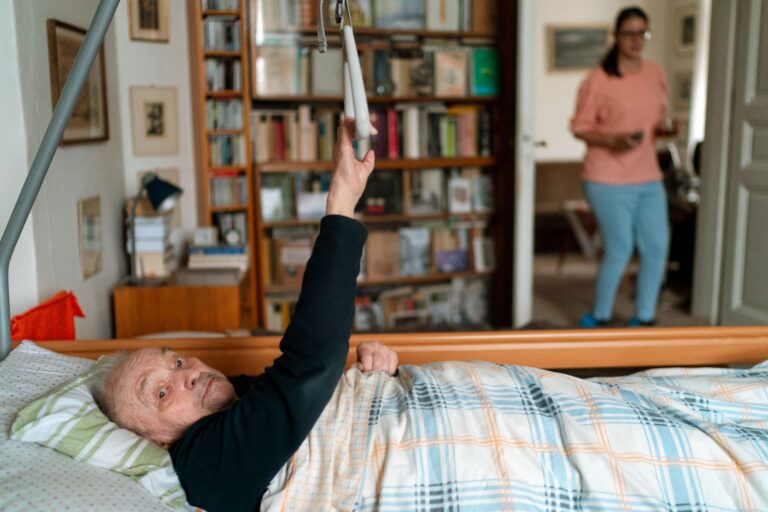
When an Alzheimer’s disease patient repeatedly asks to “go home,” they are often expressing a deep need for safety, familiarity, and identity that goes beyond the literal physical location. This behavior, sometimes called “elopement urge” or “going-home behavior,” typically emerges as memory loss progresses and the brain struggles to orient itself in time and space. A person with advanced Alzheimer’s may not recognize their current living environment—or the current year, or their own age—and instinctively seeks the home, the people, or the period of life that feels most real and safe to them.
An 78-year-old woman living with her adult son might ask repeatedly to “go back to the house on Maple Street,” the home where she raised her children decades ago, convinced that her grown children are still small and waiting for her there. The request to go home is not confusion, stubbornness, or a communication error. It is the person’s brain attempting to navigate an increasingly disorienting world by reaching for the touchstones of memory and belonging that remain most vivid. Understanding why this happens—and how to respond—is essential for caregivers and family members supporting someone with Alzheimer’s disease.
Table of Contents
- What Does “Going Home” Really Mean to an Alzheimer’s Patient?
- How Memory Loss and Brain Changes Drive the Going-Home Behavior
- The Emotional and Psychological Roots of Going-Home Requests
- How Caregivers Can Respond Practically to Going-Home Requests
- When Going-Home Requests May Signal Other Needs or Dangers
- Creating Environments That May Reduce Going-Home Urges
- Understanding the Request as Communication, Not Delusion
What Does “Going Home” Really Mean to an Alzheimer’s Patient?
For a person with Alzheimer’s disease, “home” often refers to a time, not merely a place. The home they wish to return to may be the family house from thirty years ago, the childhood home where they grew up, or a composite of several meaningful locations blended together by deteriorating memory. Their brain may be experiencing time in a fragmented way, with recent years fading first while older memories—though increasingly distorted—remain more accessible. When they say they want to go home, they may be expressing a longing to return to a period when their brain worked correctly and the world made sense. The request to go home also represents a search for identity and autonomy.
Home, in the deepest sense, is a place where a person belongs without question, where they know the rules and their own role. For someone whose sense of self is fragmenting with each passing month, the idea of home—any version of home—becomes an anchor. It is where they were known, where they were safe, where they had control. Asking to go home is an attempt to reclaim that stability. A man with Alzheimer’s who spent his career as a factory supervisor might ask to go to work, expressing the same need: to return to a version of himself that he recognizes and can understand.
How Memory Loss and Brain Changes Drive the Going-Home Behavior
alzheimer‘s disease damages the hippocampus and related memory structures in ways that affect how a person experiences their surroundings and their own history. As these areas deteriorate, short-term memory fails rapidly while earlier memories may remain more intact—though often inaccurate or fragmented. The person cannot form new memories reliably, so every morning in a facility, a hospital, or even an adult child’s home can feel like the first time. The environment itself never becomes familiar; it remains strange and unsafe, no matter how long they have been there.
Additionally, the brain regions responsible for spatial awareness and navigation degrade as Alzheimer’s progresses. A person may not be able to recognize the physical layout of a building, understand that they are on the second floor of a care facility rather than in danger, or remember how to find the bathroom in a place they have lived for two years. This disorientation creates genuine distress. They are not being difficult; they are experiencing a world that has become incomprehensible. A significant limitation of current care is that pharmaceutical interventions have limited effectiveness in preventing or stopping this progression, and the emotional distress caused by disorientation often persists despite attempts at reassurance or distraction.
The Emotional and Psychological Roots of Going-Home Requests
Beyond the neurological changes, asking to go home often reflects anxiety and fear. A person with Alzheimer’s may not understand why they are in an unfamiliar place, who these people around them are, or what is happening to them. They may experience sundowning—a phenomenon where confusion and agitation worsen in the evening—and their longing to go home intensifies as daylight fades. The request to go home is sometimes a plea for help: *I am frightened and lost. Help me get back to somewhere safe.* Recognizing this emotional core is crucial, because it means the appropriate response is not always a physical return to a previous home, but rather an emotional reassurance and the creation of safety and familiarity in the present environment.
For some people, asking to go home is also a way of expressing grief. On some level, the person may sense that something is wrong with them, that their mind is not working as it should. The home they seek may represent a version of themselves before the illness took hold. This is especially true in the early stages of Alzheimer’s, when insight into cognitive decline is often clearer. A person recently diagnosed may ask to go home to escape the reality of what is happening to them, hoping that if they can just reach the right place, they will wake up and find their abilities restored.
How Caregivers Can Respond Practically to Going-Home Requests
When someone with Alzheimer’s asks to go home, the first instinct of many caregivers—to reason with them or insist that they are already home—typically fails and may increase agitation. A direct confrontation with “reality” usually makes the distress worse, because the person cannot hold on to a corrected version of events; within minutes, they may ask again and experience the same confusion and fear anew. A more effective approach involves validating the emotion, acknowledging the feeling of loss or longing, and gently redirecting without arguing about facts. Some caregivers find success by validating and then pivoting: “I know you miss home.
That was a wonderful place. Let’s look at some photos from there,” or simply, “You are safe here. Let’s have a cup of tea together.” Others use reminiscence—talking about the home or the time period the person wants to return to—as a way to satisfy some of the longing without literally attempting the journey. This is not the same as pretending the person’s memory is accurate; it is acknowledging that what they are feeling is real and important, even if their understanding of the present situation is confused. The trade-off is that this approach requires patience and a willingness to step into the person’s world rather than insisting they step into the caregiver’s version of reality.
When Going-Home Requests May Signal Other Needs or Dangers
Persistent and intensifying requests to go home can indicate that other needs are not being met. If a person with Alzheimer’s is in pain, experiencing urinary tract infection, hungry, or uncomfortable, they may express this through vague requests to leave or go home. A person whose care facility is too loud, too crowded, or inadequately lit may ask to go home as a way of saying, “This place is not right for me.” Caregivers should always consider whether the request is a communication of a more specific, addressable problem. A warning sign is if the person’s going-home behavior becomes accompanied by aggressive behavior, signs of physical discomfort, or sudden changes in mood—these may indicate an underlying medical or environmental issue rather than pure disorientation.
Additionally, some people with advanced Alzheimer’s may attempt to leave in dangerous ways—wandering in traffic, leaving during severe weather, or attempting to climb out windows. This is not mere confusion; it is a serious safety risk that requires careful environmental management, supervision, and sometimes professional intervention. Facilities and home caregivers must balance respect for the person’s autonomy and emotional needs with the necessity of preventing harm. There is no simple answer to this dilemma, and the approach often depends on the severity of the person’s disease, their physical abilities, and their specific circumstances.
Creating Environments That May Reduce Going-Home Urges
While it is not always possible to prevent or eliminate requests to go home, creating an environment that feels safe and familiar can reduce their frequency and intensity. This might include displaying photographs and familiar objects from different periods of the person’s life, playing music from their earlier years, maintaining consistent routines and staff members, and ensuring good lighting and clear visual cues. Some facilities create memory boxes or reminiscence stations where residents can access photographs and objects from their past.
However, a warning: not all going-home behavior can be eliminated through environmental design alone. Some people continue to ask regardless of how welcoming or familiar an environment becomes, because their need is rooted in a neurological drive or a deep emotional longing that transcends the physical space. For these individuals, the goal shifts from prevention to compassionate response.
Understanding the Request as Communication, Not Delusion
A practical distinction worth making is that an Alzheimer’s patient’s request to go home, while based on confused memory, is not purely delusional. The person is trying to communicate something real: fear, longing, discomfort, or a sense of being lost. They may have the details wrong—the house was actually blue, not white; they lived there in 1985, not last year—but the feeling underneath is genuine and deserves recognition.
When caregivers treat these requests with respect and curiosity rather than dismissal, they often find that the person calms more readily and trust deepens. A caregiver who listens and responds with “Tell me about that home. I’d like to hear about it” may find that the person’s agitation eases, even if they never leave the room or the facility, because the emotional need—to be heard and valued—has been partially met.
- —