The best sleep aid device for most Alzheimer’s patients is a bright light therapy box delivering 5,000 to 10,000 LUX, used consistently each morning to reset disrupted circadian rhythms. Light therapy stands out because it addresses the underlying biological cause of sleep disturbances in dementia—a malfunctioning internal clock—rather than simply sedating patients. For a patient experiencing “sundowning” and nighttime wakefulness, a morning session with a quality light therapy box can reduce daytime sleeping and increase nighttime sleep duration without the fall risks and cognitive side effects associated with sleep medications.
However, the “best” device depends heavily on the individual patient’s specific sleep problems and disease stage. Someone with severe anxiety-driven insomnia may benefit more from a weighted blanket’s calming pressure, while patients with mild-to-moderate Alzheimer’s who haven’t responded to non-drug approaches might be candidates for Belsomra, the only FDA-approved medication for insomnia specifically in this population. The Alzheimer’s Association and National Institutes of Health strongly recommend exhausting non-drug approaches first, since research shows sleep medications generally do not improve overall sleep quality in older adults and carry significant risks. This article examines the evidence behind each major sleep aid option—from light therapy devices and weighted blankets to the newer wearable monitoring technology unveiled in 2025 and 2026—so caregivers can make informed decisions based on their loved one’s specific situation rather than marketing claims.
Table of Contents
- Which Sleep Aid Devices Actually Work for Alzheimer’s Patients?
- How Does Light Therapy Compare to Sleep Medications for Dementia?
- What Makes Bright Light Therapy Effective for Alzheimer’s Sleep Problems?
- Should Caregivers Consider Wearable Sleep Monitoring Technology?
- What Are the Risks of Sleep Aids for Dementia Patients?
- How Do Weighted Blankets Help with Dementia-Related Sleep Issues?
- What Does the Future Hold for Alzheimer’s Sleep Treatment Technology?
Which Sleep Aid Devices Actually Work for Alzheimer’s Patients?
Light therapy devices have accumulated the strongest evidence base for treating Alzheimer’s-related sleep disturbances. Research reviews consistently indicate that bright light therapy can reduce excessive daytime sleeping while increasing consolidated nighttime sleep. A 2021 study found that blue-light enriched therapy improved not just sleep patterns but also cognitive function in Alzheimer’s patients—a dual benefit no medication has demonstrated. The mechanism is straightforward: the aging brain, particularly one affected by Alzheimer’s, loses its ability to regulate the sleep-wake cycle, and bright light exposure helps recalibrate this internal clock. Weighted blankets represent the second most promising non-pharmacological option, particularly for patients whose sleep problems stem from anxiety and agitation rather than circadian disruption.
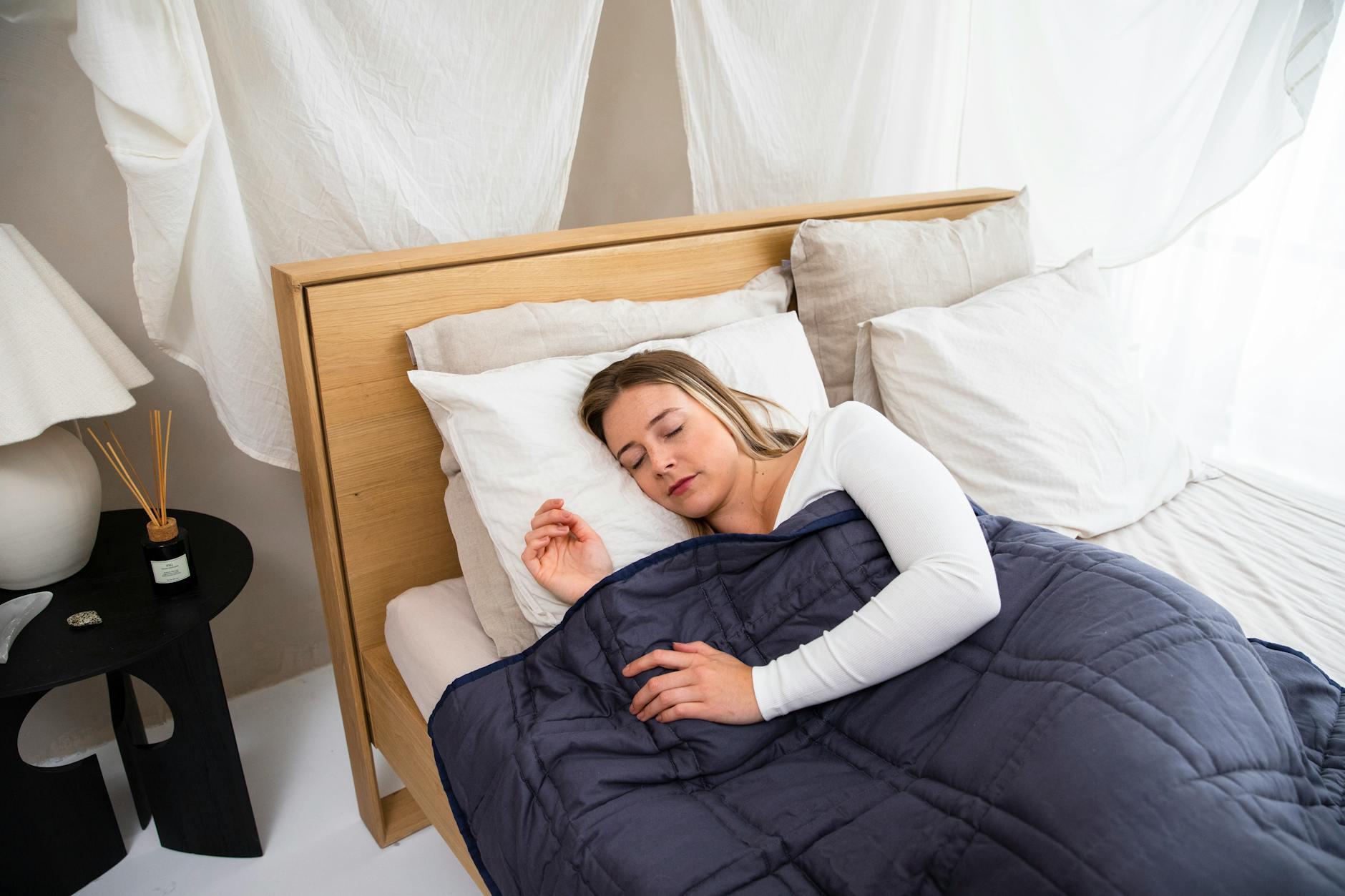
These blankets work through deep pressure therapy, which triggers serotonin production and creates a calming effect similar to being held. For a dementia patient who becomes restless and anxious at bedtime, a weighted blanket can provide continuous, gentle sensory input that promotes relaxation. A randomized controlled trial specifically examining weighted blankets for hospitalized dementia patients is currently underway, with data collection expected to complete by March 2026. The Vielight Neuro RX Gamma headset represents a newer, more experimental category of device. This headset transmits near-infrared light directly to the brain, and early studies have reported improvements in sleep quality, reduced anxiety, and decreased wandering behavior. However, this technology remains in earlier research stages compared to standard bright light therapy, and the devices carry a significantly higher price point.
How Does Light Therapy Compare to Sleep Medications for Dementia?
In February 2020, Belsomra (suvorexant) became the first medication to receive FDA approval specifically for treating insomnia in people with mild-to-moderate Alzheimer’s disease. The Phase 3 clinical trial involving 285 participants showed that patients receiving suvorexant gained 73 minutes of total sleep time compared to 45 minutes for the placebo group—a 28.2-minute advantage after four weeks. These numbers represent meaningful improvement, but they come with important caveats that caregivers must weigh carefully. The side effect profile of Belsomra includes increased somnolence (4% versus 1% with placebo), dry mouth (2% versus 1%), and notably, falls (2% versus 0% with placebo). For Alzheimer’s patients, that fall risk deserves serious consideration.
A fall can result in hip fractures, hospitalization, and accelerated cognitive decline. Light therapy, by contrast, has virtually no side effect profile and addresses the root circadian dysfunction rather than chemically inducing sleep. However, light therapy requires consistent daily use and caregiver involvement to be effective, whereas medication offers a simpler intervention. For families stretched thin by caregiving demands, the practical reality of implementing a daily light therapy routine may prove challenging. The choice often comes down to weighing the superior safety profile of light therapy against the convenience of medication, always keeping in mind that expert consensus favors trying non-drug approaches first.
What Makes Bright Light Therapy Effective for Alzheimer’s Sleep Problems?
The effectiveness of bright light therapy for Alzheimer’s patients hinges on the disease’s specific impact on the suprachiasmatic nucleus—the brain’s master clock located in the hypothalamus. Alzheimer’s pathology damages this region, disrupting the normal production and timing of melatonin and other sleep-regulating hormones. Bright light exposure, particularly in the morning, sends powerful signals to this compromised system, helping restore some degree of normal circadian rhythm even when the underlying neural tissue is damaged. For practical application, a patient might sit near a 10,000 LUX light box for 30 minutes each morning during breakfast. The key is consistency and timing—morning exposure helps consolidate nighttime sleep, while evening exposure can actually worsen sleep problems.
One family found that positioning the light therapy box on the breakfast table, angled toward their mother’s face while she ate, transformed her sleep patterns within two weeks. She went from waking four to five times per night to sleeping in longer stretches with only one or two brief awakenings. The 2021 research on blue-light enriched therapy adds another dimension to consider. Blue wavelengths appear particularly effective at influencing circadian rhythms, though they must be used with caution in patients with certain eye conditions. Standard full-spectrum light boxes remain the most studied and widely recommended option, with blue-enriched devices representing a potentially more targeted but less extensively researched alternative.

Should Caregivers Consider Wearable Sleep Monitoring Technology?
The wearable technology landscape for Alzheimer’s care shifted significantly with Samsung’s announcement at CES 2026 of its Brain Health feature, which tracks sleep “stability” patterns associated with cognitive decline. This development reflects growing research showing that sleep changes can be linked to Alzheimer’s pathology before cognitive symptoms emerge. For families with a genetic predisposition to Alzheimer’s or those in the earliest stages of mild cognitive impairment, such monitoring could provide valuable early warning data. The tradeoff with wearable monitoring involves balancing useful health information against practical caregiving realities. A smartwatch that detects disrupted sleep patterns provides data, but that data only helps if caregivers can act on it.
For someone already providing round-the-clock care for a patient with moderate dementia, detailed sleep metrics may add stress without improving outcomes. Conversely, for patients still living independently or with minimal supervision, wearable data might alert family members to sleep deterioration that signals disease progression. Wearable devices enabling remote brain monitoring are currently being studied specifically for early Alzheimer’s screening applications. This research represents a shift from reactive treatment toward proactive detection, potentially allowing interventions to begin before significant cognitive decline occurs. However, these applications remain largely in the research phase as of early 2026, and current commercial devices should be viewed as health information tools rather than medical diagnostic devices.
What Are the Risks of Sleep Aids for Dementia Patients?
The most significant risk across all sleep interventions for Alzheimer’s patients is the potential for increased confusion and falls. Even the most benign-seeming intervention can backfire in a compromised brain. Weighted blankets, for instance, can cause distress rather than comfort if a patient with advanced dementia doesn’t understand why they feel constrained and cannot communicate their discomfort. Caregivers should introduce any new sleep aid gradually and monitor responses carefully during the first several nights. Medication risks extend beyond the direct side effects listed in clinical trials.
Belsomra’s 2% fall rate in studies represents controlled conditions with close monitoring—real-world rates among patients with varying disease severity, medication interactions, and home environments may differ. Additionally, the somnolence side effect that helps patients sleep at night can carry over into morning hours, affecting daytime alertness and potentially increasing confusion during the period when Alzheimer’s patients typically function best. Light therapy carries the fewest risks but isn’t entirely without concerns. Patients with macular degeneration or other retinal conditions should consult an ophthalmologist before beginning bright light exposure. There’s also the practical risk that a confused patient might stare directly at the light source for extended periods or attempt to touch a hot bulb in older device models. LED-based light therapy boxes have largely eliminated burn risks, but eye safety during use still requires caregiver supervision.
How Do Weighted Blankets Help with Dementia-Related Sleep Issues?
Weighted blankets address the anxiety and agitation component of dementia sleep problems through deep pressure stimulation. This pressure activates the parasympathetic nervous system, reducing cortisol levels while increasing serotonin and melatonin production.
For a patient who becomes increasingly restless and worried as evening approaches—a phenomenon so common in dementia that it has its own name, sundowning—this physiological calming effect can make the difference between a combative bedtime and a peaceful one. The typical recommendation is a blanket weighing approximately 10% of the patient’s body weight, though some dementia patients do better with lighter options that provide sensory input without feeling restrictive. A care facility in the Midwest reported that introducing weighted blankets to their memory care unit reduced the need for as-needed sedative medications by roughly 40%, though such anecdotal reports await confirmation from the controlled trial currently underway.
What Does the Future Hold for Alzheimer’s Sleep Treatment Technology?
The convergence of wearable monitoring, artificial intelligence, and our growing understanding of sleep’s role in brain health points toward increasingly personalized and preventive approaches. The research establishing connections between sleep disruption and Alzheimer’s pathology—detectable before cognitive symptoms appear—suggests that future devices may serve a dual purpose: treating current sleep problems while simultaneously monitoring for disease progression or treatment response.
Near-infrared light therapy devices like the Vielight Neuro RX Gamma represent another frontier, potentially offering direct brain stimulation rather than the indirect circadian signaling of traditional light therapy. As this technology matures and larger clinical trials provide clearer evidence, it may eventually complement or even replace current approaches. For now, families should focus on the well-established interventions—bright light therapy, weighted blankets, and consistent sleep hygiene—while staying informed about emerging options that may prove beneficial as evidence accumulates.