For Alzheimer’s patients who slide forward in their chairs, a tilt-in-space wheelchair is the most effective mechanical solution available. Unlike a standard wheelchair or recliner, a tilt-in-space chair angles the entire seat backward, shifting the person’s center of gravity from the hips to the back. This makes forward sliding significantly harder without relying on restraints or constant staff intervention. Broda Wheelchairs, an industry leader in dementia seating, builds models with up to 40 degrees of tilt and proprietary Comfort Tension Seating that conforms to the resident’s body shape. For families or facilities working within a tighter budget, anti-thrust wedge cushions starting around $104 to $117 can reduce sliding risk on existing chairs, though they are not as reliable as purpose-built seating.
The sliding problem is not a minor inconvenience. Older adults with Alzheimer’s disease are over twice as likely to experience a fall compared to cognitively normal older adults, and they are three times more likely to suffer hip fractures. Sliding out of a wheelchair can result in skin tearing, pressure sores, broken bones, or traumatic brain injury. As Alzheimer’s advances, problems with vision, spatial perception, and balance compound the risk, making proper seating one of the most impactful safety decisions a caregiver can make. This article walks through the full range of seating options, from specialized clinical chairs and tilt-in-space wheelchairs to budget-friendly cushion add-ons and positioning accessories. It also covers common mistakes that actually increase sliding risk, what occupational therapists recommend, and how to weigh cost against effectiveness when choosing a solution.
Table of Contents
- Why Do Alzheimer’s Patients Slide Forward, and What Seating Prevents It?
- Specialized Clinical Chairs for High-Risk Patients
- Tilt-in-Space Wheelchairs and What Sets Broda Apart
- Anti-Slide Cushions and Budget-Friendly Alternatives
- Positioning Accessories and Common Mistakes That Increase Risk
- When Rocking Chairs and Movement-Based Seating Help
- Getting an Occupational Therapy Assessment Before You Buy
- Conclusion
Why Do Alzheimer’s Patients Slide Forward, and What Seating Prevents It?
Forward sliding happens for several overlapping reasons, and understanding them matters because the right fix depends on the cause. Some patients slide because their chair is simply too deep or too wide, so their body has no structural support to stay put. Others slide because of muscle weakness, poor trunk control, or the restlessness and agitation that often accompany mid- to late-stage Alzheimer’s. In many cases, a patient who once sat safely in a standard wheelchair gradually loses the postural stability needed to stay upright, and caregivers only recognize the problem after a near-fall or injury. The most important design principle, according to occupational therapists, is seat rake, meaning a slight downward slope toward the back of the seat. A flat seat offers nothing to counteract gravity pulling a person forward.
A tilt-in-space wheelchair takes this principle to its logical conclusion, angling the entire seating system so that gravity works to keep the patient in place rather than pulling them out. Broda’s Elite Positioning Wheelchair, the Model 785, offers 40 degrees of tilt and is widely used in memory care facilities. Their Dynamic Rocking models add a gentle rocking motion that can reduce agitation, which itself is a common trigger for sliding and attempts to stand. Here is a critical distinction that trips up many caregivers: reclining only the backrest, without tilting the seat, can actually increase sliding risk. When you recline the back while the seat stays flat, the patient’s hips tend to push forward. Tilt-in-space avoids this by keeping the seat-to-back angle constant while tilting the entire frame. If a facility or family is considering a reclining wheelchair, this is the single most important detail to get right.

Specialized Clinical Chairs for High-Risk Patients
For patients with complex positioning needs or a history of serious falls, specialized clinical chairs offer the highest level of support, though they come at a significant cost. The Seating Matters Sorrento Chair features a pelvic positioning harness that crosses the pelvis and secures at four points to the seat base, combined with adjustable back recline and tilt-in-space. It holds a 1A accreditation from the Dementia Services Development Centre, the highest rating available. Pricing starts at $8,420.91. Their Phoenix Chair, designed for highly dependent patients with the most complex needs, starts at $9,153.23. These chairs are not impulse purchases, and they are not appropriate for every patient.
A person in early-stage Alzheimer’s who occasionally shifts forward in a standard wheelchair does not need a $9,000 clinical chair. These products are designed for residents who have failed other interventions, who have severe postural instability, or who face immediate and repeated fall risk. Many long-term care facilities lease or trial these chairs before committing to a purchase, and insurance coverage varies widely. However, if a patient’s sliding has already resulted in injuries, or if they require constant one-on-one monitoring to stay safely seated, the cost of a clinical chair can be justified quickly. A single hip fracture in an elderly Alzheimer’s patient often leads to hospitalization, surgery, extended rehabilitation, and a steep decline in overall function. The math, both financial and human, often favors early intervention with proper seating over repeated emergency responses.
Tilt-in-Space Wheelchairs and What Sets Broda Apart
The tilt-in-space wheelchair category includes products from several manufacturers, but Broda has become nearly synonymous with dementia seating for good reason. Their Comfort Tension Seating system uses heavy-gauge polyvinyl straps instead of traditional sling upholstery. These straps conform to the individual resident’s body shape and redistribute pressure across a wider surface area, reducing the risk of pressure sores, a common secondary problem for patients who spend long hours seated. The straps return to their original shape within 10 seconds after pressure is removed, so the chair maintains its support characteristics over time. Broda’s product line includes standard tilt-in-space models and their Dynamic Rocking wheelchairs, which are particularly popular in memory care settings. The rocking feature serves a dual purpose.
It provides gentle vestibular stimulation that can calm agitated patients, and it gives restless residents a safe physical outlet without needing to transfer them between a wheelchair and a separate rocking chair. For a patient who slides forward partly because they are agitated or seeking movement, this can address the root cause rather than just the symptom. Broda chairs carry a 10-year frame warranty and a 2-year parts warranty. Pricing for tilt-in-space wheelchairs in general ranges from roughly $1,600 to $4,500 or more, depending on features, size, and accessories. One limitation worth noting: tilt-in-space wheelchairs are bulkier than standard wheelchairs. They do not fold as compactly, they weigh more, and they can be difficult to transport in a standard vehicle. For families who need to take a patient to medical appointments or outings, a tilt-in-space chair may need to be supplemented with a lighter transport chair and appropriate cushioning for shorter trips.
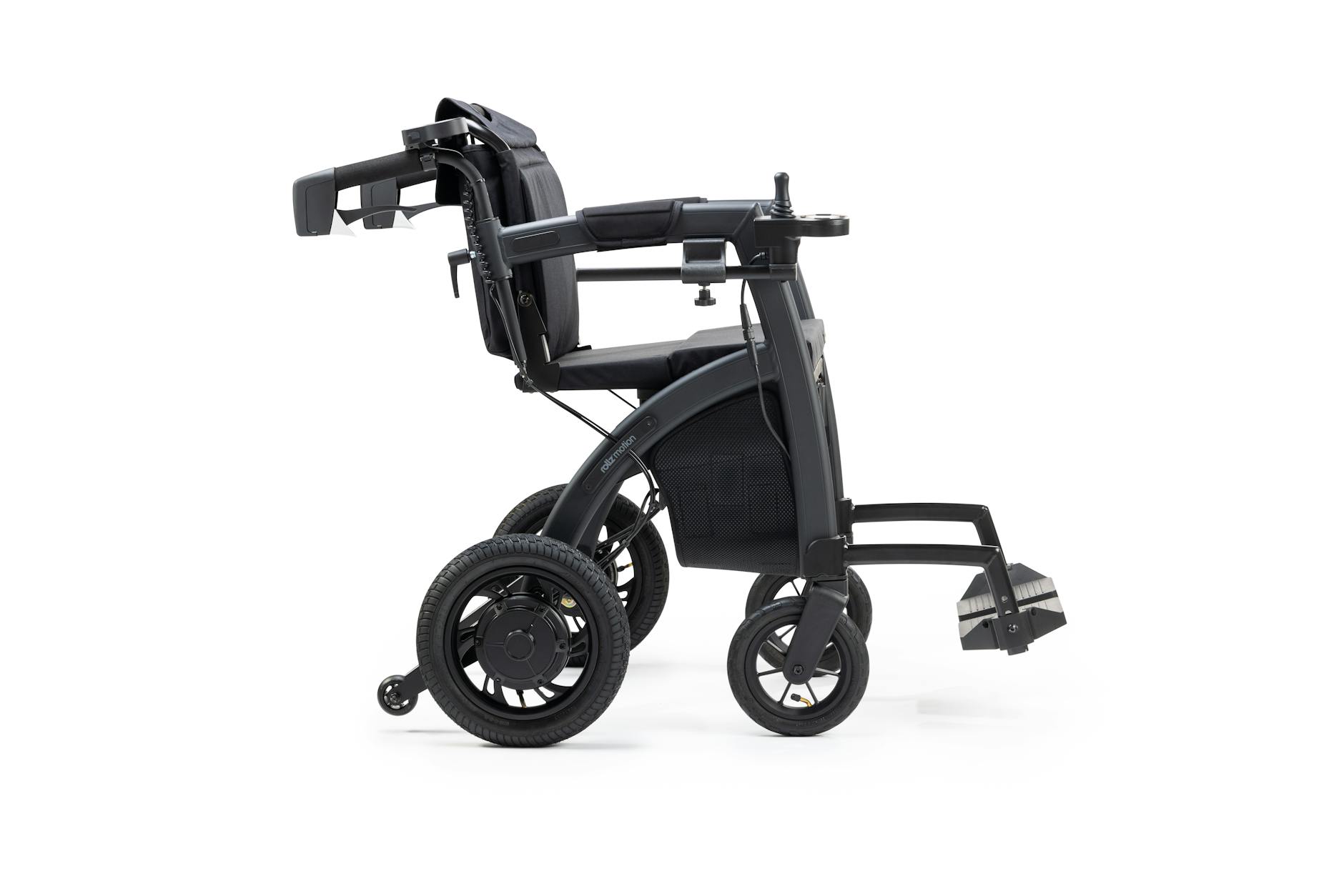
Anti-Slide Cushions and Budget-Friendly Alternatives
Not every family or care facility can invest in a new wheelchair, and not every sliding situation requires one. Anti-thrust wedge cushions and pommel cushions can meaningfully reduce forward sliding on an existing chair at a fraction of the cost. An anti-thrust wedge cushion is higher in front and lower in back, which raises the knees slightly and seats the person deeper into the chair. The high-density foam barrier at the front edge prevents forward migration. The AliMed Anti-Thrust Wheelchair Cushion runs approximately $117, and the Blue Chip Medical Anti-Thrust Wedge is available through Amazon at a similar price point. Pommel cushions take a different approach. They feature a raised protuberance between the legs, similar to a saddle pommel, that physically prevents the patient from slipping forward and out.
Beyond anti-slide function, pommel cushions reduce internal rotation contracture and skin shear, and they create natural knee separation that reduces pressure on the coccyx. The Secure Safety Solutions Wedge Pommel Cushion is available at Walmart for approximately $104.99. For pressure relief specifically, gel cushions using T-Gel or silicone compounds outperform foam, while air cushions offer the most adjustability but cost more. The tradeoff is straightforward. Cushions are affordable and easy to try, but they address symptoms rather than root causes. A patient who slides aggressively or who has significant postural instability will likely defeat a cushion within minutes. Cushions work best as part of a layered approach, paired with proper chair fit, correct footrest positioning, and periodic reassessment. They are a reasonable first step, not a final solution, for patients with moderate sliding tendencies.
Positioning Accessories and Common Mistakes That Increase Risk
Several accessories can supplement a wheelchair or clinical chair to reduce sliding, but they must be used correctly. Pelvic positioning belts, angled across the hips rather than the abdomen, stabilize the pelvis and prevent the downward slide that precedes a forward slide. Lap trays and lap buddies serve double duty as an activity surface and a physical barrier. Lateral supports and trunk wedges prevent the side-to-side leaning that often precedes a forward slide. And properly positioned footrests are more important than many caregivers realize. When a patient’s feet dangle or rest on the floor instead of on footplates, they can push themselves forward, intentionally or not. The most common mistake is treating restraints as a first-line solution.
Belts and harnesses are regulated in many care settings, and for good reason. A confused Alzheimer’s patient who is restrained may become more agitated, struggle against the restraint, and injure themselves in the process. Proper positioning through chair design is strongly preferred over restraint-based approaches. Restraints should be considered a last resort, used only when other interventions have failed, and implemented under clinical supervision. Another frequent error is selecting a chair based on general dimensions rather than the individual patient’s body. An occupational therapist assessment is recommended before choosing seating, and a thorough evaluation may involve observing the patient over several weeks to understand their specific movement patterns, agitation triggers, and postural tendencies. A chair that fits one 160-pound patient perfectly may be completely wrong for another person of the same weight but different proportions. Proper chair fit, ideally made-to-measure, is considered the single most effective sliding prevention strategy by occupational therapy professionals.

When Rocking Chairs and Movement-Based Seating Help
For patients whose sliding is driven by agitation, restlessness, or a need for sensory input, movement-based seating can address the underlying behavior rather than just blocking the physical result. Broda’s Dynamic Rocking wheelchairs are the most widely used product in this category within memory care facilities. The gentle rocking motion provides calming vestibular input that can reduce the frequency of agitated episodes.
This approach is not appropriate for all patients. Those with severe postural instability may not have the trunk control to safely use a rocking feature, even with tilt-in-space support. And some patients find the motion disorienting rather than calming. A trial period, ideally supervised by an occupational therapist or experienced nursing staff, is the best way to determine whether a particular patient benefits from movement-based seating.
Getting an Occupational Therapy Assessment Before You Buy
Before spending thousands of dollars on specialized seating, an occupational therapy evaluation can save money and produce better outcomes. An OT can identify whether the sliding problem stems from chair fit, postural weakness, agitation, medication side effects, or some combination. They may recommend environmental modifications, repositioning schedules, or targeted exercises alongside or instead of new equipment. In some cases, a relatively inexpensive cushion combined with correct footrest height and a positioning belt resolves the problem entirely.
In others, the assessment confirms that a tilt-in-space wheelchair or clinical chair is genuinely necessary, which strengthens the case for insurance coverage. The seating landscape for Alzheimer’s patients continues to evolve. Manufacturers are developing lighter tilt-in-space frames, more adjustable cushion systems, and chairs that integrate pressure mapping sensors to alert caregivers when a patient begins to shift. For now, the fundamentals remain the same: proper fit, appropriate tilt, and a layered approach to positioning will prevent the majority of sliding incidents. The best time to address the problem is before the first fall, not after.
Conclusion
The best seating option for an Alzheimer’s patient who slides forward depends on the severity of the problem, the patient’s specific needs, and the available budget. Tilt-in-space wheelchairs, particularly those from Broda, represent the most effective mechanical solution for the majority of patients, with prices ranging from about $1,600 to $4,500. For patients with complex positioning needs, clinical chairs like the Seating Matters Sorrento or Phoenix provide the highest level of support at a higher price point.
Anti-thrust wedge cushions and pommel cushions offer a reasonable and affordable starting point for moderate sliding, typically costing between $100 and $120. Whatever the chosen solution, two steps should come first: an occupational therapy assessment to understand the individual patient’s needs, and a clear understanding that restraints are not the answer. Proper positioning through thoughtful chair design, correct fit, and appropriate accessories will keep more patients safe than any belt or harness. Given that Alzheimer’s patients face more than double the fall risk of their cognitively normal peers and three times the hip fracture risk, getting the seating right is one of the most consequential decisions a caregiver can make.