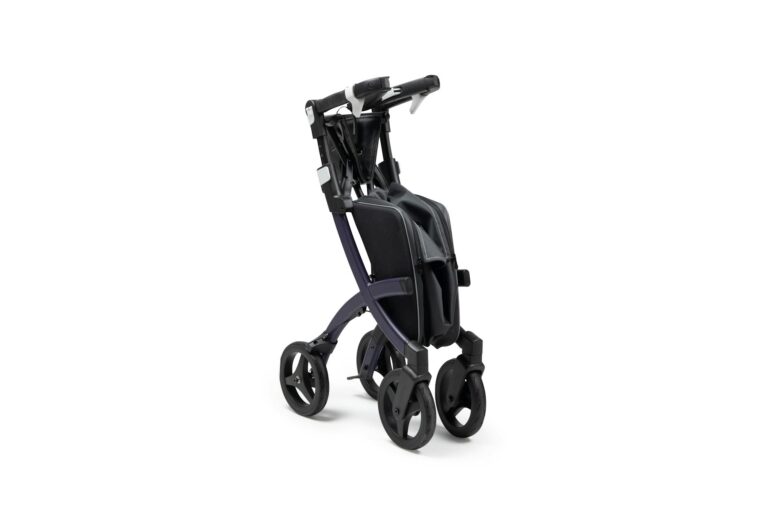
The best outdoor walking aid for most Alzheimer’s patients is a four-wheeled rollator with large all-terrain wheels, push-down brakes, and a built-in seat for resting. Models like the Drive Medical Nitro Euro-Style with 10-inch front wheels or the MAXWALK Rollator with 12-inch oversized wheels handle uneven outdoor surfaces far better than standard walkers, while the seat allows for frequent breaks that dementia patients often need. For someone in the early or middle stages of Alzheimer’s who still has reasonable mobility and can follow basic instructions, this type of walking aid strikes the right balance between independence and safety. However, choosing the right walking aid for someone with dementia requires more thought than simply picking the highest-rated model.
Research published in BMC Geriatrics found that mobility aid use in people with dementia actually increases falls three-fold, which means proper assessment and fit matter enormously. There’s also a sobering statistic to consider: six in ten people with dementia will wander at least once. A rollator that makes outdoor walking easier could also make unsupervised wandering easier, so families need to weigh mobility benefits against wandering risks. This article covers how to evaluate which type of walking aid suits your loved one’s specific stage and abilities, compares the top all-terrain models currently available, explains critical safety features like brake types and wheel sizes, and addresses how GPS tracking technology can provide an additional layer of security for outdoor use.
Table of Contents
- Which Type of Walking Aid Works Best for Dementia Patients Who Walk Outdoors?
- Essential Safety Features for Alzheimer’s-Friendly Outdoor Walkers
- Top-Rated All-Terrain Rollator Models for Outdoor Use
- Proper Fitting and Training for Dementia Patients
- When a Rollator Is Not the Right Choice
- Looking Ahead: Mobility and Dementia Care
Which Type of Walking Aid Works Best for Dementia Patients Who Walk Outdoors?
rollators, the four-wheeled rolling walkers with hand brakes and seats, are generally the best choice for Alzheimer’s patients who can still walk independently outdoors. Unlike standard walkers that must be lifted with each step, rollators glide forward continuously, which reduces the cognitive load of coordinating lift-and-step movements. For someone whose brain is already working harder to process their environment, this smoother motion can make the difference between a successful outing and a frustrating one. The key distinction is between indoor and outdoor use. Standard rollators with small 6-inch wheels work fine on smooth hospital floors or flat indoor surfaces, but they struggle on cracked sidewalks, gravel paths, grass, or any uneven terrain.
Outdoor-specific rollators feature wheels ranging from 8 to 12 inches in diameter, and this matters significantly. A rollator with 10-inch or larger wheels can roll over small obstacles, handle bumps without jarring the user, and maintain stability on surfaces that would stop a smaller-wheeled model in its tracks. That said, rollators are not appropriate for everyone with dementia. If your loved one is in the later stages of Alzheimer’s, struggles significantly with balance, or cannot remember how to operate hand brakes, a rollator may create more danger than it prevents. Researchers developed the Safe Use of Mobility Aid Checklist, known as SUMAC, specifically to evaluate whether someone with dementia can safely use a four-wheeled walker. If there’s any doubt about your family member’s ability, request an assessment from a physical therapist who has experience with dementia patients before purchasing any walking aid.

Essential Safety Features for Alzheimer’s-Friendly Outdoor Walkers
The brake system is arguably the most critical feature to evaluate when choosing a rollator for someone with cognitive impairment. Push-down brakes, which engage when the user presses down on the handles, are significantly easier for dementia patients to use than traditional squeeze brakes. Squeeze brakes require the user to grip and pull the brake lever toward the handle, a motion that demands more hand strength and coordination. When someone with Alzheimer’s forgets the correct motion or lacks the grip strength, push-down brakes provide a more intuitive and reliable stopping mechanism. Locking brakes serve a different but equally important function. When the user wants to sit on the rollator’s built-in seat, the brakes must lock firmly in place to prevent the walker from rolling away.
This is not optional for dementia patients. A rollator that rolls backward when someone sits down can cause a serious fall injury. Before any purchase, test that the locking mechanism is simple to engage and that it holds the rollator absolutely stationary on slight inclines. Beyond brakes, look for adjustable height settings, a lightweight aluminum frame, and a comfortable padded seat. However, if your loved one tends to sit down frequently and without warning, be aware that even properly locked brakes can fail on steep slopes. Some caregivers solve this by only allowing outdoor walks on flat terrain or by standing directly behind the rollator whenever the person sits. The seat is a wonderful feature for planned rest stops, but it requires supervision to use safely.
Top-Rated All-Terrain Rollator Models for Outdoor Use
Several rollator models stand out for their outdoor performance, though each has tradeoffs worth considering. The Drive Medical Nitro Euro-Style features 10-inch front wheels that handle most outdoor surfaces well, combined with a lightweight aluminum frame that makes it easier for both the user and caregiver to manage. Its sleek design is also more visually appealing than medical-looking alternatives, which some families find helps their loved one feel less self-conscious about using a walking aid. For truly rough terrain, the MAXWALK Rollator offers 12-inch oversized wheels that can handle gravel, grass, and significantly uneven surfaces. The ELENKER All-Terrain model provides good bump absorption with its 10-inch wheels and suspension system. For heavier users, the Soundfuse All-Terrain supports up to 350 pounds and features 8-inch puncture-proof wheels, while the BlessReach Heavy-Duty model is built for larger individuals who need extra stability. Budget also plays a role in the decision. Basic outdoor-capable rollators start under $100, with models like the Lumex Walkabout Lite offering decent functionality at a low price point. Mid-range all-terrain options typically cost between $150 and $300, which is where most families find the best balance of features and durability. Premium and heavy-duty models can exceed $300. The NOVA Vibe 6 Rollator frequently appears on recommended lists for offering strong price-to-feature value along with a lifetime limited warranty on the frame, which provides some peace of mind for a device that will see regular outdoor use.
## How to Address Wandering Risks When Using Outdoor Walking Aids The same features that make a rollator effective for outdoor walks also make unsupervised wandering easier, and this creates a genuine dilemma for caregivers. A person with Alzheimer’s who has access to a well-functioning outdoor rollator can potentially travel much farther from home than they could without it. Given that six in ten people with dementia will wander at least once, this risk cannot be dismissed. GPS tracking technology offers one solution. The Ravencourt Safer Walking GPS Locator was developed in partnership with the Alzheimer’s Society specifically for dementia patients. For walking aids specifically, the Optimus 3.0 tracker includes a built-in magnet that allows it to attach directly to rollators or other mobility devices, providing passive tracking without requiring the person to remember to carry or charge a separate device. Modern GPS trackers also include Smart Fall Detection that can identify both “soft falls” where someone slides to the ground and “hard falls” involving sudden impact. The tradeoff with any tracking solution involves balancing safety with dignity. Some families find that GPS tracking allows them to give their loved one more outdoor freedom, knowing they can locate them if needed. Others worry about surveillance and the emotional impact on someone who may already feel that their independence is slipping away. There is no universally correct answer, but having the conversation with your care team and, when possible, with your loved one in the earlier stages of their diagnosis helps establish what approach feels right for your family.

Proper Fitting and Training for Dementia Patients
Even the best rollator becomes dangerous if it does not fit the user properly or if the user does not understand how to operate it. Height adjustment is the most basic fitting consideration. When standing upright with hands on the handles, the user’s elbows should bend at approximately a 15 to 20 degree angle. Handles set too low force the user to hunch forward, while handles set too high prevent proper weight distribution and control. For someone with Alzheimer’s, learning to use a new walking aid may require significant repetition and patience. In the early stages of dementia, most people can learn new routines if they practice consistently in low-pressure environments.
Start with indoor use on smooth floors before introducing outdoor terrain. Walk alongside your loved one, gently reminding them about brakes and pacing. If they repeatedly forget how to stop the rollator or seem confused by the brake mechanism despite practice, this may indicate that a rollator is not the right choice for their current cognitive level. Physical therapists who specialize in geriatric or dementia care can provide invaluable guidance during this process. They can assess whether a rollator is appropriate, recommend specific models, ensure proper fit, and develop a training plan tailored to your loved one’s abilities. This professional assessment becomes even more important given the research showing that mobility aid use triples fall risk in dementia patients. The goal is to improve quality of life through outdoor mobility, not to create new hazards.
When a Rollator Is Not the Right Choice
A rollator works well for many Alzheimer’s patients, but it is not a universal solution. If your loved one has significant balance impairment, cannot reliably remember to use the brakes, or has progressed to a stage where they struggle to walk even with assistance, other options may be safer. A transport wheelchair pushed by a caregiver allows outdoor outings without requiring the person with dementia to manage a walking aid independently.
This removes the fall risk associated with self-operated mobility devices. For someone who falls between rollator-capable and wheelchair-dependent, a gait belt combined with close caregiver support may work for short outdoor walks. Some families also find success with U-step walkers, which have a different braking mechanism that requires the user to squeeze a lever to move forward, automatically stopping when they let go. This reversal of standard brake logic can work better for some people with cognitive impairment, though it requires relearning for anyone accustomed to traditional walkers.
Looking Ahead: Mobility and Dementia Care
The landscape of walking aids and assistive technology continues to evolve. GPS tracking devices are becoming smaller, more accurate, and longer-lasting on a single charge. Fall detection algorithms improve each year, reducing false alarms while better identifying genuine emergencies. Some researchers are exploring smart walkers that can detect changes in gait patterns that might indicate declining health or increased fall risk.
For families navigating dementia care today, the practical advice remains straightforward. Assess your loved one’s current abilities honestly, ideally with professional help. Choose a walking aid with appropriate wheel size for outdoor terrain and brakes designed for cognitive impairment. Fit the device properly, practice extensively, and consider GPS tracking if wandering is a concern. Outdoor walking provides real benefits for physical health, mood, and quality of life, and with the right equipment and supervision, many Alzheimer’s patients can continue enjoying time outside safely.