The best chair cushion for a dementia patient living in a multi-level home is a portable, lightweight pressure relief cushion that can travel with the patient from floor to floor throughout the day. For most families, that means starting with something like the ComfiLife Gel Enhanced Seat Cushion, which runs about $35-45 and combines high-density memory foam with a cooling gel layer and a coccyx cutout to reduce pressure on the tailbone. It is light enough to carry between rooms, effective enough to prevent skin breakdown during long sitting periods, and affordable enough to keep a backup on another floor if needed. For patients who struggle to stand from seated positions, a portable lift assist cushion such as the Seat Boost, which weighs just 8.5 pounds and provides up to 70% lift assistance without batteries, can be a genuine safety intervention in a home where stairs already pose a daily risk. But choosing a cushion is not as simple as picking one off a bestseller list.
Nearly 50% of older adults with dementia experienced one or more falls in 2016, compared to about 31% of older adults without cognitive impairment, according to research from Drexel University. People with dementia are four to five times more likely to fall than those without cognitive impairment and face triple the risk of serious injuries like fractures. Meanwhile, sitting for ten or more hours per day is linked to higher dementia risk itself, with the risk rising 50% at twelve hours and nearly tripling at fifteen, per Harvard Health. So the cushion you choose has to solve two problems at once: keep your loved one comfortable and safe while seated, and make it easy enough for them to stand that they actually get up and move throughout the day. This article covers the specific cushion types that matter, how to evaluate them for a multi-level home, the stair safety modifications that should accompany any cushion strategy, and when it is time to bring in an occupational therapist.
Table of Contents
- Why Do Dementia Patients in Multi-Level Homes Need Specialized Chair Cushions?
- Pressure Relief Cushions That Actually Work for Extended Sitting
- Portable Lift Assist Cushions and Why They Matter on Stairs
- How to Set Up Seating Stations Across Multiple Floors
- Stair Safety Modifications That Should Accompany Your Cushion Strategy
- When to Consult an Occupational Therapist About Seating
- Planning Ahead as the Disease Progresses
- Conclusion
- Frequently Asked Questions
Why Do Dementia Patients in Multi-Level Homes Need Specialized Chair Cushions?
Dementia and Alzheimer’s patients are considered one of the most difficult patient groups to seat, according to seating Matters, a clinical seating manufacturer. The reasons stack up fast: agitation and constant movement mean a patient may shift, slide, or try to stand unpredictably. Cognitive decline means they may not report discomfort, numbness, or pain from sitting too long in one position, which dramatically raises the risk of pressure ulcers. And in a multi-level home, there is the added complication that a patient may sit in three or four different chairs throughout the day, on different floors, each with its own risks. A standard sofa cushion is usually the worst offender. Over time, couch cushions sag and lose support, creating a low, soft surface that is both hard to get out of and poor at distributing pressure. Repose Furniture recommends placing a firm cushion insert on top of sagging couch cushions, combined with a support rail, to make existing soft furniture safer for dementia patients.
But in a multi-level home, you cannot retrofit every piece of furniture on every floor. The more practical approach is a portable cushion the patient uses wherever they sit, which ensures consistent support regardless of the chair. Consider a family whose mother with mid-stage Alzheimer’s spends mornings in a kitchen chair on the first floor, afternoons in a recliner in the upstairs living room, and evenings on a bedroom chair. Without a portable cushion system, she faces different pressure risks and different fall risks at every transition. The multi-level dimension also introduces a transfer problem. Every time a patient moves between floors, they face the most dangerous moment: standing up from a seated position and navigating stairs. A cushion that is too soft makes standing harder. A cushion that is too bulky to carry means the caregiver has to choose between lugging equipment or leaving the patient without support on one floor.

Pressure Relief Cushions That Actually Work for Extended Sitting
The core job of any chair cushion for a dementia patient is pressure redistribution. Because patients may sit for hours without shifting their weight, and because they often cannot articulate discomfort, the cushion has to do the work of preventing skin breakdown on its own. There are three main categories worth considering, and each comes with real tradeoffs. Memory foam with gel, like the ComfiLife Gel Enhanced Seat Cushion at $35-45, is the most accessible option. The gel layer helps dissipate heat, which matters because warmth and moisture accelerate skin breakdown. The coccyx cutout relieves pressure on the tailbone, one of the most common pressure ulcer sites for seated patients. For a step up, the Cushion Lab Pressure Relief Seat Cushion at $60-70 uses a patented multi-region design that physical therapists frequently recommend, creating different firmness zones under the thighs, sit bones, and coccyx.
However, if your loved one is already showing signs of reddened skin or early-stage pressure sores, a passive foam cushion may not be enough. For patients at higher risk, the Harvest Ultra-Thin Pressure Relief Cushion uses a nodular foam design that allows airflow beneath the patient and actively redistributes weight across the sitting surface. It fits most standard armchairs. At the most clinical end, the Viola II Alternating Pressure Relief Cushion System is designed for patients at what clinicians classify as “very high risk” of pressure ulcers. It uses alternating air pressure technology, cycling air through different cells to constantly shift pressure points. The limitation here is portability. An alternating air system requires a pump and power, making it impractical to move between floors multiple times per day. If your loved one needs this level of intervention, it is a signal that their seating arrangement needs to be consolidated to one floor rather than distributed across the house.
Portable Lift Assist Cushions and Why They Matter on Stairs
In a multi-level home, the act of standing up is where many falls begin. A dementia patient who struggles to rise from a chair may lurch forward, lose balance, or grab at unstable furniture. If that chair is near a staircase, the consequences escalate quickly. Portable lift assist cushions address this specific moment by providing mechanical assistance during the sit-to-stand transition, and several models are designed to move with the patient from room to room. The Seat Boost Lift Assist Cushion weighs 8.5 pounds, supports up to 240 pounds, and uses a self-powered hydraulic mechanism to provide up to 70% lift assistance. No batteries, no cords, no charging.
A caregiver can carry it from the kitchen to the bedroom and back without hassle. The Carex Upeasy Seat Assist Plus is slightly heavier at 9 pounds but supports a wider weight range of 200-340 pounds using a hydro-pneumatic gas spring, also without electricity. For patients who need more lift force or who weigh more, the SitnStand Lift Assist Classic is battery-powered, supports up to 400 pounds, and has a compact version that is TSA-compliant. The price difference is stark, though: the SitnStand runs $599 compared to roughly $80-120 for the mechanical options. A practical example: a caregiver managing her husband with Lewy body dementia in a two-story colonial keeps a Seat Boost on each floor, eliminating the need to carry it up and down stairs. The $70-90 cost of a second unit is minor compared to the cost and trauma of a fall-related hip fracture. For families on tighter budgets, a single portable unit that the caregiver carries is still a significant safety improvement over no lift assist at all.

How to Set Up Seating Stations Across Multiple Floors
The National Institute on Aging recommends relocating the master bedroom, bathroom, and laundry to the first floor to reduce stair use for Alzheimer’s patients. This is the gold standard, but not every family can afford a renovation or has the floor plan to make it work. When a patient must use multiple floors, creating intentional seating stations on each level reduces the number of transitions and ensures each sitting location is as safe as possible. Each seating station should include a firm, supportive chair at a low seat-to-floor height, which Seating Matters identifies as a key factor in reducing accidental falls. A portable pressure relief cushion should be placed on the chair, and ideally a grab rail or support handle should be mounted nearby to assist with standing. On the primary floor where the patient spends the most time, consider investing in a higher-end cushion like the Cushion Lab or even a clinical option.
On secondary floors where the patient may sit for only an hour or two, a basic gel-foam cushion may suffice. The tradeoff is cost versus consistency. Having identical cushions on every floor ensures the patient always has the same support and the caregiver does not have to think about which cushion to bring. But for a three-story home with two or three sitting locations per floor, outfitting every spot adds up quickly. A reasonable middle ground: invest in one high-quality portable cushion that follows the patient to their primary chair, and place inexpensive firm cushion inserts on secondary seating to at least prevent the worst of the sagging-sofa problem. Waterproof or water-resistant covers with sealed seams or waterfall flap zippers are essential on every cushion, regardless of tier, to manage incontinence. Vivid Care specifically recommends these features for dementia-friendly furniture, and a cushion that cannot be cleaned after an accident will be discarded within weeks.
Stair Safety Modifications That Should Accompany Your Cushion Strategy
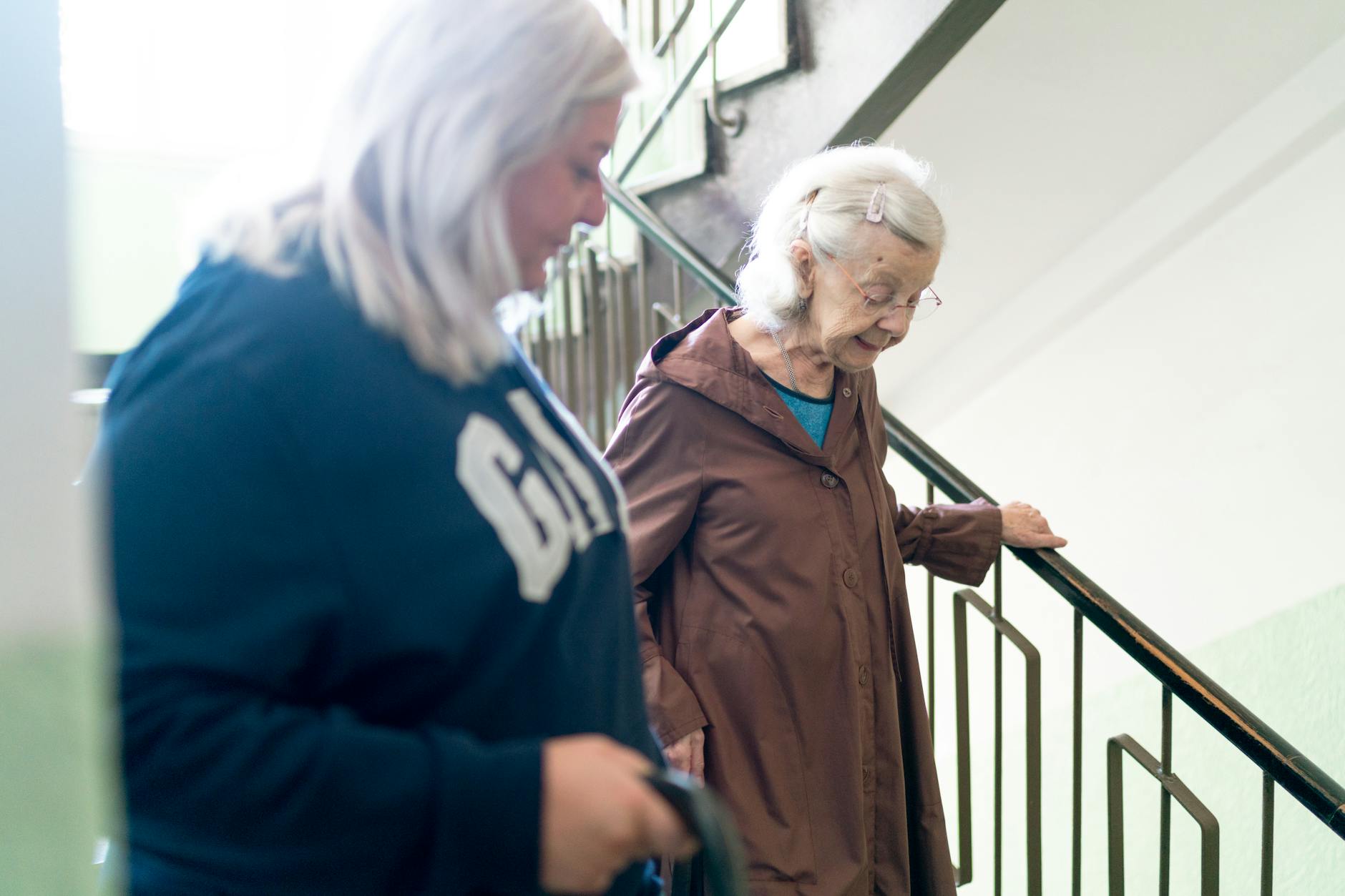
No cushion, no matter how well chosen, compensates for an unsafe staircase. In a multi-level home, stair safety and seating safety are two halves of the same problem. The Alzheimer’s Society UK recommends non-slip strips, contrasting color nosing on stair edges, and motion-activated lighting as essential stair modifications. The contrasting color is particularly important for dementia patients who may have impaired depth perception and struggle to distinguish where one step ends and the next begins. Stair gates are another critical layer. They should be at least 36 inches tall with metal or reinforced construction and tamper-resistant locks, according to guidance from Heisinger Bluffs. Standard child safety gates are not appropriate.
A dementia patient with moderate physical strength and impaired judgment may lean heavily on a gate, attempt to climb it, or repeatedly manipulate the latch. The gate needs to withstand that kind of use without failing. However, gates also introduce a new risk: if a patient becomes agitated about being confined to one floor and tries to force past a gate, they can fall in the process. This is where seating strategy intersects with stair safety. If a comfortable, well-supported seating station exists on the patient’s current floor, with a lift assist cushion that makes standing manageable, the patient has less reason to wander toward the stairs in search of a different chair or position. One limitation families often discover too late: stair modifications and gates do not help if the patient needs to use the stairs for essential activities like reaching their only bathroom. If eliminating stair use entirely is not possible, the National Institute on Aging’s recommendation to relocate critical rooms to one floor should be treated as a priority rather than a suggestion.
When to Consult an Occupational Therapist About Seating
DailyCaring and multiple clinical sources emphasize that occupational therapists and wound care nurses should be consulted to recommend the right cushion, particularly because dementia is a progressive condition and seating needs change over time. A cushion that works perfectly in the early stages, when a patient is still relatively mobile and can shift their own weight, may become inadequate as the disease advances and the patient becomes more sedentary or loses the ability to reposition themselves. An occupational therapist can also evaluate the specific chairs in your home and identify risks that a caregiver might miss, like armrest height that discourages independent standing, or a chair angle that encourages sliding forward.
Seating Matters manufactures therapeutic “cocoon-design” clinical chairs that provide sensory feedback across the body, reducing agitation and preventing slips. These are designed specifically for dementia patients and may be recommended by an OT for patients whose agitation makes standard seating unsafe. They are a significant investment, but for a patient who has already fallen multiple times from conventional chairs, the cost may be justified by the hospital visits it prevents.
Planning Ahead as the Disease Progresses
The uncomfortable reality of dementia care seating is that what works now will likely not work in eighteen months. A patient who currently moves independently between floors with a portable cushion may eventually need to be consolidated to a single floor with clinical-grade pressure relief and a full lift assist system. Families who plan for this progression early, by already having first-floor sleeping and bathing arrangements ready, by establishing a relationship with an occupational therapist, and by choosing modular cushion solutions that can be upgraded rather than replaced, save themselves crisis decisions later.
Cool-gel and alternating air-system cushions are especially important to keep on the radar as the disease progresses, because patients in later stages may sit for much longer stretches and lose the ability to communicate that they are in pain. Seating Matters notes that these technologies reduce pressure ulcer risk, which becomes a primary care concern as mobility declines. The cushion strategy that starts as a fall prevention measure in a multi-level home gradually shifts into a skin integrity and comfort measure as the patient’s world narrows. Planning for both phases from the beginning is the most practical thing a caregiver can do.
Conclusion
The best chair cushion for a dementia patient in a multi-level home is one that is portable enough to move between floors, supportive enough to prevent pressure injuries during long sitting periods, and compatible with the patient’s ability to stand independently. For most families, a gel-enhanced memory foam cushion like the ComfiLife paired with a hydraulic lift assist cushion like the Seat Boost or Carex Upeasy covers the essential bases without breaking the budget. Add waterproof covers, set up intentional seating stations on each floor, and address stair safety with gates, non-slip strips, and contrasting nosing.
Beyond the cushion itself, the bigger picture matters. Consult an occupational therapist to match the cushion to your loved one’s current stage and to plan for progression. Consider whether consolidating daily life to one floor is feasible, because eliminating stair transitions removes the single greatest fall risk in a multi-level home. And remember that sitting for ten or more hours a day carries its own dementia-related risks, so the best cushion is ultimately one that makes it easy enough to stand up that your loved one actually does.
Frequently Asked Questions
Can I just use a regular pillow instead of a specialized cushion?
A regular pillow does not distribute pressure evenly and will compress flat within days of continuous use, offering no meaningful pressure relief. It also raises the seat height unpredictably, which can make standing less stable. Even an inexpensive gel-foam cushion like the ComfiLife at $35-45 provides significantly better support and durability.
How often should a dementia patient be repositioned if they are using a pressure relief cushion?
Even with a high-quality pressure relief cushion, caregivers should encourage repositioning or standing every one to two hours. The cushion reduces the risk of pressure injuries but does not eliminate it entirely, especially for patients who cannot shift their own weight.
Are lift assist cushions safe for dementia patients to use without supervision?
Generally, no. The hydraulic and pneumatic mechanisms in lift assist cushions activate based on weight shifts, and a dementia patient who stands unpredictably or leans to one side may not engage the mechanism properly. A caregiver should be present during sit-to-stand transitions, particularly in the middle and later stages of the disease.
Should I buy one cushion and move it, or buy separate cushions for each floor?
If budget allows, separate cushions on each floor reduce the chance that the cushion gets left behind during a transition. A secondary cushion does not need to be as high-end as the primary one. However, a single portable cushion that travels with the patient is far better than no cushion at all on any given floor.
Do I need a doctor’s prescription to get a pressure relief cushion?
Most consumer cushions like the ComfiLife or Cushion Lab do not require a prescription. Clinical-grade alternating pressure systems like the Viola II may be covered by insurance or Medicare with a prescription and a documented assessment of pressure ulcer risk. An occupational therapist or wound care nurse can help navigate this process.