Home safety checks for dementia should assess fall hazards, bathroom modifications, kitchen hazards, wandering prevention, medication access, lighting, and appliance controls—ideally before a person is diagnosed with moderate cognitive decline, when they can still participate in planning. A home safety checklist for dementia isn’t about removing all risk (which is impossible) but about reducing the most dangerous scenarios: falls that break bones, kitchen fires, medication overdoses, and extended wandering that leads someone to get lost or injured. For example, a 72-year-old with early-stage Alzheimer’s who leaves the stove on without realizing it isn’t being careless—their memory and judgment have changed, and the environment needs to change first.
The goal is to make the living space work *with* the person’s changing abilities rather than constantly fighting against them. This means looking at the home not from the perspective of a healthy adult, but through the lens of someone with reduced mobility, memory loss, impaired judgment, and possibly visual or hearing changes. A professional home safety assessment by an occupational therapist can identify hazards in 2–3 hours; alternatively, a structured checklist and a careful walk-through with the family can catch most critical issues.
Table of Contents
- What Are the Most Critical Fall Hazards in a Home with Dementia?
- How Should Bathrooms Be Modified for Dementia Safety?
- Why Kitchen Safety Requires Special Attention in Dementia Care
- Creating a Practical Maintenance and Monitoring Schedule
- Addressing Wandering and Elopement Risks
- Medication and Appliance Access Controls
- Lighting, Vision, and Environmental Clarity
- Frequently Asked Questions
What Are the Most Critical Fall Hazards in a Home with Dementia?
Falls are the leading cause of injury-related death in people with dementia, and most falls happen at home. The hazards that matter most are loose rugs, poor lighting, cluttered pathways, slippery bathroom floors, and missing handrails on stairs. A person in early-to-moderate dementia may forget they need to move slowly, may misjudge a step, or may not reach for a handrail even if one is present. Unlike a younger person who catches themselves, someone with dementia is more likely to fall hard and is at higher risk for a hip fracture, which often triggers a cascade of complications—infection, immobility, further cognitive decline.
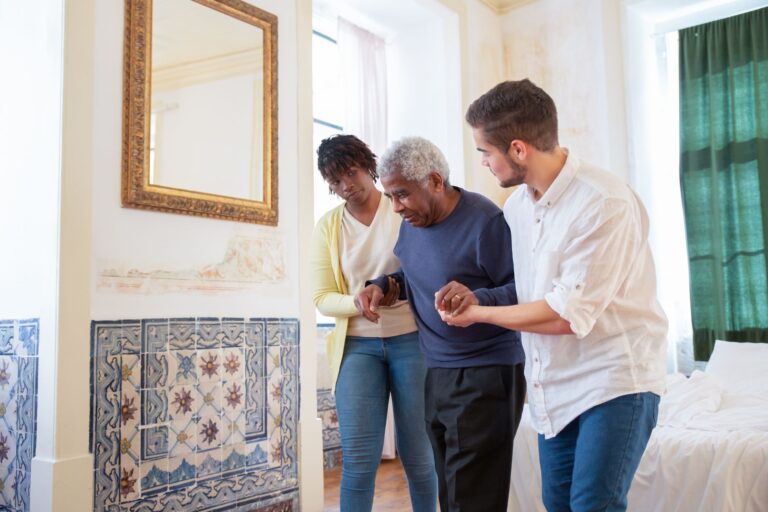
Start with flooring: remove all throw rugs, secure the edges of larger rugs with non-slip tape, and check for transitions between rooms where a person might catch their toe. Make sure pathways are clear of clutter, electrical cords, and pet toys. Install handrails on both sides of stairs and in hallways where balance might be compromised. For comparison, a home without dementia considerations might have a decorative rug in an entryway; the same home with dementia needs that rug removed entirely, the floor kept clear, and motion-sensor lighting added to light the path to the bathroom at night.
How Should Bathrooms Be Modified for Dementia Safety?
Bathrooms are high-risk zones because they combine water, hard surfaces, slippery floors, and often poor lighting. The minimum modifications are grab bars, non-slip mats, adequate lighting, and a walk-in shower or low-step tub. Grab bars should be 1.5 inches in diameter, installed at 33–36 inches from the floor for horizontal bars and 42–48 inches for vertical bars, and rated to support at least 250 pounds. Many caregivers make the mistake of installing bars in visually inconspicuous locations or using decorative towel racks instead of structural grab bars; the person with dementia won’t ask for help or remember where a bar is, so placement must be obvious and functional.
A shower chair or transfer bench is critical if the person has balance problems or reduced mobility. Non-slip mats should cover the tub floor and the surrounding bathroom floor; some caregivers add a second mat outside the shower to catch drips. Water temperature should be controlled so the maximum temperature is 120°F (49°C), preventing accidental scalding—this is especially important because a person with dementia may not realize water is too hot. One limitation of bathroom modifications is that they can feel institutional, and some people resist them for that reason; choosing colors that match the existing décor or installing bars in brushed nickel rather than stainless steel can help, but function must come first.
Why Kitchen Safety Requires Special Attention in Dementia Care
The kitchen is where unsupervised access can lead to a fire, poisoning, or consumption of spoiled food. A person with dementia may turn on the stove and forget about it, may confuse cleaning supplies with food, or may eat raw meat without realizing it needs cooking. The core modifications are restricting access to a knob-cover stove (so the burners won’t turn on without removing the cover), removing cleaning supplies and medications from under the sink or kitchen cabinets (or locking them), and using a kettle with an automatic shut-off. Some kitchens require removing the oven entirely if the person is likely to turn it on or climb inside during confusion.
A concrete example: a 68-year-old man with mid-stage dementia turned on the front burner, set a dish on it, and left the kitchen. His daughter found a small fire developing twenty minutes later. After that incident, the family installed a knob-cover stove and set a rule that the kitchen was off-limits without supervision. They also removed the dishwasher’s ability to run automatically—someone had to manually start each cycle—because he had washed a raw chicken on the delicate cycle, creating cross-contamination risk. The comparison is important: a kitchen for a cognitively intact person is about convenience and efficiency; a kitchen for someone with dementia is about preventing access to hazards and making it obvious what is food and what is not.
Creating a Practical Maintenance and Monitoring Schedule
Once major modifications are in place, safety depends on regular checks and upkeep. Handrails become loose, non-slip mats develop gaps, and lighting bulbs burn out. A practical approach is a monthly walkthrough with a checklist: check that all grab bars are secure, that rugs are still in place and non-slip tape is holding, that pathways are clear, that lighting is adequate, and that locks on medication/cleaning storage are functioning.
If the person lives alone or with an elderly spouse, a family member or paid caregiver should do this check; if the person is in assisted living or a care facility, staff should follow a facility protocol. A tradeoff exists between frequent formal assessments (which can catch problems early but are expensive) and informal family checks (which are free but might miss hazards). Many families find a middle ground: a professional occupational therapist does a full assessment every 1–2 years, and informal checks happen monthly. Documentation matters—writing down the date and any issues found makes it easier to spot patterns (e.g., lights keep burning out in the hallway, suggesting a wiring issue) and provides a record if safety concerns ever become evidence in legal or care-planning discussions.
Addressing Wandering and Elopement Risks
Wandering (moving without purpose or awareness of location) and elopement (leaving a safe area with intent or without awareness) are among the most frightening safety issues for caregivers. A person with dementia may leave the house in the middle of the night looking for a deceased spouse, may not remember their own address, and may not respond to their name. Environmental controls include locks on exterior doors, motion sensors that alert caregivers when a door opens, and secure fencing if the person has access to a yard.
The limitation is that locks and sensors prevent exits but do nothing to help if the person gets out anyway. That’s why additional safeguards matter: a medical alert bracelet with GPS tracking, a recent photo kept handy, and enrollment in the Alzheimer’s Association’s Safe Return program (in the US) or similar services. A warning: electronic monitoring can fail—batteries die, signals drop, devices get lost—so it should never be the only safety measure. A person at high risk for elopement should wear identification at all times, not just when caregivers remember to put it on.
Medication and Appliance Access Controls
Accidental medication overdose is a real risk when a person with dementia can access their own medications. The safest approach is a locked medication box, ideally on a timer, that dispenses only the correct dose at the correct time. A family member or caregiver administers the medications, or a pill organizer is checked by a caregiver before each dose. Over-the-counter pain relievers, antacids, and cold medicines should also be stored securely because a person with dementia may take multiple doses, thinking they forgot the first one.
Appliances like space heaters, hair dryers, and electric blankets pose fire and burn risks. These should be removed from the bedroom or stored where the person cannot access them independently. A specific example: a man with dementia pulled an electric blanket around himself at night for hours without realizing it was on, resulting in thermal burns. The solution was removing the blanket from the bedroom entirely and providing a regular fleece blanket instead.
Lighting, Vision, and Environmental Clarity
Good lighting is one of the most underestimated safety tools. The goal is to eliminate dark areas where a person might trip, get disoriented, or have a fall. Hallways should have motion-sensor lights so the path to the bathroom is lit without needing to find a switch. Nightlights should be placed in the bedroom, hallway, and bathroom.
Stairways need lighting at the top and bottom, and each step should be clearly visible—painting the edge of each step a contrasting color (e.g., white edge on a dark stair) helps reduce trips. Poor vision and dementia together create a particularly hazardous combination. If the person has cataracts, macular degeneration, or reduced contrast sensitivity, even a well-lit home might feel confusing. Regular eye exams are part of home safety planning, not optional. A concrete detail: someone with advanced dementia who also has cataracts might not recognize their bathroom by sight alone, even if they’ve used it for decades; adding clear signage with a picture (not just words) can help orient them, but relying on this is optimistic—supervision and handrails matter far more than hope that they’ll find the right room.
- —
Frequently Asked Questions
How much does a professional home safety assessment cost?
A full occupational therapy home safety assessment typically costs $200–$600, depending on your location and whether it’s through insurance or private pay. Many insurance plans cover part or all of the cost if ordered by a physician. Some Alzheimer’s Association chapters offer lower-cost assessments or can recommend evaluators.
Can I do a home safety check myself, or do I need a professional?
You can start with a checklist and informal walkthrough, which will catch obvious hazards like throw rugs and poor lighting. A professional assessment is more thorough and will identify hazards you might miss—for example, grab bar placement, electrical hazards, and risks specific to the person’s mobility level. If the person has had a fall or is in mid-to-late stage dementia, a professional evaluation is worth the investment.
Should I install cameras to monitor safety?
Cameras can help alert you to falls or wandering, but they raise privacy concerns and don’t prevent injuries. They work best as part of a larger plan that includes handrails, clear pathways, and personal attention, not as a replacement for these basics. Many families decide against cameras because the person with dementia finds them distressing or doesn’t understand their purpose.
What should I do if the person refuses safety modifications?
In early-stage dementia, involving the person in planning and explaining why modifications matter can increase buy-in. In later stages, when the person may not understand the reasoning, modifications often need to happen anyway for safety. Frame it to the person in ways that make sense to them—for example, “I installed these bars so you won’t slip” rather than “You have dementia and can’t be trusted.” If the person becomes angry or agitated by modifications, a care manager or therapist can sometimes help find an approach that feels less threatening.
How often should I redo a home safety assessment?
A full assessment makes sense at diagnosis or when a significant change occurs—a fall, a hospitalization, a move to a new living situation, or noticeable cognitive decline. Many families do a follow-up assessment every 18–24 months as abilities change. Informal monthly checks for loose handrails, clear pathways, and working lights should happen year-round. —