Reviewed by the Help Dementia Editorial Team — our editors review every article for accuracy against guidance from the National Institute on Aging, the Alzheimer’s Association, and peer-reviewed sources.
Falls are the leading injury-related cause of death and disability among older adults, and they are highly preventable—yet prevention requires caregivers to understand specific risk factors, environmental hazards, and interventions proven to work. According to the CDC, 1 in 4 older adults falls each year, totaling 14 million Americans age 65 and older. For caregivers of people with dementia, the stakes are even higher: cognitive decline impairs balance awareness, increases confusion about environmental obstacles, and reduces the ability to catch oneself during a fall. Your role as a caregiver directly influences whether the person in your care remains mobile and independent or becomes injured and further disabled by a preventable accident. What caregivers should know about fall prevention goes far beyond installing a grab bar in the bathroom. Effective prevention requires a combination of environmental modifications, medical management, physical activity, assessment of individual risk, and your own education about recognizing hazards.
The good news is that falls are not an inevitable part of aging or dementia—they are often the result of correctable factors. A 75-year-old with dementia who lives in a well-modified home, takes medications that do not impair balance, and engages in guided exercise can have a fall risk profile very different from one who does not receive these interventions. The economic and human cost of falls is staggering. Over 95% of hip fractures result from falls in older adults, and one-fifth of falls lead to serious injury like fractures or head trauma. In 2024, falls claimed 43,020 lives. Yet the CDC’s STEADI program (Stopping Elderly Accidents, Deaths & Injuries) and other evidence-based initiatives consistently show that comprehensive, tailored prevention works—reducing fall incidence by up to 20–30% when multiple strategies are combined.
Table of Contents
- Why Fall Rates Are Rising and What That Means for Your Caregiving
- Understanding Fall Risk Factors Specific to Dementia Caregiving
- Creating a Safer Home Environment: The Room-by-Room Approach
- Medication Management and Medical Optimization
- Assessment Tools and When Professional Evaluation Matters
- The Role of Guided Exercise and Physical Activity
- Caregiver Education and Awareness as a Prevention Strategy
Why Fall Rates Are Rising and What That Means for Your Caregiving
Over the past decade, fall-related deaths among older adults have surged dramatically. Age-adjusted fall death rates have increased 21% since 2018, rising from 64.7 per 100,000 in 2018 to 78.4 per 100,000 in 2024. More broadly, fall-related deaths have climbed over 51% in the past 10 years, and emergency department visits for fall injuries increased by 38%. These trends underscore that the fall crisis is worsening, not improving, despite greater awareness and more resources available than ever before. This upward trend matters for you as a caregiver because it means the healthcare system is becoming more strained, emergency departments are busier, and prevention—not treatment after the fact—is increasingly critical. For someone with dementia, a fall can trigger a cascade of complications: hospitalization, delirium, loss of independence, accelerated cognitive decline, and a sharp drop in quality of life.
What happens in those hours after a fall often determines whether your loved one returns home or enters institutional care. The stakes justify the preventive effort. The rise in falls is not due to a single cause. Medication use, polypharmacy (taking multiple drugs), chronic diseases like Parkinson’s disease and cerebrovascular disease, vision loss, and the aging of the population all contribute. For people with dementia specifically, the combination of balance impairment, medication side effects, and environmental confusion creates a perfect storm for falls. Understanding this context helps you avoid complacency and prioritize prevention as actively as you would manage diabetes or heart disease.
Understanding Fall Risk Factors Specific to Dementia Caregiving
people with dementia face unique fall vulnerabilities because the disease directly affects the brain regions controlling balance, spatial awareness, and motor planning. Unlike an older adult with arthritis whose fall risk is primarily mechanical, someone with dementia may fall because they misjudge the height of a step, forget where the bathroom is and wander into unsafe areas, or become dizzy from medication side effects that also impair their judgment about safety. Sedatives and antidepressants are particularly problematic—they increase fall risk not only by impairing balance but also by reducing alertness and slowing reaction time, exactly when quick reflexes matter most. Chronic conditions compound the problem. Someone with dementia and Parkinson’s disease faces a double burden: the progressive loss of balance control and the rigidity that makes corrective movements nearly impossible. A person with dementia and a history of stroke may have weakness on one side, further destabilizing their gait.
Medication reviews are essential but often overlooked. Many caregivers do not realize that a doctor may have prescribed a medication appropriate for the condition without considering its fall-increasing effects—or that doses may have drifted upward over time, intensifying the risk. The limitation of standard fall risk assessment tools is important to recognize. The Morse Fall Risk Scale, one of the most widely used, assigns numerical scores based on history of falls, secondary diagnosis, ambulatory aid use, and other factors, but a high score does not automatically prevent falls, and a low score does not guarantee safety. Recent guidance from April 2025 emphasizes that comprehensive multifactorial assessment—looking at exercise capacity, medication effects, home hazards, vision, and cognitive status—is more effective than relying on prediction scores alone. For dementia, this means you cannot simply plug numbers into a formula; you need to understand the person’s specific vulnerabilities and address them directly.
Creating a Safer Home Environment: The Room-by-Room Approach
Over 50% of falls occur at home, making environmental modification one of the highest-impact preventive interventions. Home safety upgrades are also among the most cost-effective health investments available—they require relatively small upfront costs and deliver large reductions in injury risk over time. The bathroom is the highest-risk area, as it combines slippery surfaces, balance demands, and reduced visibility. Install grab bars firmly anchored to wall studs near the toilet and inside the tub or shower. A non-slip bath mat and a handheld showerhead can further reduce the risk of slipping while increasing independence. Lighting is critical and often overlooked. Poor lighting in hallways, stairways, and bedrooms is a common precipitant of falls, especially for someone with dementia who may have reduced night vision or feel disoriented when moving from a lit room to darkness. Install motion-activated nightlights along pathways to the bathroom—a dementia-specific need, since someone may wake at 2 a.m. confused and try to find the bathroom in the dark.
Use bright, even lighting in all main living areas, and eliminate dark corners. Throw rugs, while aesthetically pleasant, are a serious trip hazard; if they cannot be removed, secure them firmly with double-sided tape or non-slip rug pads. Handrails on all staircases are non-negotiable. A handrail on only one side is less effective than railings on both sides, especially if the person with dementia has a weak side from stroke or does not remember which side to hold. Keep floors level and clear of clutter. For someone with dementia, items left on the floor—a basket of laundry, shoes, a pet bed—can be an unexpected obstacle. Cords, vacuum cleaners, and furniture pushed into walkways should be removed. Furniture itself should have stable legs and not shift when someone leans on it for support. These modifications sound basic but represent the core of fall prevention; they address the physical environment before considering any other intervention. A small home safety assessment by an occupational therapist can identify hazards you might miss and recommend modifications tailored to the person’s specific mobility and cognitive abilities.
Medication Management and Medical Optimization
Your loved one’s medication list is a fall risk assessment tool in itself. Sedative medications and antidepressants are well-documented as increasing fall risk, but so are sleeping pills, blood pressure medications that lower blood pressure too aggressively (causing dizziness on standing), and pain medications. Polypharmacy—taking five or more medications—compounds the risk because drug interactions can impair balance, cognition, or both. A medication review with the primary care doctor or, ideally, a pharmacist is essential at least annually and sooner if you notice new dizziness, confusion, or unsteadiness. The key limitation of medication management is that you cannot always eliminate the offending drug. If your loved one has bipolar disorder and a sedating antipsychotic is managing severe behavioral symptoms, you may not be able to switch it without risking a psychiatric crisis.
In such cases, you strengthen prevention elsewhere: modify the home more rigorously, ensure closer supervision, increase physical activity to offset medication effects, and monitor for any opportunity to reduce doses. Discuss with the doctor whether a lower dose, a change to a less-sedating alternative, or a timing adjustment (taking the medication at night rather than morning, for instance) might help. Do not assume that all medications must stay at their current doses forever; doses can often be adjusted, especially as cognition changes. Chronic condition management matters equally. Someone with Parkinson’s disease needs skilled physical therapy and medication optimization specifically to maintain balance. A person with atrial fibrillation on blood thinners must be monitored carefully, because a fall leading to a head injury becomes a medical emergency—the fall itself plus the bleeding risk. Ensure vision is corrected (cataracts and refractive errors are common and correctable), that hearing aids are worn if prescribed, and that pain from arthritis or other conditions is managed, because pain-related splinting and guarding of movement can trigger falls.
Assessment Tools and When Professional Evaluation Matters
Several standardized assessment tools exist to identify fall risk. The Morse Fall Risk Scale is most common and uses a scoring system from 0 to 125, with higher scores indicating higher risk. The Falls Risk Assessment Tool (FRAT) is another well-validated option. The Berg Balance Scale, Timed Up and Go Test (TUG), and BOOMER are alternatives that focus more on functional balance and mobility. These tools can be useful for identifying trends and communicating risk within a healthcare team, but they have a critical limitation: they predict risk on average but do not identify who will actually fall. A person can score high and not fall, while another scores low and falls unexpectedly. Recent expert guidance from April 2025 recommends moving away from prediction tools as the primary decision-making tool and toward comprehensive multifactorial assessment.
This means a thorough evaluation of the person’s exercise capacity, medication list, home environment, vision, cognition, and medical history, followed by tailored interventions. For dementia specifically, cognitive assessment is essential because someone who scores low on balance tests but has severe cognitive impairment may fall because they forget to use a walker or do not understand how to navigate stairs safely. An occupational therapist brings value here by assessing not just balance but also self-care adaptations, environmental modifications, and safety awareness. Professional fall prevention programs that combine exercise, education, and environmental assessment have strong evidence behind them. A multifactorial intervention program should include supervised exercise guided by a physical therapist, a home hazard assessment, vision assessment, and medication review. If your loved one is in a long-term care facility, active educational interventions for caregivers and staff significantly reduce fall incidence—training alone improves fall prevention outcomes. If you are the primary caregiver at home, seeking guidance from a physical therapist or occupational therapist, even for a few sessions, can teach you how to supervise movement safely and spot hazards you might otherwise miss.
The Role of Guided Exercise and Physical Activity
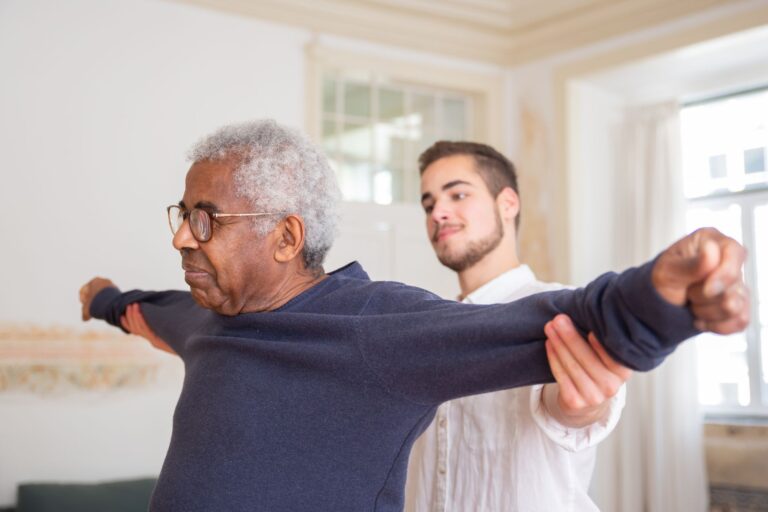
Body exercise interventions guided by physical therapists are strongly recommended and have robust evidence, particularly in long-term care and clinical settings. Exercise does not simply build muscle; it improves proprioception (the body’s sense of position in space), strengthens balance reflexes, and improves confidence in movement. For someone with dementia, exercise also provides structure, reduces agitation, and may improve sleep, all of which reduce fall risk indirectly. Walking on level ground is good; targeted balance training—where someone practices standing on one leg, walking in a straight line, or transitioning from sitting to standing—is better. A critical point: exercise must be supervised or adapted for someone with dementia.
An unsupervised person may overestimate their ability, attempt movements they cannot safely perform, or become confused about what they are doing. A physical therapist can design a safe, appropriate program and teach you how to supervise or assist. The frequency and intensity matter; research suggests that exercise programs must be ongoing, not one-time interventions. Someone who does physical therapy for four weeks and then stops will lose the gains. The commitment is long-term, which is a realistic burden for a caregiver to acknowledge but also a powerful lever for preventing falls.
Caregiver Education and Awareness as a Prevention Strategy
Active educational interventions for caregivers increase knowledge and demonstrably reduce falls in care settings. This means that your own understanding of fall hazards, risk factors, and prevention strategies directly translates to injury prevention for your loved one. Training programs that cover recognizing environmental hazards, understanding medication effects, supervising movement safely, and learning proper body mechanics for assisting someone to move are highly effective. The CDC’s STEADI program provides free resources for patients and caregivers online; occupational therapy and physical therapy organizations also offer evidence-based education. Your role as a caregiver includes vigilance.
Watch for new signs of balance problems or dizziness, recognize when a medication change coincides with new falls or near-falls, notice when your loved one is confused about their surroundings or forgets how to navigate familiar spaces, and advocate for reassessment and intervention. A fall that does not result in injury is still a warning sign that something has changed—medication, cognition, strength, or environment. Each near-miss or minor fall is data that should prompt a conversation with the doctor or a professional assessment. For someone with dementia, who may not report falls or may not remember them, you are often the only person who witnesses the pattern. Documenting falls—when they happen, where, what the person was doing, any injuries—gives the healthcare team information to act on. The CDC estimates that falls are preventable despite rising trends; that prevention depends on caregivers like you recognizing risks and taking action.
- —