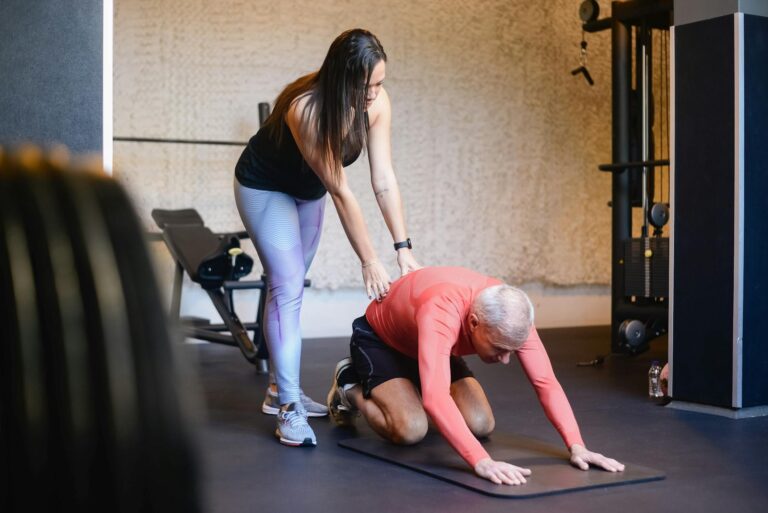
The bird dog exercise is a deceptively simple core-stability movement that directly strengthens the deep spinal muscles responsible for protecting your vertebrae and reducing lower back strain. Performed from an all-fours position, you simultaneously extend your opposite arm and leg while maintaining a neutral spine—a movement that Cleveland Clinic’s 2024 research shows can meaningfully reduce lower back pain by building endurance in the stabilizer muscles that support your spine.
For someone recovering from an injury, managing chronic back discomfort, or simply looking to improve how their body moves and protects itself during daily activities, the bird dog offers measurable benefits without requiring equipment or complicated positioning. This article walks you through the exact step-by-step technique, explains what happens in your body during the movement, and addresses a critical 2025 research finding that’s important to understand: while the bird dog is highly effective for middle-aged and older adults—especially those in recovery or managing pain—it doesn’t necessarily deliver the same performance benefits for younger, athletic populations. We’ll cover the muscles being activated, the clinical research behind spine stability, common form mistakes, and how to integrate this exercise safely into your routine.
Table of Contents
- How the Bird Dog Exercise Activates Your Core and Stabilizes Your Spine
- Step-by-Step Technique and the Importance of Form Precision
- Clinical Research on Bird Dogs and Lower Back Pain Management
- Building Your Bird Dog Practice: Progression and Integration
- Common Form Mistakes and Warning Signs
- Bird Dogs for Older Adults and Dementia Care Contexts
- Integrating Bird Dogs into a Comprehensive Spine Health Routine
- Conclusion
How the Bird Dog Exercise Activates Your Core and Stabilizes Your Spine
The bird dog works by engaging your deep core muscles simultaneously on one side of your body at a time, which is fundamentally different from how many popular core exercises function. When you extend your right arm and left leg while staying in a stable tabletop position, your abdominal muscles, obliques, and spinal stabilizers on that side must fire in a coordinated way to prevent your spine from rotating or twisting. A 2024 ultrasound imaging study found that the bird dog produced the greatest overall increase in muscle thickness compared to other core exercises, specifically targeting three key stabilizers: the transversus abdominis (your deepest core layer), the internal oblique, and the lumbar multifidus (a muscle that wraps directly around your spine). What makes this exercise particularly valuable for spine stability is how it reduces lumbar compressive force—the pressure on your vertebrae—compared to other core movements. Research dating back to 2012 has confirmed this effect, and it’s one reason physical therapists frequently prescribe bird dogs for people managing lower back pain.
The cross-body nature of the movement means you’re not bracing your entire core symmetrically; instead, one side is working hard while the other remains stable, which actually reduces the amount of compressive pressure your discs experience. This is notably different from a plank or crunch, where both sides activate together and pressure builds uniformly. However, the depth of activation matters only if you’re doing the movement correctly. Simply moving your limbs in an all-fours position won’t produce these muscle-activation benefits. You must actively engage your core by contracting your abdominal muscles as if you’re bracing for a light punch—not “sucking in” your stomach, but creating genuine tension through your core. Without this engagement, you’re just moving your limbs, and your spine doesn’t receive the stabilizing benefit.

Step-by-Step Technique and the Importance of Form Precision
To begin, position yourself on all fours with your knees directly under your hips and your hands directly under your shoulders. Your spine should be in a neutral position—imagine a straight line running from the top of your head through your tailbone; no excessive arching of your lower back, and no excessive rounding. Your gaze should be at the floor slightly ahead of your hands, keeping your neck aligned with your spine rather than jutting your head forward or dropping it down. From this position, simultaneously extend your right arm straight forward and your left leg straight backward. Move slowly and with control, extending until your arm and leg are roughly parallel to the floor. Here’s where the 6-8 second hold becomes critical: pause at the top of the extension, maintain your core contraction, and feel the muscles on that side of your body working to keep you stable.
The hold duration matters because it’s during this pause that your deep core muscles develop endurance—the ability to sustain stabilization under mild tension, which translates directly to better spine protection during everyday movements like bending, lifting, or walking. A common mistake is allowing your lower back to arch or your hips to rotate as you extend your limbs. If your core isn’t properly engaged, gravity will pull your extended leg down and your spine will compensate by arching, which defeats the purpose of the exercise. Similarly, some people let their opposite hip drop, creating an imbalance. If you notice either of these happening, it’s a sign to reduce your range of motion slightly or focus more intently on the abdominal bracing before extending. For anyone recovering from injury or managing existing back pain, prioritize perfect form over any amount of extension—a small, controlled movement with proper engagement is far more beneficial than a large movement with poor stability.
Clinical Research on Bird Dogs and Lower Back Pain Management
Cleveland Clinic’s 2024 guidance specifically indicates that bird dog exercises can reduce lower back pain by improving the endurance capacity of your deep spinal muscles. This matters because lower back pain often develops not from a single dramatic injury, but from the gradual fatigue of stabilizer muscles over time. When your core stabilizers become fatigued—from sitting at a desk, standing for long periods, or simply from aging—your spine relies increasingly on passive structures like ligaments and discs, which are more prone to irritation and pain. By building endurance in your transversus abdominis, obliques, and multifidus through regular bird dog practice, you’re essentially giving your spine better active protection throughout the day. Beyond back pain management, the bird dog improves movement efficiency in any activity that requires trunk stability.
Athletes in sports like running, swimming, and golf experience this benefit directly—a stable spine means better power transfer from your lower body through your upper body, and more consistent performance without compensation injuries. However, a critical 2025 double-blind randomized trial published in PLOS One complicates this picture for younger populations. The study found that short-term bird-dog training programs did not enhance trunk performance or whole-body dynamic balance in young, physically active males. This suggests that while the bird dog is genuinely effective for building spine stability and managing pain in middle-aged and older adults—or in younger people recovering from specific injuries—it may not be the optimal exercise choice for younger athletes seeking general athletic performance gains. This distinction is particularly relevant for people on a dementia care or brain health website, as the population tends to skew toward middle-aged and older adults, exactly the group where bird dog research shows the most consistent benefits. For this population, the exercise addresses a real, ongoing challenge: maintaining the muscular support system for the spine as the body ages.
Building Your Bird Dog Practice: Progression and Integration
If you’re new to the bird dog, start conservatively—perform the movement for 6-8 second holds and complete 8 to 10 repetitions on each side before switching. Rest for 30 to 60 seconds between sets, then repeat for two to three sets total. This might seem minimal, but remember that you’re training endurance and stability, not strength, so the goal is sustained muscular engagement rather than fatigue. As you become comfortable with the movement and notice your core bracing becoming more automatic, you can increase the hold duration to 10-15 seconds, or add a second or third set. One practical progression that many physical therapists recommend is adding a slight arm or leg movement while maintaining the hold position—for instance, small pulses of the extended arm or leg without returning to the starting position. This variation increases the demand on your stabilizer muscles without changing the fundamental movement pattern.
Another progression is to perform the movement with your eyes closed, which removes visual feedback and forces your deep core muscles and proprioceptive system to work harder to maintain stability. However, try this variation only after you’ve mastered the basic movement with good form and no back discomfort. The timing of your bird dog practice matters too. If you’re managing lower back pain or recovering from an injury, your physical therapist may recommend performing these holds early in your day when your muscles are fresher and less fatigued. If you’re using them as preventive maintenance, incorporating them into a general fitness routine two to three times per week provides consistent stability benefits without overuse. Unlike high-impact exercises, bird dogs carry minimal injury risk when performed with proper form, so there’s no “penalty” for doing them regularly—consistency matters more than intensity.
Common Form Mistakes and Warning Signs
The most frequent error people make is losing their neutral spine by either excessive arching in the lower back or rounding through the torso. Both mistakes reduce the stabilizing benefit and can create discomfort, especially for anyone with existing back issues. If you find yourself arching your back during the hold, your core isn’t braced tightly enough—stop, reset, re-engage your abdominals, and try again with a shorter range of motion. A helpful mental cue is to imagine someone is gently pulling your extended limbs away from your body; your core should create enough tension to resist that pull without your spine changing its position. Another common issue is moving too quickly or performing repetitions without proper holds.
The benefit of the bird dog comes from sustained muscular contraction, not from explosive movement. Moving slowly and deliberately—taking one or two seconds to extend, holding for the full 6-8 seconds, then taking one or two seconds to return—ensures your muscles are under tension for the duration that builds endurance. Rushing through repetitions turns the exercise into a dynamic mobility movement rather than a stability-building exercise. If you experience sharp pain (as opposed to muscular fatigue or mild discomfort) during or after bird dogs, stop and consult your physician or physical therapist. Mild muscle fatigue that resolves within a few hours is normal, but persistent or sharp pain is a sign that something isn’t right—possibly a form issue, a preexisting condition that makes this particular movement problematic, or a need to modify the exercise. Never push through genuine pain with the assumption that it will improve; instead, modify the movement or try an alternative exercise.

Bird Dogs for Older Adults and Dementia Care Contexts
For older adults, the bird dog offers particular value because it addresses the spine stability decline that naturally occurs with age. As we grow older, our deep core muscles tend to atrophy faster than larger, more frequently used muscles, leaving the spine increasingly vulnerable to discomfort and injury from routine activities. A regular bird dog practice helps counteract this decline, maintaining the muscular architecture that keeps your spine protected during daily movements—bending to pick something up, walking, reaching for items, or transitioning from sitting to standing. For someone in dementia care, maintaining spine stability and core strength also supports better balance and gait, which can reduce fall risk.
The beauty of the bird dog for older populations is its simplicity and the minimal equipment needed. You need only a comfortable surface, typically a yoga mat or padded floor, and space roughly the size of a yoga mat. There’s no expensive equipment, no need to leave home, and no risk of sudden impact or high-speed movement. It’s also straightforward to teach: the all-fours position is familiar to most people from childhood, and the concept of extending opposite limbs is intuitive. This makes it a realistic exercise for older adults to perform independently at home or in a care facility setting, potentially supervised by a family member or caregiver.
Integrating Bird Dogs into a Comprehensive Spine Health Routine
While the bird dog is a powerful single exercise, spine stability and overall back health benefit from a balanced approach. Combining bird dogs with gentle mobility work—stretching the hip flexors, hamstrings, and low back—helps address the tightness that often contributes to back pain and poor posture. Adding a walking routine or low-impact cardio supports cardiovascular health and keeps your metabolism active.
For many people, a simple routine of 5-10 minutes of bird dog holds two or three times per week, combined with daily walking and basic stretching, provides sufficient spine support to prevent pain and maintain mobility. The future of evidence-based spine care increasingly emphasizes these gentle, stability-focused exercises over outdated approaches like aggressive stretching or heavy-load training. Research continues to evolve—as we’ve seen with the 2025 PLOS One study adding nuance to which populations benefit most—and bird dogs remain a cornerstone recommendation across physical therapy, sports medicine, and geriatric care settings. For anyone on a brain health or dementia care journey, maintaining a strong spine and core supports not only physical independence but also confidence and quality of life in everyday activities.
Conclusion
The bird dog exercise is a straightforward, evidence-backed movement that directly strengthens the deep stabilizer muscles protecting your spine, with particular benefits for middle-aged and older adults managing back pain or recovering from injury. Performed correctly—with your core braced, your spine neutral, and a solid 6-8 second hold—the bird dog activates your transversus abdominis, internal obliques, and lumbar multifidus while reducing compressive force on your vertebrae. The movement carries minimal risk, requires no equipment, and can be performed easily at home.
Start with conservative programming: 8-10 repetitions per side, 2-3 sets, two to three times per week, with perfect form prioritized above any increase in duration or intensity. As you build confidence and notice improved stability in everyday movements, you can progress the exercise or integrate it into a broader routine of stretching and gentle activity. If you experience sharp pain or have questions about whether the bird dog is appropriate for your specific situation, consult your physical therapist or physician—they can modify the movement to match your needs and ensure it’s part of a comprehensive approach to spine health and overall well-being.