Parkinson's disease dementia (PDD) does not have a proven direct causal link to freezing in doorways. Freezing of gait is a temporary, involuntary inability to move, and a calm helper can support safer movement without pushing or rushing. PDD is cognitive decline that affects daily life after at least one year of Parkinson's motor symptoms. It may involve confusion, impaired problem-solving, and visual-perceptual difficulties, which can make a freezing episode harder to understand or communicate.
Medical information disclaimer: This article is for general educational purposes only and does not provide medical advice, diagnosis, or treatment. Always consult a physician or other qualified health professional about symptoms, medications, tests, or treatment decisions.
Table of Contents
- What PDD and doorway freezing mean
- Does PDD cause freezing in doorways?
- What should a helper do during a freeze?
- How should you communicate with someone who has PDD?
- When should freezing be reported?
- Frequently Asked Questions
What PDD and doorway freezing mean
The Parkinson's Foundation defines PDD as dementia that develops after Parkinson's motor symptoms have been present for at least one year. Cognitive changes can affect judgment, comprehension, communication, and the ability to respond to several instructions at once. Parkinson's Foundation explains the diagnostic timing and symptoms of PDD.
Freezing of gait is different from dementia. It describes a brief inability to start or continue walking, even when the person intends to move. Doorways, turning, transitions, multitasking, and delayed dopaminergic medication can trigger it. The Parkinson's Foundation describes these freezing triggers.
Does PDD cause freezing in doorways?
Current evidence does not establish that PDD causes doorway freezing. A 2019 study from University of Sydney researchers examined 19 people with Parkinson's who already experienced freezing, but it did not prove that dementia caused the episodes. The PubMed study record describes the research and its limits.
That distinction matters when deciding what help to provide. A person may freeze because of Parkinson's-related gait problems, while PDD may make it harder to follow instructions, explain what is happening, or judge a safe response. Treat the freezing episode as a mobility problem and adapt communication to the person's cognitive needs.
What should a helper do during a freeze?
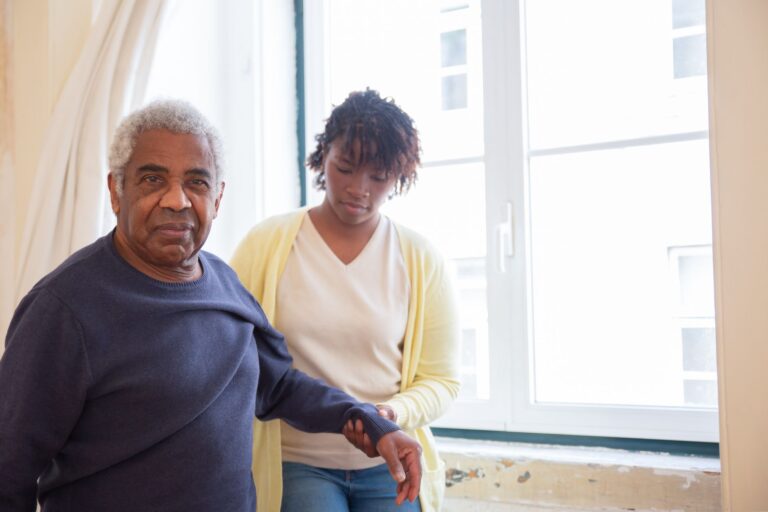
Do not push, pull, or rush the person. Forced movement can worsen loss of balance, so remain calm and wait briefly.
Freezing is unpredictable and raises fall risk; the Parkinson's Foundation reports that about 38% of people with Parkinson's fall annually. If the person needs assistance, use one simple cue at a time: The Parkinson's Foundation recommends these strategies for helping someone move through a freezing episode. Its guidance includes the foot-placement technique and cueing options.
- Encourage slow breathing.
- Invite marching in place, counting, or gentle side-to-side weight shifting.
- Place one foot perpendicular to the person's feet and invite them to step over it.
- Reduce nearby distractions and allow time for the response.
How should you communicate with someone who has PDD?
Keep requests brief, calm, and concrete. Ask one question or give one cue, then pause. Several instructions at once may overwhelm someone whose PDD affects comprehension or communication.
Instead of saying, "Turn, step forward, and get through the doorway," try, "Take one step over my foot." If that does not work, wait and offer one different cue, such as counting or marching. Avoid arguing about whether the person is stuck; focus on the next safe movement. Reduce distractions where possible. Loud conversation, hurried activity, or several people giving directions can make it harder for the person to process what you are saying.
When should freezing be reported?
Frequent freezing should be reported to the person's Parkinson's clinician. Record when it happens and what was occurring, including whether it followed a doorway, turn, transition, multitasking, or delayed medication.
Timing and circumstances may help the clinical team consider treatment adjustments. A Parkinson's-trained physical or occupational therapist can teach strategies to reduce falls and manage freezing. Professional guidance is especially useful when episodes become frequent, unpredictable, or difficult for a companion to handle safely.
Frequently Asked Questions
Should I pull someone through a doorway when they freeze?
No. Do not push or rush the person. Wait briefly, then try a calm cue such as counting, marching, or stepping over your foot.
Is doorway freezing proof that someone has Parkinson's disease dementia?
No. Doorway freezing can occur with Parkinson's disease, but research has not established that PDD causes it.
What information should caregivers report?
Note when freezing happens and its circumstances, then share that information with the Parkinson's clinician.